
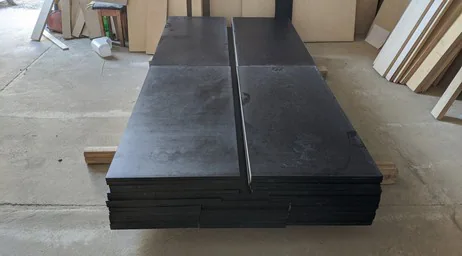
Film faced plywood is a plywood panel with a resin-impregnated paper overlay pressed onto one or both faces. The film provides a concrete-contact or industrial working surface; the veneer core and adhesive provide the underlying panel construction. Buyers choose the face, core, thickness and supplied work together to suit the component.
PanelSource manufactures film faced plywood as full sheets and cut parts. Tell us what you are casting or making, or show a panel you want to replace. We help choose the construction, prepare a useful sample and quote the factory work you need.
Choose your film faced plywood starting point
| Your requirement | Where to start | What to choose together |
|---|---|---|
| Concrete walls, slabs, beams and precast forms | Film faced shuttering plywood | Select the working face and core around the required concrete surface and form detail. |
| A black-film component specified at 18mm | 18mm black film faced plywood | Match the finished dimensions, face arrangement and machining to your component. |
| Brown-film sheets across a project schedule | Brown film faced plywood | Keep each thickness, construction and supplied finish clear in a mixed order. |
| A textured working face for floors or access panels | Mesh pattern anti-slip plywood | Develop the surface and panel choice around traffic, support and exposure. |
How the film, veneer core and bond work together
| Part | Decision | What to check |
|---|---|---|
| Film overlay | Colour, resin paper, face texture and approved surface reference | Continuity, scratches, bubbles and suitability for the required concrete finish |
| Face veneer | Veneer construction beneath the film | Surface support and visible defects around cut samples |
| Inner veneers | Species, layup, repairs and gaps | Thickness consistency, edge integrity and the product data needed for design |
| Adhesive bond | Declared requirement and test method | Evidence for the actual panel construction, independent of film colour |
Choose the overlay alongside the plywood grade and construction. The APA concrete forming guide treats panel grade, tolerances, surface characteristics and form design as distinct subjects. Its named APA grades belong to that grading system; specify the grade and supporting documents required for your actual order.
Plan the working face and exposed edges
Compared with a raw veneer face, a suitable film can give a more consistent contact surface and make cleaning after a pour easier. The concrete finish also depends on face condition, release agent, joints, pressure and site practice. For architectural work, bring a physical finish reference into selection and use a project trial to assess the assembled face.
Protect the working component at its overlay, corners, cut edges, fixing holes and joints. Factory edge coating covers the original sheet edges as supplied; include treatment of new site cuts and holes in the project method. Plan protection around the actual wetting and service conditions.
After stripping, check whether the film is still bonded and whether the face has concrete buildup, abrasion or impact damage. APA’s forming guidance describes cleaning, compatible release-agent use and careful handling as factors affecting the life of a form panel. The result depends on both our supplied construction and the site’s use.
Choose the core for your component
Our film-faced range includes poplar, birch and mixed-wood core descriptions. Select whether the named species describes every inner veneer or a particular part of the layup, then agree repair and gap limits, finished thickness and relevant technical information. When weight matters, compare the actual quoted construction and moisture condition so the handling plan follows the panel you will receive.
Use a sample cross-section to review the visible gaps, overlaps and veneer repairs, then agree sampling and acceptance rules for production. For concrete-contact panels carrying load, keep the relevant strength and stiffness data for the construction and orientation with the project designer’s requirements.
Choose bonding and moisture protection together
Specify the bonding requirement through the required standard, test method and panel construction. Our WBP guide explains how the familiar trade term relates to adhesive chemistry, completed bond performance and the full panel designation.
Plan moisture protection alongside the water-resistant bond. The wood, film and exposed boundaries can respond differently to wetting. Describe temporary wet concrete, rain during storage or repeated wetting after cutting, then choose the protection and inspection plan for those conditions.
How to specify it for formwork
If your drawing calls for “formply,” identify the required panel grade, construction and documents before comparing a film-faced option. Use our formwork plywood specification guide to prepare the panel and project requirements.
For the engineered formwork plan, keep panel location, expected pressure or load, supports, main strength direction and permitted deflection together. ACI 347R explains that fresh-concrete pressure and form design depend on the placement and system conditions. The project’s qualified designer approves the complete arrangement and supplies the corresponding panel requirements.
Then state the proposed panel size, nominal and finished thickness, core, bond, film working face, edge treatment, concrete finish, quantity and document requirements. For repeated orders, hold a control sample that identifies both face condition and the cut edge. If the construction changes, review whether the old sample and test information still apply.
Plan reuse around accepted concrete work
Plan reuse around the work the panel must continue to produce. Core, overlay, bond and edges matter alongside mix chemistry, release agent, stripping, cleaning, site cuts and storage. A panel may still form ordinary concrete after its surface no longer meets an architectural-finish criterion, so the finish requirement belongs with each reuse record.
Track a batch in the intended form system. Record construction and sample identity, pour sequence, location, surface defects, repairs and the reason for retirement. This gives you a project-specific basis for comparing future panel orders and estimating the accepted work from the selected construction.
Choose the surface for other applications
Film faced plywood may be considered for temporary protective floors, transport lining or industrial components. The selection criteria change: slip resistance, abrasion, fasteners, cleaning chemicals, wetting and loading can govern. A smooth concrete-contact film may be unsuitable where a non-slip walking surface is required. Review our textured film options separately for such an application.
Bring a component drawing, the required panel properties and the selected surface into each order. For a floor, transport lining or industrial part, use the actual contact, cleaning, wetting and loading conditions to choose the construction and sample detail.
Check the delivered sheet against the order
- Compare pallet labels, quantity and sheet size with the specified construction.
- Measure sampled thickness, dimensions, diagonal and flatness by the agreed method.
- Inspect the film for scratches, blisters, wrinkles, dry areas and corner damage.
- Inspect representative edges for veneer construction, gaps and continuity of the original edge coating.
- Review bond and mechanical documents where the order requires them, matching the test specimens to the offered panel.
Store panels flat and protected from direct rain and ground water. Review the physical sheets and agreed documents together at receiving, recording any transport damage and keeping the construction and bond evidence linked to the delivered order.
Keep the full-sheet reference linked to the state supplied. For factory-cut parts, include a representative corner, opening or fixing detail and the protection of those new edges. Identify the working face, reverse and drawing revision with the sample. Review appearance and machining together with the construction’s bond or mechanical evidence and the project trial for the required concrete finish.
Carry the accepted construction, drawing and sample references into the order and pack identification, with factory work and remaining site cuts clearly separated. At receiving, check the supplied sheet or part before later site handling changes its condition. Record delivery discrepancies separately from damage, repairs and finish changes during use, and review a construction change before carrying the previous trial or reuse observations into a repeat order.
Film faced plywood buying questions
Does black film make the panel stronger?
No. Compare the core, layup, thickness and relevant properties separately from colour. See our red versus black film guide.
Can a film faced sheet be left outdoors?
Assess the specified panel and exposure. Protect damage and cut edges as required. The film by itself is not an all-weather guarantee.
What should we send for a quotation?
Start with a use description, photograph or part sketch. We help develop the panel size, thickness, core, working face and supplied processing, then add quantities, destination and any required documents to the quotation.