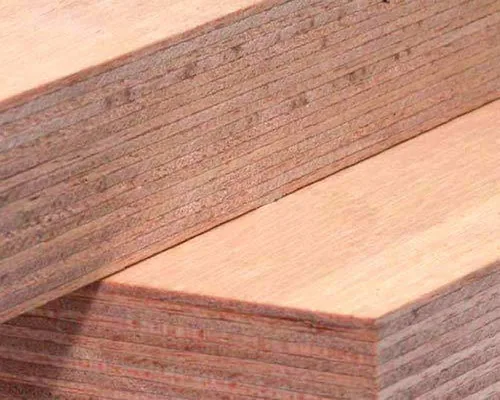
WBP plywood is a familiar starting point for panels that need weather- and boil-resistant bonding. Tell us whether you are making formwork, exterior joinery, vehicle parts or another component, using a photo or current board if helpful. Our factory helps choose the core, face and supplied finish, then connects the required bond class and exposure details with a practical sample and quote.
Film faced plywood Marine plywood Waterproof melamine panels
Build the WBP choice around face, core and use
A purchase description such as “18 mm WBP plywood” leaves several independent decisions open. It does not tell us whether the face is decorative or intended to be covered, whether the core is birch or a mixed construction, how tight the finished thickness must be, or whether the sheet will carry a design load. Even an accurately stated bond requirement cannot fill these gaps.
WBP is not a wood species or a face grade. It is also not one universal resin recipe. Descriptions such as phenolic or melamine-modified identify adhesive chemistry, but the finished panel still needs the agreed evidence. The adhesive, veneers and production conditions work together; the resin name alone is not an acceptance test.
Keep WBP and BWP wording separate on purchase documents. If a drawing, enquiry or quotation uses a different abbreviation, ask which national or project standard it refers to. Do not silently reverse the letters and assume identical requirements. We put the applicable standard and class in the technical specification so the order does not depend on an abbreviation.
Connect the bond class with the complete panel
EN 314-2 specifies bonding requirements; its companion EN 314-1 gives the test methods. EN 636 addresses the plywood panel and intended dry, humid or exterior conditions. Where these are the project’s references, record the relevant requirements together. A bonding classification is not a complete declaration of the panel’s end use.
| Unclear request | Information to add | Why it changes the order |
|---|---|---|
| “WBP glue” | Bond standard, required class and report scope | Makes the bonding requirement verifiable |
| “For outdoor use” | Actual exposure, panel-use requirement and protective system | Separates occasional wetting from demanding service conditions |
| “Strong core” | Species, layup and design properties where needed | Distinguishes construction from an unsupported strength claim |
| “18 mm, good quality” | Finished thickness tolerance, face grade and core acceptance requirements | Defines what inspection must assess |
| “Marine WBP” | Named marine specification and evidence for the offered panel | Prevents bond terminology from substituting for marine requirements |
Where can plywood described as WBP be used?
Concrete formwork
For formwork, we need the panel construction, concrete-contact surface, cut-edge treatment and project design requirements. A suitable bond is only one part of the decision. Film condition, machining damage and the forming system also matter. Do not derive a reuse count or allowable support spacing from WBP wording. Use our film faced shuttering plywood page to compare the product configuration, then supply the formwork specification.
Protected exterior joinery
For a painted exterior component, identify whether it sits under cover, receives wind-driven rain or traps water at joints. Ask for an appropriate panel specification and a compatible finishing system. Include drainage and maintenance in the component design. Painting an unsuitable substrate does not establish a verified exterior panel grade.
Vehicle interiors, flooring and packaging
For a vehicle lining, the visible finish and fixing details may dominate the enquiry. For a load-bearing floor, the load case, supports and relevant design properties become essential. For an export case, the packing design and transport exposure need their own assessment. None of these applications can be approved solely because a panel has a moisture-resistant bond.
Marine components
If the drawing requires marine plywood, specify the marine standard rather than replacing it with WBP. Read our marine plywood specification guide for the distinction between panel construction, bond evidence and component design. We do not equate every exterior-bonded sheet with a marine panel.
Read the method and results of a boiling test
Two sample photographs after boiling do not necessarily represent the same test. Specimen preparation, conditioning sequence, exposure duration, cooling and the evaluation method must be defined. A statement that a specimen looked intact after immersion does not describe a measured result or the acceptance rule used.
Ask for the method, specimen identification, conditioning details, measured results and conclusion. Check whether the report covers the proposed construction and whether sampling is appropriate to the purchasing agreement. The official EN 314-1 reference identifies the plywood bonding test-method standard. Obtain the specified procedure rather than inventing a separate pass criterion from a marketing claim.
We do not assign a universal boiling-hour range to each resin name. Nor do we translate a laboratory duration into years outdoors. A test is evidence under its stated conditions. The installed component has different moisture paths, machining details and maintenance conditions that the purchasing specification must also address.
Match structural properties to the component
No. Bond durability and structural suitability are separate requirements. A wet-service bond does not establish a panel’s structural rating; use the strength, stiffness and design information for the offered construction.
When a component carries load, ask for the properties required by the project designer and a declaration applicable to that product. Keep thickness, grain orientation and the construction covered by those properties aligned with the order. WBP wording is not a basis for choosing a roof span, floor loading or formwork support layout.
Example: buying panels for an outdoor equipment cabinet
Suppose the enquiry is “WBP plywood for an outdoor cabinet.” First identify which panels receive rain and whether the base can hold standing water. Specify the visible face, intended coating and cut-edge details. Then identify whether the cabinet has a structural duty, such as supporting equipment, rather than merely enclosing it.
Send the drawing, nominal and finished dimensions, bond and panel requirements, coating details and inspection needs. Approve a sample of the intended face and a machined edge if those are important to the finish. Agree who applies protection after drilling and assembly. This brief enables a comparison of actual constructions; a quote comparison based only on “WBP” and sheet price does not.
Check the agreed panel details at delivery
- Identity: panel description and packing labels match the order and the documents supplied.
- Dimensions: sampled thickness and sheet size meet the agreed tolerances.
- Condition: note visible delamination, edge damage, face defects and packing moisture according to the inspection agreement.
- Evidence: bond reports describe the relevant product, method and scope; structural evidence is supplied separately when required.
- Substitutions: changes in core or construction are assessed against the original specification before acceptance.
These are separate checks. Passing a visual inspection does not prove a bond class, and a bond report does not excuse a dimensional mismatch. Keep the original report and the inspection record linked to the shipment.
WBP purchasing questions
Is WBP plywood always hardwood?
No. The term concerns bonding in trade usage, not botanical species. State the face and core materials separately.
Can I use WBP instead of marine plywood?
Only if the proposed panel meets the actual project specification. WBP wording alone is insufficient evidence for a marine requirement.
Does a darker glue line prove a better bond?
No. Colour is not a bond test or a complete identification of the adhesive formulation. Use the agreed technical evidence.