
Climbing formwork repositions forming equipment as concrete construction advances upward. Where the specified assembly uses plywood, our factory supplies the concrete-contact sheets and replacement parts. Start with the core, pier or wall you are forming, a photo or a facing drawing; we help choose plywood and develop the panel details for repeated casting stages.
Compare film faced shuttering plywood for the specified facing. If the panel schedule calls for 18mm black film, review our 18mm black film faced plywood, matching the construction and finished dimensions to the system.
Define the assembly and its working cycle
Climbing equipment can be used on structures such as building cores, bridge piers and towers. The arrangement may bring together wall forms, supporting brackets, work platforms and access equipment. Which components remain connected during movement depends on the actual system.
The term also needs a construction-method boundary. Equipment that is relocated between distinct pours is different from slipforming, where movement is part of a progressive forming process. A panel order should identify the system and its work cycle rather than rely on the general word “climbing.”
For a cooling tower or tapered shaft, read our tower-formwork geometry guide alongside this article. Changing shape introduces panel-scheduling questions beyond the relocation method.
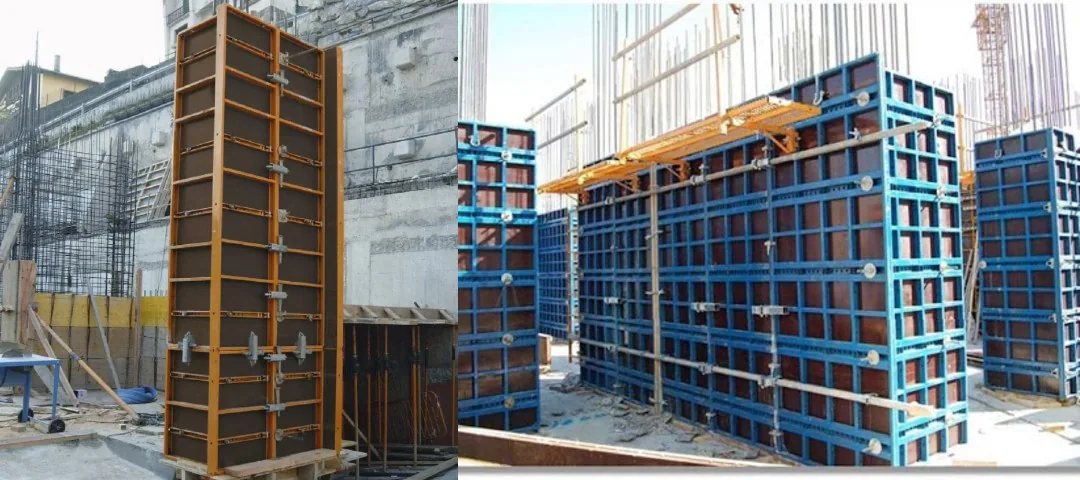
Compare crane-jumped and self-climbing arrangements
| Question | Crane-jumped arrangement | Self-climbing arrangement |
|---|---|---|
| What raises the unit? | A crane lifts the designated assembly | The system's climbing mechanism raises the designated equipment |
| What must be scheduled? | Crane access, lifting window and receiving position | Climbing equipment, support transitions and the specified operating sequence |
| Is the facing specification automatic? | No; it depends on the form and its backing | No; the lifting mechanism does not define the facing grade |
| What sets operating limits? | System instructions and the project lifting arrangement | System instructions and the project climbing arrangement |
Crane-independent climbing does not mean that every delivery, initial assembly or material-handling task is crane-free. Identify the equipment needed for each activity in the project plan.
Identify support conditions at each work stage
The load path during concreting can differ from the load path during relocation. The project documents need to show how the equipment is supported, which anchors or brackets are engaged and what concrete condition is required at the relevant stage.
A specified concrete strength for transferring a particular load cannot be replaced by a generic number of curing days. Temperature, mix development and the verification method matter. Similarly, the visible presence of an anchor does not establish correct installation, embedment or suitability for the next operation.
UK HSE temporary-works guidance supports a coordinated approach to design, installation and checking. The plywood schedule should identify the facing scope while retaining clear references to the assembly documents that govern these support conditions.
Plan the cycle around defined checks
The work plan should distinguish checks before a pour, checks before stripping or relocation, and checks after the assembly reaches its next position. These are separate decisions: acceptance for the previous pour does not automatically authorise the next movement or loading stage.
For the facing supply, connect inspection and replacement opportunities to that plan. Establish when the concrete-contact face is accessible, where cleaned panels can be stored and how replacement pieces reach the work area. The equipment manual determines the operating sequence; this planning discussion is not a release-and-lift procedure.
Maintain the panel identification through the cycle. If a damaged piece is replaced, record its location, construction and drawing revision so later inspections do not rely on the assumption that every facing remains identical.
Design the facing layout for repeated concrete surfaces
Panel joints, tie holes, construction joints and any architectural pattern should be coordinated before cutting. Repeating a layout can make successive lifts visually consistent, but changes in wall thickness, openings or geometry may require revised pieces.
Specify the facing's finished thickness, directional properties, coating, edge treatment and fixing detail. The backing arrangement still controls the panel's span and local response to fresh concrete pressure. The fact that a form climbs does not reduce the need to check those conditions.
Our red-versus-black film guide explains why surface colour is an identification feature rather than a load rating. Use the construction and supporting evidence to compare material proposals.
Keep operating limits attached to the actual system
Wind limits, permissible platform loads, concrete placement conditions and movement restrictions belong to the specified equipment configuration and project plan. A single wind speed or a standard number of lifting points should not be copied across unrelated assemblies.
Concrete pressure also depends on the conditions assumed in formwork design. A change in mix, placing method or casting sequence needs consideration against those assumptions. An isolated temperature threshold cannot establish a safe placement rate for every concrete and form.
For purchasing, record any panel requirements resulting from the design, including properties, orientation and permitted machining. Avoid filling missing engineering information with a thicker-looking sheet or a higher advertised reuse count.
Inspect facing condition between cycles
Record damaged film, lifted veneers, swollen edges, distorted holes and surface patches separately. Some defects primarily affect finish; others may indicate that the facing or its connection no longer meets the specified function. Use the project's acceptance criteria to decide repair, replacement or further assessment.
Do not treat a coating touch-up as evidence that delamination or a weakened connection has been restored. Our formwork-plywood defect guide helps distinguish the visible symptoms.
Arrange cleaning and repairs in the planned accessible condition. Unexpected movement, leakage or support problems during loading require the site's controlled response, rather than improvised work on a loaded form. Keep the cause and location in the inspection record to avoid repeating the same damage at each lift.
Plan your replacement facing order
Start with the concrete use, an existing facing photo or a drawing. We help choose the panel construction and a useful sample, then develop the sizes and quantities for the casting stages.
Before production, agree the system and panel references, support and fixing details, finished dimensions, hole patterns and surface requirements. Separate repeated pieces from changing closures, and confirm marks, packing and destination. System engineering, anchors and relocation equipment remain with the project’s specified system team.
Climbing formwork plywood facings buying questions
Does black plywood make a form self-climbing?
No. Self-climbing describes the equipment and movement method. The facing construction is selected to match its backing, fixing and concrete-contact requirements.
Can the factory supply replacement facing parts?
Yes. Begin with the existing part or drawing, then agree construction, dimensions, machining and sample checks before ordering the replacement quantity.