
Veneered plywood and veneered MDF offer a real wood face for furniture fronts, open shelves and interior panels. Choose between them by the finished edge, fittings, weight and processing your component needs. We manufacture both plywood and MDF substrates in our own factory and help compare the two routes around one project.
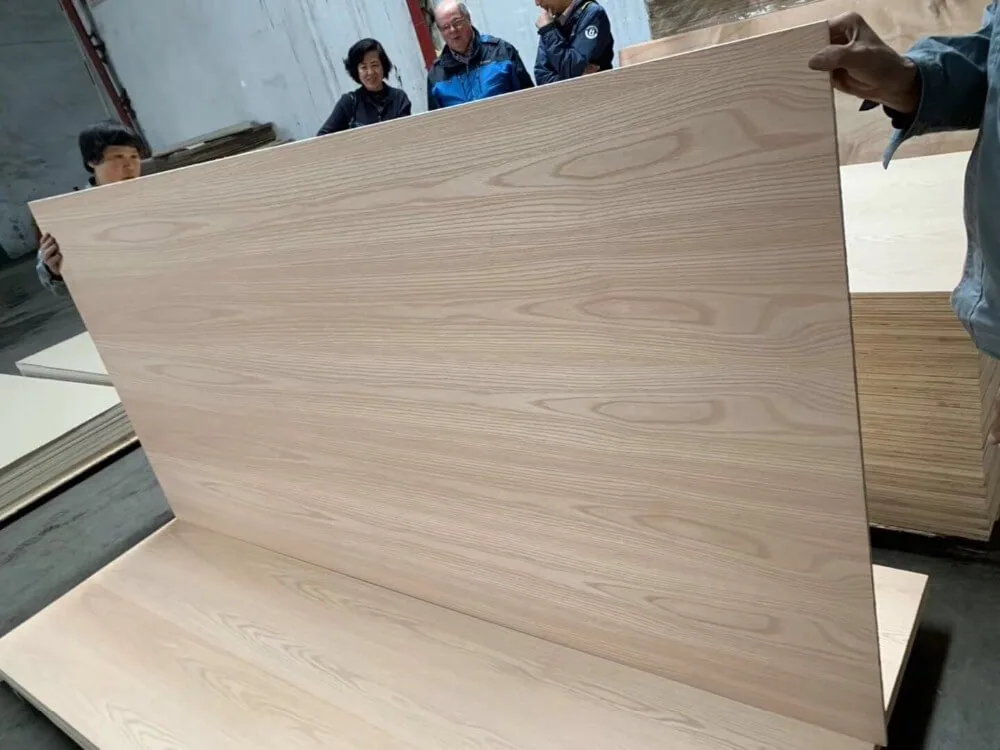
Start with the wood look you like and what you are making. For an oak cabinet or wall panel, compare natural oak veneer plywood with oak veneer MDF using the same face, edge and coating brief; a photo or sketch is enough to begin.
Natural oak veneer plywood Oak veneer MDF Walnut veneer MDF
Keep the wood face and finish the same
Both options here are complete panels carrying a wood veneer face, on either a plywood or MDF substrate. For loose facing material and thin complete panels, the guide to veneer and plywood explains the distinction.
Compare real wood veneer with real wood veneer. PVC film, melamine decorative paper and HPL are different surface systems, even if all display an oak pattern. Natural and engineered veneer also need to be identified separately when their visual requirements differ.
Record the species or pattern, appearance range, matching arrangement, visible back, edge treatment and coating. Otherwise, a price difference attributed to the core may actually come from a different face, a cheaper back or unfinished edges.
Compare cores around the finished component
| Decision | Veneered plywood | Veneered MDF |
|---|---|---|
| Internal structure | Specify veneer species, layup and defect limits | Specify the MDF product type and relevant properties |
| Visible machined edge | May expose alternating veneers and local core features | Exposes fibreboard unless separately covered or finished |
| Decorative face support | Check crossbands and possible surface show-through | Check surface condition and uniform preparation |
| Fixings | Verify the connection in the offered construction | Use fittings and drilling details suitable for the MDF |
| Handling weight | Use the actual panel mass, not a species assumption | Use the offered density or mass for the complete panel |
| Moisture exposure | Confirm bond, construction and protection details | Confirm MDF type, finish and protection details |
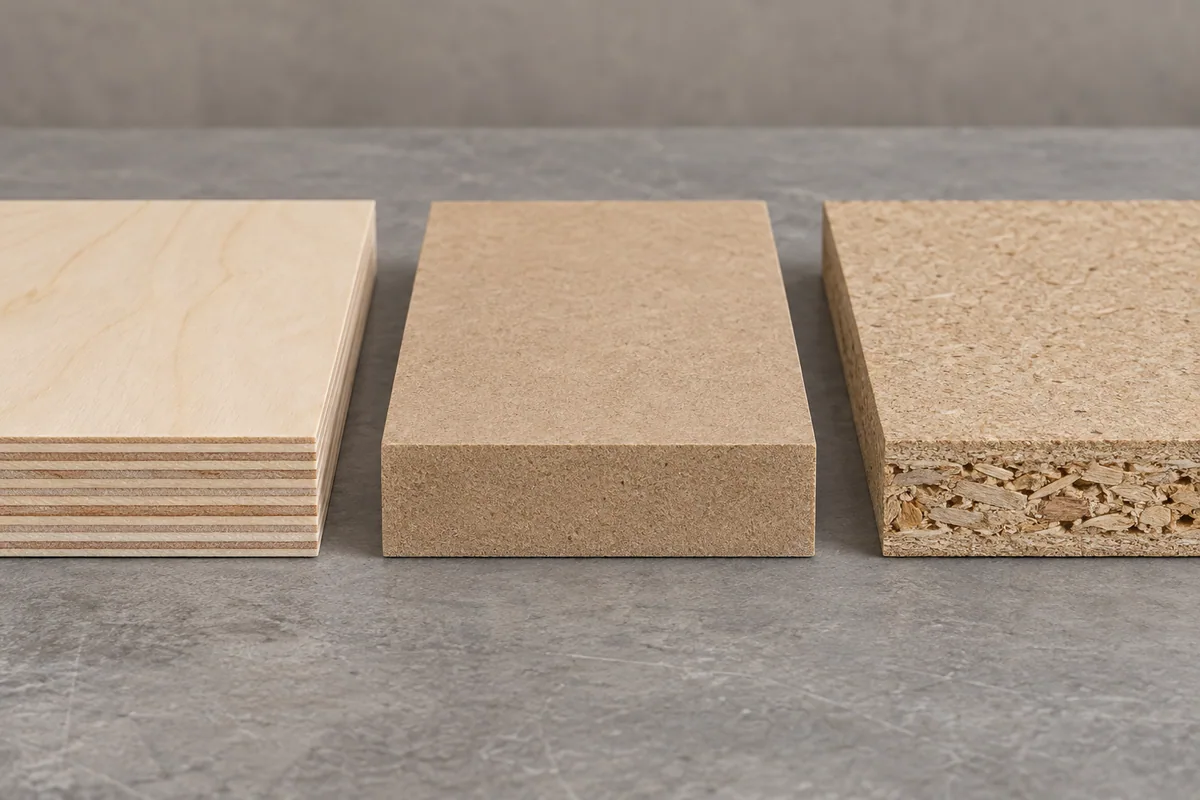
The word plywood describes a veneer-based construction, not wood chips pressed into a board. MDF uses wood fibres. EN 636 addresses plywood specifications, while EN 622-5 addresses MDF requirements. These are separate product frameworks, not interchangeable quality rankings.
Calculate cost per usable finished part
Include panel purchase, freight allocation, cutting and matching yield, edge work, machining, coating and rejects. Compare these on the same finished quantity. A lower material price can be offset by a lower usable yield or more finishing work.
Material cost per usable square metre = quoted material cost ÷ usable finished area. Work from the actual veneer layout, grain direction, permitted repairs and cutting list for each core. Add machining, edging and finishing to compare the complete component rather than the sheet alone.
Then add the different processing and transport costs. If one option already has the specified finish, do not add the same finishing allowance to both. If the visual matching requirement changes, recalculate the layout rather than reusing the original yield percentage.
Review the edge after machining
A routed profile can expose MDF beneath a thin wood veneer. A routed plywood profile can expose several veneer layers and any local inner defects. Neither result is automatically acceptable or unacceptable: the required appearance and edge treatment decide.
For a flat veneered door, consider the face and back balance and completed flatness. For an open shelf, consider the visible edge, support and load. For a hidden cabinet component, face appearance may matter less than machining and attachment. These examples can justify different cores within the same furniture collection.
Our veneered MDF fabrication guide and veneer-core plywood guide explain the construction-specific details behind these decisions.
Include finished weight in the fitting choice
Obtain the offered panel mass or calculate it from the relevant density and dimensions. Include coatings, edging and fittings for a completed door or movable component. Avoid assuming all plywood is lighter than all MDF; the species, core design and thickness can change the comparison.
Check the hinge or connector system against the actual component. A heavier front may change hardware selection and assembly handling. For repeated deliveries, record the construction used for the approved sample so a later substitution is not judged only by the same face colour.
Choose the core and coating for the exposure
A wood veneer does not make either core waterproof. Around sinks, floor junctions and plumbing cutouts, assess likely wetting and the completed edge and seam details. Moisture-resistant MDF and suitably bonded plywood still need applications consistent with their specifications.
Surface wear, scratching and liquid staining depend on the actual finish as well as the face. EN 12720 evaluates resistance of furniture surfaces to cold liquids. A result for a coated surface does not describe a submerged core or an unsealed cut edge.
For repair, consider the thickness of the decorative face and the coating system. A small coating repair may be possible without replacing a panel, while damage through a thin veneer may need a different repair route. Avoid promising repeated full resurfacing for either construction.
Compare emission and sourcing evidence separately
Do not rank emissions simply by counting glue lines or estimating adhesive quantity. Request results for the relevant finished construction, with the method, units, sample identity and scope. An E-label without its test basis is not enough to compare two products from different classification systems.
Responsible sourcing is a separate question. FSC explains chain-of-custody certification as tracking forest-based material through the supply chain. Check the applicable product claim and order documentation rather than interpreting a general company certificate as proof of every panel property.
For a carbon or life-cycle comparison, use compatible boundaries, quantities and service assumptions. A claim that a panel contains wood, recycled material or a fast-growing species is not by itself a complete environmental comparison.
Try the same furniture detail in both cores
Select a representative part, such as a cabinet front with its real edging, finish and hinges. Record completed weight, appearance, fit, machining results and the required performance checks. Keep the criteria the same so the comparison does not favour one option through an easier trial.
If the design changes to suit one material, compare the revised finished cost and result openly. A thicker panel, extra support or different edge can be a valid design choice, but it is no longer an identical component comparison.
Carry the selected sample into production
Our oak veneer plywood and oak veneer MDF offer two starting points. Keep the face, reverse, matching, thickness and supplied stage together, and identify each trial with its construction and drawing revision. Retain the supplied sample and the part your workshop finishes as set out in our sample and order guidance.
Carry the selected sample into the order specification. Both quotes should list the supplied stage, machining, finish, packing, delivery and remaining workshop operations. Keep applicable product reports and pack references with the chosen construction for production and receiving checks.
Request comparable factory quotations
Start through our enquiry form with a furniture idea, veneer photo or drawing. Tell us whether appearance, weight, machining or finished cost matters most. We help develop the core, visible faces, edges and finish, then add sizes, quantity and destination to compare veneered plywood and veneered MDF on the same basis.
Veneered panel comparison questions
Can the same oak appearance be supplied on both cores?
Yes. We help select the oak range, matching and finish for both constructions. Review actual adjacent faces and their edges so natural variation is considered with the complete part.
Is veneered MDF always the cheaper option?
Compare the accepted finished component. Cutting and matching yield, edge preparation, machining, coating and delivery can change the result even when one sheet costs less.
Is veneered plywood always lighter?
Use the mass of the offered construction and finished component. Veneer species, core design, thickness, edging and fittings can change the comparison; the board name alone does not settle it.