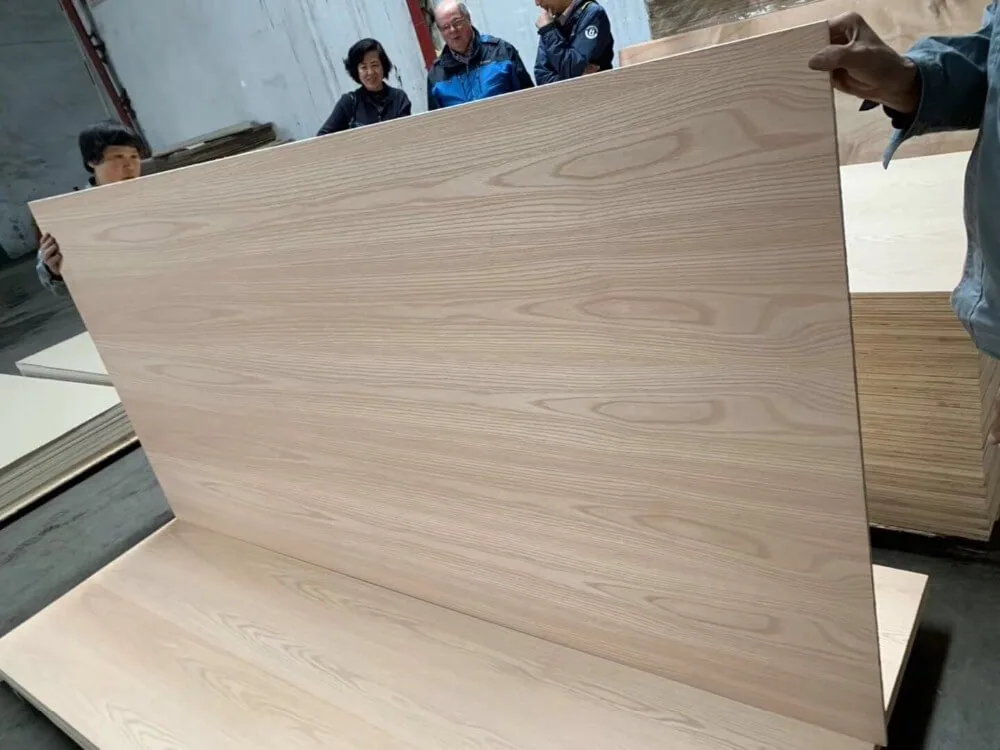
For cabinet and furniture fronts
Use the complete elevation to identify adjoining doors, drawers and visible ends. Select their grain, edges and finish as one set.
PLYWOOD & MDF · CHINA

OUR FACTORY · OAK VENEER MDF
Oak character, carried across the furniture you make.
Bring natural oak warmth to cabinet fronts, furniture and interior joinery. Choose the grain, matching, edges and finish over MDF made in our own factory. Order sheets for your workshop or coordinated components, with samples built around your project.
Available to order · sheets or matched components · 7–10 day production.
NATURAL OAK CHARACTER · MDF CONSTRUCTION · COMPLETE COMPONENT
Oak veneer MDF combines a real wood face with an MDF substrate for cabinetry, furniture and interior joinery. We manufacture the substrate and customize the veneer, reverse, sizes and supplied finish for full sheets or matched components.
Use the complete elevation to identify adjoining doors, drawers and visible ends. Select their grain, edges and finish as one set.
Supply the face drawing and deepest section. Review the exposed groove, retained core and finish on a machined sample.
Explore our natural veneer MDF range for other decorative wood faces. Compare natural oak veneer plywood for a layered plywood core, or woodgrain melamine MDF for a printed oak-effect decor. Choose the surface and substrate together for the component you want to make.
FULL SHEETS · CUT PARTS · MATCHED COMPONENTS
| Order choice | Options to discuss |
|---|---|
| Decorative face | Natural oak veneer; white oak, red oak or a separately specified engineered oak appearance reviewed against the order |
| Thickness range | 2–40 mm across our MDF supply range; confirm the selected substrate and finished faced-panel thickness in the order. |
| Sheet sizes | 1220 × 2440 mm; 1220 × 3050 mm; 1830 × 3660 mm; 1830 × 2440 mm; 2100 × 2800 mm. Confirm the size, thickness and finish combination in the quotation. |
| MDF substrate density | 650–710 kg/m³; this range describes the MDF substrate, not a uniform density for every finished faced panel. |
| Emission options | E0, E1 or E2 as specified for the order. Agree the applicable standard, edition, test method and limit for the selected construction and destination. |
| Minimum order | 1 × 20′ GP container |
| Production time | 7–10 days; the order confirms the start date. Sea transit is additional. |
| Packing and container quantity | Calculated for the selected sizes, thickness, density, packing and permitted shipment weight. |
| Oak identity | Specify the required species information and any origin requirement separately from colour or trade name |
| Cut and figure | Plain sliced or quarter cut; discuss a rift appearance where reduced ray fleck is important |
| Face selection | Agree colour range, ray-fleck preference, natural character, sapwood, repairs and restricted visible zones |
| Leaf arrangement | Book, slip or project matching reviewed on the complete face |
| Adjacent components | Define matching groups, grain direction, sequence, face orientation and reserve scope |
| MDF substrate | Standard, moisture-resistant or other project-specified grade confirmed for the intended service |
| Reverse construction | Concealed balancing back or visible oak reverse; material and finishing requirement agreed |
| Decorative layer | State retained veneer requirements where sanding, brushing or machining depends on them |
| Supplied condition | Raw or sanded; coating, cutting and additional machining discussed for the project |
| Delivered thickness | Bare substrate, sanded veneered board or coated component identified explicitly |
| Edges | Oak veneer edging, specified timber lipping or separately finished substrate; final dimensions agreed |
| Grooves and profiles | Drawing required for width, depth, pitch, stop positions, exposed substrate and intended finish |
| Coating reference | Agree colour, pore appearance, texture and sheen on the actual face-and-edge assembly |
| Dimensional checks | Size, thickness, squareness and flatness limits with measurement datums and condition |
| Interior applications | Cabinet fronts, furniture, wall panels and retail joinery under defined service conditions |
| Packing and quotation | Decorative-face protection, flat pallets, part identification, quantity, destination and delivery schedule |
APPLICATIONS & THE DETAILS THAT CHANGE THE ORDER
Define the matching group, visible reverse, hinges and edge profile. Check the finished door pair in its installed orientation.
Mark grain direction, crown position and top-to-bottom part codes across the complete layout.
Show reveals, returns, access panels, cut-outs and mounting. Attach any fire requirement to the complete assembly.
Coordinate groove stops, lipping and rear hardware; approve the exposed substrate treatment on a machined and coated sample.
Group by fixture or installation area. Compare oak-faced MDF, solid trims and plywood under their complete finishes.
Specify expected wetting and service conditions so the MDF grade, joints, coating, edge protection and installation can be assessed together.
SPECIES IDENTITY, CUT & RAY-FLECK PREFERENCE
Specify white oak, red oak or a separately identified engineered oak appearance, with any species or origin requirement. A photograph shows grain scale; choose the offered veneer and finish from a physical sample.
Compare offered faces under the intended finish. The cut influences grain and ray fleck; retain a representative range rather than one preferred leaf.
| Appearance target | Selection to discuss | What the reference should show |
|---|---|---|
| Broad natural figure | Plain-sliced or crown appearance | The crown position inside the final visible component |
| Linear grain with visible fleck | Quarter-cut appearance | The permitted ray-fleck range across several leaves |
| Quieter linear face | Rift appearance or another agreed selection | Accepted residual fleck, colour variation and leaf joins |
| Controlled repeated pattern | A separately identified engineered veneer | Pattern reference, repeat, direction and offered material description |
Agree sapwood, knots, mineral markings, repairs and permitted variation. Mark focal zones around handles or drawer centres so face allocation follows the finished component.
LEAF JOINS, LIGHT REFLECTION & FURNITURE GROUPS
Specify leaf matching, the crop within each component and the relationship across the installed group separately.
Book matching mirrors adjoining leaves; slip matching keeps successive leaves in the same face orientation. Compare the joined face after coating from the intended viewing positions, including any light-and-dark reflection across strips.
Mark part codes, top edge and grain direction on the elevation, including return views for visible ends. Keep these labels through cutting and packing; check the layout before rotating parts for nesting.
| Scale | Agree with us | Keep in the production record |
|---|---|---|
| One decorative face | Leaf arrangement, join positions and appearance range | Face reference and presentation side |
| One furniture component | Crop, direction, edge treatment and visible reverse | Part code and drawing revision |
| One installed group | Adjacent relationships and acceptable transitions | Elevation, sequence labels and reserve scope |
COLOUR, PORES, TEXTURE & SHEEN
Specify colour, pore appearance, texture and sheen independently. Open-pore and filled finishes can look different even at the same colour.
Compare pale finishes on the actual veneer and edging; include joins, ray fleck and permitted repairs for darker stains or contrasted pores. Approve the complete topcoat.
| Decision | Specify | Review on the assembly |
|---|---|---|
| Colour | Natural, lightly pigmented or stained target | Face, edge, ray fleck and permitted repairs together |
| Pore appearance | Open, partly filled or filled reference | The dried complete coating under side lighting |
| Surface texture | Sanded face or a separately agreed textured process | Retained veneer, joins and consistent treatment |
| Sheen | Physical reference and any required measurement method | Normal viewing positions and adjoining components |
Agree the supplied sanding condition and retained veneer needed for later brushing, filling or sanding. Keep that allowance separate from overall board thickness.
Trial the coating supplier’s preparation and application process on an offcut that includes a face join and edge transition.
Protect unfinished oak from water marks and contamination. For tannin-related dark marks, identify the affected material and finishing system before trialling a compatible treatment.
SUBSTRATE, REVERSE & DELIVERED THICKNESS
Choose the MDF grade for humidity, wetting, cleaning, loading and mounting conditions. A decorative oak face does not establish the service performance of the complete panel.
Specify a balancing material and finish for a concealed back. A visible oak reverse needs its own appearance, grain orientation and sheen.
European Panel Federation guidance on veneering MDF explains panel balance. Record the complete face-and-back construction and delivered flatness limits.
An 18mm dimension may refer to bare MDF, the sanded veneered panel or the coated component. State the stage, tolerance and measuring condition so hinges, rebates and adjoining parts fit.
Include supports for thin panels and hardware, spans and concentrated loads for thicker parts when agreeing component checks.
Confirm emission evidence and document scope for the substrate, veneered panel or finished component supplied. Fire or acoustic requirements must identify the complete construction and mounting arrangement.
GROOVED FRONTS · FLUTED DETAILS · FINISHED COMPONENTS
For fluted doors or grooved wall panels, provide the face drawing and deepest section with the oak reference.
Routing can expose the bond and MDF beneath the veneer. Specify a coated groove, separately lined profile or construction for continuous wood appearance; include shoulders, walls and bottom in the finish sample.
Show the cutting datum and deepest front cut alongside any rear hinge cup, fitting or cable recess. Check retained material and fitting performance where operations overlap.
| Drawing detail | What to include | Approval check |
|---|---|---|
| Groove section | Width, depth, shape, cutting datum and exposed materials. | Coated shoulders, walls and bottom on the actual build. |
| Pattern and edges | Centre spacing, clear lands, outer margins, stops and grain direction. | Adjacent parts aligned at their installed joint or gap. |
| Back machining and fittings | Position and depth of overlapping hardware, attachment and support. | Retained material and fitting performance on the finished component. |
| Finish scope | Face, groove surfaces, end cuts, outer edges and visible reverse. | Coating process and supplied finish agreed for the complete part. |
Check exposed adhesive, breakout, groove geometry, corner coating and adjoining-panel alignment. Retain the machined and coated section with its drawing revision and fitted hardware.
EDGES, HARDWARE & THE HANDOVER BETWEEN WORKSHOPS
Choose veneer edging, solid timber lipping or separately finished MDF for the actual edge profile. Compare grain, colour and pore response beside the oak face after coating.
For timber lipping, specify net width after machining, grain direction, corner joint and bonding sequence. Show whether veneer crosses the joint or meets visible timber.
European Panel Federation guidance on MDF lipping covers timber condition, joint accuracy and conditioning before finishing; apply these to the actual edge section.
Separate rough, edge-ready and final sizes. State whether hardware datums use the substrate or finished lipped edge, including later sanding and trimming allowances.
Include fitting depth and show-face clearance on the same section as front machining.
Use clean face separators, flat export pallets and protection suited to the finish. Put part and sequence labels in concealed locations and group related components together.
Store panels flat under the agreed conditioning requirements. Record handling damage with part and package identities before further work.
ACCEPTANCE TIED TO THE OAK REFERENCE & DRAWING
Inspect against the accepted oak range, drawing and delivered stage: raw sheet, sanded part or coated component.
| Check | Review | Record against |
|---|---|---|
| Oak appearance | Colour, figure, ray fleck, sapwood, repairs and restricted areas | Accepted face range and visible component perimeter |
| Face assembly | Leaf joins, splits, overlap, exposed glue and preparation marks | Joined-face sample and supplied sanding stage |
| Panel geometry | Length, width, thickness, squareness and flatness | Agreed limits, datums, support and measurement condition |
| Machined features | Groove width, depth, pitch, margins, breakout and hardware overlap | Section drawing, tool trial and finished component sample |
| Edge and finish | Corner joint, tone, pores, sheen and exposed substrate treatment | Complete coated assembly and process reference |
| Groups and packaging | Sequence, top-edge labels, quantities, protection and reserves | Elevation, packing list and part/group codes |
Use agreed lighting and viewing conditions. Any numerical colour or sheen limit needs its method and reference; check bonding and performance separately.
Record concerns in whole-part and detail photographs with the order, part code and measuring stage. Retain the piece before further surface work.
FROM OAK RANGE TO A FINISHED REFERENCE ASSEMBLY
Choose the smallest sample that resolves the purchase decision, using the actual construction and complete finish.
| Decision | Useful sample | Retain with the approval |
|---|---|---|
| Oak appearance | A representative face range showing colour, grain, fleck and permitted natural character. | Oak identity, cut, face selection and intended finish. |
| Matching across parts | An adjoining pair or the critical part of a furniture elevation. | Visible face, top edge, positions and matching group. |
| Edges and machining | A finished corner or grooved section with the actual fitting. | MDF, reverse, thickness stage, edge build and drawing revision. |
| Repeat supply | The accepted finished assembly and appearance range. | Finish process, group identity and intended neighbouring parts. |
Keep the accepted assembly, face range, finish process, matching layout and drawing revision together. Use photographs to identify the controlling physical sample.
For repeat orders, identify new parts beside existing joinery and compare the current oak selection and finish with the retained reference. Agree whether reserves must replace one part, a pair or a complete group.
MATERIAL RECORDS · COMPONENT APPROVAL · DELIVERY TRACEABILITY
Request documents for the selected oak, MDF, reverse, finish and destination; keep them linked to the accepted sample and drawing.
| Record | Connect it to the supply |
|---|---|
| MDF substrate | Identify the grade and thickness. The 18mm white MDF report and green HMR MDF report describe their own board configurations; request relevant records for your selected substrate. |
| Veneered construction | Oak identity, face and reverse, bonding, finish and any emission or other project requirement for the complete supplied panel. |
| Appearance and fit | Accepted oak range, matching-group layout, coated corner, machining section and current drawing revision. |
| Inspection and delivery | Order and lot references, dimensional and appearance checks, component labels, pack quantities and dispatch records. |
Include sourcing and destination requirements in the enquiry. See the veneered MDF and plywood purchasing guide for a comparison of face, core and finished work.
PLAN YOUR PANEL ORDER
Plan neighbouring faces, visible edges and the finished surface together. Our team helps select the oak character and matched component layout, then carry the chosen sample into your order so the workshop receives a clear reference for the furniture you want to make.
Oak Veneer MDF
Our MDF substrate production. We manufacture MDF substrates in our own factory in Jiangsu, China. Talk to our factory team about the board and finish for your components.
A finished oak door corner
Make the selected oak face, actual edge and visible reverse into a coated corner or useful furniture component sample. Include the profile and hardware detail where they matter, retaining the MDF construction, full finish and drawing revision as one workshop reference.
Review this product’s sample planFor a quotation, add your quantity, destination and required timing. You can start with the details you already have.
PanelSource · Xuzhou PanelSource Co., Ltd.
https://www.plywoodsupplier.cn/product/oak-veneer-mdf/
sales@plywoodsupplier.cn
SAMPLES & ORDER PLANNING
Tell us your quantity, sample needs and target delivery date. We’ll put the price, payment terms and production schedule into your quotation.
DOCUMENTS & ORDER SUPPORT
We help your purchasing team gather product reports, inspection records and packing documents for your order.
Product reference: Oak Veneer MDF — specification.
Share the material, thickness and test standard your project requires. Our factory team will help you select the product reports and documents for your purchase.
We can plan production and inspection around your panel specification, with dimensional checks, recorded readings and packing photographs for your order.
Plan the inspection scopeWe prepare packing details, pack quantities and dispatch documents for your order. Share the destination and receiving requirements so our team can help plan delivery.
Review the delivery scopeStart with your application or panel reference. Our team will help with the specification and documents.
SHEETS, FINISHED PARTS & MATCHED SETS
State whether the order is sheets, individual parts or matched sets. Include the delivered dimensions, processing stage, quantities and destination.
| Order line | Include | Resolve before production |
|---|---|---|
| Veneered sheets | Size, delivered thickness, substrate and face/reverse build | Usable face area, matching between sheets and supplied sanding condition |
| Furniture components | Part code, dimensions, grain, visible sides and drawing revision | Who cuts, edges, drills, finishes and checks final size |
| Matched groups | Elevation, positions, number of complete groups and reserve scope | Appearance transitions, labelling and how a rejected part is replaced |
| Grooved or profiled parts | Section, pitch, depth, edge margin and coating reference | Exposed substrate treatment, reverse machining and accepted sample |
Compare the same face selection, reverse, matching, processing, finish and packing. Square metres alone do not describe the cost of an accepted furniture set.
Available to order. Production timing is listed in the supply table and confirmed per order. Container freight and delivery terms are quoted separately; protect and label each matching group.
Supply includes a 180-day warranty. Send order, pack and component references with photographs of any issue; we agree the return or replacement and related freight for that case, including the matching scope.
PRODUCT-SPECIFIC QUESTIONS
Choose a real oak veneer face bonded to our MDF substrate for furniture and interior components. Select the reverse, edges and complete finish beside that construction; our team helps develop the wood-faced composite panel around your design.
Yes. Include the oak identity and appearance you want with your reference, and we help select the offered white oak, red oak or separately identified engineered face. Keep any required species or origin information with the sample and quotation for that chosen veneer.
Quarter-cut oak can bring visible ray fleck to a straighter grain face. For a quieter linear scheme, choose the permitted fleck range on representative offered material and discuss a rift or other selection with our team.
Send the white oak identity you need, a colour or furniture reference and your preferred grain and ray-fleck appearance. We help select the offered veneer and compare complete finishes on the actual face and edge, retaining the chosen range with your quotation.
Book matching gives adjoining leaves a mirrored arrangement. Compare the joined face under the intended finish, light and installed direction, then choose the natural colour and reflection range that works across your furniture.
Yes. Bring the complete elevation with door positions, grain direction and visible ends. Our team helps plan the matching group, selected leaves or sheets, part labels and useful reserves so the quoted components follow the chosen layout.
Yes, we can develop a visible oak reverse alongside the front. Choose its face range, orientation and coating for the view inside a door or on a divider; use a separately specified balancing back where the reverse remains concealed.
Yes. Tell us about moisture exposure, cleaning, joints and the finished component. We’ll help select the MDF grade and oak construction with suitable face, edge and opening protection for that use. Include any outdoor exposure separately with the project details.
Yes. Choose colour, pore appearance, texture and sheen on a complete physical reference. We help develop the supplied condition and finishing responsibilities around the actual oak face and edge, then carry that coating reference into the order.
Plan brushing or further sanding around the actual retained veneer and selected process. Review an offcut of the chosen construction so the preparation retains the decorative layer needed for the finish, keeping that allowance separate from the overall MDF thickness.
Choose the groove appearance with its section drawing. A cut through the veneer can expose MDF and adhesive; our team helps develop a coated groove, lining or alternative construction, then review the complete detail on a machined sample.
Bring the sound-absorption or fireproof brief with the backing, mounting and cavity arrangement. We help connect relevant evidence to that complete assembly, while selecting the oak groove pattern and finished appearance for the design.
Send the profile drawing, quantities and complete finish reference. Include groove walls and bottoms, stops, outer edges, the visible reverse and any overlapping rear machining. We help define the preparation, processing and coating for the component your workshop needs to receive.
Our MDF supply range is 2–40 mm, with sheet sizes of 1220 × 2440 mm; 1220 × 3050 mm; 1830 × 3660 mm; 1830 × 2440 mm; 2100 × 2800 mm. Confirm the size, thickness and finish combination in the quotation. Specify whether your dimension is the substrate or finished faced panel thickness.
Choose the edge construction around the depth and shape of the pull. Send the profile and machining sequence, and our team helps develop timber lipping, a separately finished MDF profile or another suitable route with a finished corner sample.
Include the required emission scheme, test method, limit and destination with your enquiry. We help select the relevant records for the MDF or complete veneered construction being supplied, keeping the stated class with its applicable method and document scope.
Plan reserves as an individual component, door pair or complete visible group around the smallest useful replacement. Keep its material selection, position labels and matching scope with the main order so the spare addresses the future furniture layout.
Start with an oak reference, elevation or profile drawing and the sizes, quantities, destination and timing you know. We help complete the face selection, matching groups, MDF grade, reverse, processing, finish and packing, then arrange useful samples and quote the starting order.
Production takes 7–10 days, with the start date confirmed in the order. The minimum order is 1 × 20′ GP container. Packing and loading quantities depend on dimensions, thickness, density and shipment weight. Sea transit follows the destination and sailing schedule.
Explore our veneer MDF category for the broader range. Use our production and quality information to connect your chosen construction, sample and component drawing with the order checks.
CONTACT OUR TEAM
Start with an elevation, oak reference or finished profile. Our team helps develop the natural face range, MDF construction, matching and supplied finish, then arrange the sample and quotation for the sheets or components your workshop needs.
Have an oak reference, elevation or profile drawing? Email it to sales@plywoodsupplier.cn. Start with the details you have; we’ll help you work through the rest.
Tell us your panel, dimensions, quantity and destination port.