
For formaldehyde concerns in installed density board or MDF, identify the materials and assess the room conditions before choosing a remedy. Ventilation and control of excessive heat or humidity can help reduce exposure, but there is no fixed airing period that proves a board or room complies. We help with MDF identification, product documents and, where replacement is needed, new panels or parts made around your existing furniture.
Start with the label, invoice or furniture photo you have. Our factory team can help clarify the panel construction and plan replacement components; room-air measurement and source investigation belong with an appropriate building assessment.
Plain MDF for replacement parts Melamine MDF furniture panels Custom-size MDF components
Identify the board and finish already installed
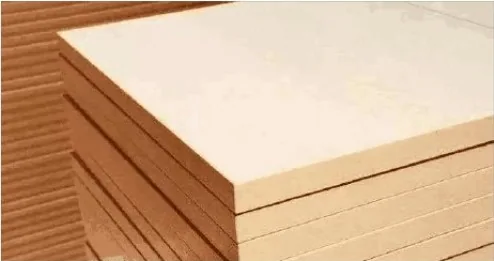
Ask the installer for the board invoice or label, supplier, grade, thickness and finish. Photograph the cut edge only as an identification aid; appearance cannot measure emissions. Note whether the material is raw, painted, melamine-faced or veneered and whether exposed edges remain. An MDF cabinet, a laminated particleboard shelf and a plywood door are different constructions despite sometimes sharing the casual name “density board.”
Some wood-based panels use formaldehyde-based resins. Formaldehyde is a component of those resin systems rather than the board adhesive by itself, and MDF products can use different binders. See our MDF formaldehyde guide for the distinction between binder chemistry, panel emissions and room concentration.
Record new materials and room conditions
List new furniture, panels, paint, adhesive, floor coverings and cleaning products introduced before the concern began. Record installation dates, room size, ventilation, temperature and humidity. Odour may prompt investigation but does not quantify formaldehyde or locate a unique source. Likewise, one board report cannot explain an air reading in a room containing several products.
The WHO indoor-air guidance treats formaldehyde as an indoor pollutant with multiple potential sources. If a building assessment is needed, ask a competent provider for an appropriate room-air measurement plan and interpretation. Tell them whether the room is occupied, how it is ventilated and whether the concern is a new installation or a longstanding condition.
Choose the evidence that answers your concern
| Question | Useful evidence | Key limitation |
|---|---|---|
| Did the supplied board meet a product requirement? | Applicable standard, product-specific laboratory and certification documents | Does not measure the current room |
| What is the room concentration? | Indoor-air sampling under recorded conditions | Does not identify one source by itself |
| Which installation may contribute? | Product inventory, records and a qualified investigation | Requires context; smell or a photo is insufficient |
ISO 12460-1 is a defined panel-chamber method. Its result should not be directly compared to a room reading or a panel extraction result. Ask for the method, units and specimen identity before using any number in a dispute or replacement decision.
Manage sources and room conditions
For a new or existing room, avoid introducing additional high-emission sources, use appropriate ventilation, and manage excessive heat and humidity. The EPA’s exposure-reduction guidance names these measures. If a particular source is confirmed, evaluate whether replacement or isolation is appropriate with the building professional. Do not assume a plant, packet of charcoal or a set number of months makes the board compliant.
Sealing a cut edge can be a sensible furniture-finishing detail, especially where moisture enters. It is not a substitute for a required emission test, and the sealant itself has to suit the application. Where a person has symptoms or an urgent concern, seek appropriate local health or indoor-environment advice rather than relying on a furniture article to diagnose exposure.
Plan suitable replacement panels when needed
Begin with a photo or sketch of the affected component. We help develop its dimensions, finish, indoor use condition, destination-market emission requirement and the documents needed with the new board. Identify whether the problem was only an exposed edge, an inappropriate panel grade, damage from moisture or a measured indoor-air concern. These details give the replacement order a clear product and documentation requirement.
For a wardrobe shelf, include sheet or cut-part size, load and supports, decorative face, edge band, hardware, quantity and the named emission method. We can discuss plain MDF or melamine MDF as distinct options; the final choice should match the actual job.
Existing-installation questions
Can I tell from smell whether the MDF failed a standard?
No. Smell does not identify a chemical concentration or the applicable product test.
Will keeping the room empty for three months solve it?
There is no universal waiting period. Indoor concentration depends on sources, ventilation and conditions, and product compliance requires its own evidence.
Should I buy an air purifier instead of investigating the material?
An appliance’s suitability depends on the pollutant and verified performance. First clarify the source and measurement question; do not treat a generic device as proof of panel compliance.