
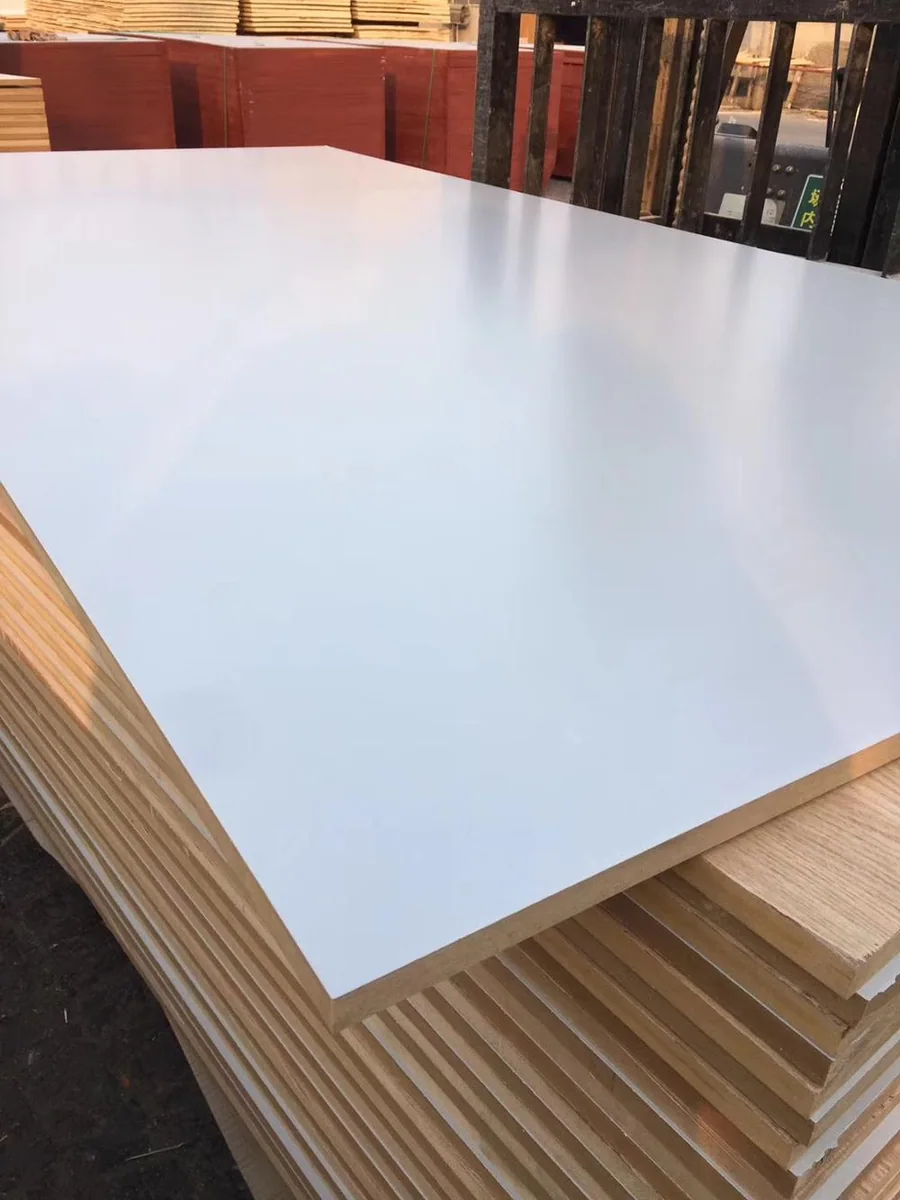
Melamine board is a decorative panel with a melamine surface; particleboard is one of the materials that can form its core. Melamine-faced particleboard is called MFC. Melamine-faced MDF uses a smooth fibreboard core, while melamine plywood uses layers of wood veneer. All can give furniture a ready-finished face, but their machining, edges and construction differ. Choose the core around the cabinet or component you need to make.
Melamine MDF furniture panels Melamine MDF sheets Melamine faced plywood Melamine colour catalogue
Which melamine board fits your furniture?
| Board | What is inside | Why buyers choose it | Details worth comparing |
|---|---|---|---|
| MFC / melamine particleboard | Bonded wood particles | Cost-conscious cabinet carcasses and flat furniture parts | Core grade, edge quality and hardware positions. |
| Melamine MDF | Fine wood fibres | Smooth faces and a consistent substrate for furniture processing | Weight, machining route, thickness and edge treatment. |
| Melamine plywood | Cross-laminated wood veneers | A layered wood core for cabinets and interior components | Core species, face quality, bond and fixing details. |
Is MDF better than particleboard?
Choose MDF when its smooth substrate and processing characteristics suit your component. Choose MFC when the design and budget suit particleboard. If you are switching materials in an existing product, check the actual joint, hardware position, finished thickness and weight on a component sample. A good substitution should fit your production line as well as the quotation.
Which option should I use in a kitchen?
Select a moisture-resistant core and protect the finished edges and cut-outs around sinks, fittings and plumbing. Melamine makes the main faces easy to clean, while the core and edge construction determine how the whole component deals with moisture. Our waterproof melamine MDF gives you a starting route for moisture-prone interiors.
Compare the cost of the completed part
The lowest sheet price can be offset by cutting waste, extra finishing or a changed hardware arrangement. Compare sheets, usable components, edging, machining and packing on the same basis. Send a current panel photo or cutting list, and we can quote an MDF or plywood option with the surface you want.
Compare the existing and proposed panels
MFC means melamine-faced chipboard or particleboard. Melamine-faced MDF has a fibreboard core. Raw particleboard is a third supply condition because it still needs the specified finish. Comparing a raw sheet price with a finished faced board omits work and materials.
Write the existing and proposed panel descriptions beside each other. Identify the core grade, finished thickness, face and back construction and supply stage. An offer described only as “equivalent melamine board” leaves the most relevant differences unresolved.
Our melamine material-name guide explains those categories. This page addresses the next decision: whether a different core can perform the same job in a design that already exists.
Match the core grade to the same service conditions
EN 312 distinguishes particleboard grades, including furniture boards for dry conditions and non-load-bearing boards for humid conditions. EN 622-5 addresses MDF requirements. These are different product families; their designations are not interchangeable grade labels.
Ask what the existing requirement was intended to achieve. If a cabinet may encounter humid air, replacing its specified core with a dry-interior alternative is a material change even when both are white-faced. A moisture-resistant designation does not mean unrestricted wet use.
Keep emissions, fire and any other required evidence with the offered construction. Do not carry a report from the original board across to the replacement solely because the same facing is used.
Compare the panels in your furniture component
| Component | Substitution check | Useful comparison evidence |
|---|---|---|
| Shelf | Span, support, stiffness and sustained load | Relevant material data and representative assembly evaluation |
| Hinged front | Mass, hinge selection and fixing behaviour | Actual front dimensions, hardware instructions and operation checks |
| Cabinet side | Connector holes, edge distances and squareness | Machined joint sample and assembly fit |
| Profiled edge | Machining quality and the planned edge finish | Finished profile using the proposed core |
The same nominal thickness does not establish the same stiffness, mass or connection performance. Where the component carries a defined load, use appropriate design information and testing rather than a general MDF-versus-particleboard strength slogan.
Check machining and edge treatment on the proposed core
MDF has a fine fibre structure, while particleboard contains visible particles. Those structures can affect the result of routing, drilling and edge preparation. A clean sample face says little about what happens after the workshop machines a hinge recess or a shaped edge.

Produce the most demanding detail in the drawing, not only a straight rectangular offcut. Check chipping at the exit face, the hole wall, the remaining material around recesses and the finished edging. Record the tool and process used so the result can be repeated.
If an alternative needs a different edge material or finishing step, include it in the proposal and price. Do not quietly change an exposed-edge detail merely to make the substitute easier to manufacture.
Recheck fixings and repeated assembly
A screw connection depends on the screw, engagement, pilot hole, edge distance, board and load direction. The EPF screw-fixing guidance specifically limits useful withdrawal comparisons to compatible screw and test conditions. A larger single withdrawal number is not proof that every cabinet joint will perform better.
Use the hardware supplier's requirements for the proposed core and component. Check hinge cups, cam fittings, shelf supports and any edge fixings separately. A through-bolted bracket and a screw driven into a panel edge present different connection questions.
For furniture that will be dismantled, include the intended assembly cycles in the evaluation. An undamaged first assembly does not establish the behaviour of reused holes after repeated moves. Our panel-fastener guide explains the evidence to compare.
Compare the finished appearance on both materials
A decor code is only part of the appearance specification. Compare the proposed panel and edge under the same light, with the same texture and gloss requirement. Include visible reverse faces and adjoining parts, especially when the substitution affects only part of a furniture set.
For pale colours, inspect the actual faced substrate rather than relying on an unpressed paper swatch. For woodgrain, check direction and the arrangement across the completed elevation. A change in usable sheet size may force a different cutting layout even when the pattern is nominally the same.
Label the physical samples by construction and revision. Our colour and texture selection guide covers a consistent viewing and recording method.
Price the changes and evaluate a representative assembly
Include machining adjustments, edging, hardware, handling and packaging in the cost comparison. A heavier finished part may change hardware or packing requirements; a different sheet size may change yield. Record these consequences instead of assuming a fixed price advantage for either core.
Choose a trial assembly that exposes the main differences. For a storage unit, that might combine a loaded shelf, a hinged front and the specified connectors. Evaluate the agreed function, fit and appearance using the actual replacement material.
Separate observed results from assumptions that still need checking. A trial can establish that a connector fits or reveal edge chipping; it does not automatically establish long-term performance in every environment. Our finished-part cost guide helps structure the commercial comparison.
Carry the selected change into your order
A substitution record should name the affected part numbers, original material, proposed material, drawing changes and acceptance evidence. State which requirements remain the same and which have been deliberately revised. Update the purchase order and sample reference together.
For a mixed construction, identify which parts use each core. Do not label the whole shipment MDF if some components are faced particleboard, or allow a one-order substitution to become an undocumented change in future supply.
Send a photo or sample of the existing panel, or the specification if you have it. Tell us which furniture part you want to replace. We can help compare our MDF and plywood options, then develop sizes, quantities and the processing details for a quotation.
Buying questions
Can you help if I only have a sample of the existing board?
Yes. Send photos of the face and exposed core, plus the furniture part and its use. We can help identify the construction and plan an alternative to compare.
Can I compare an alternative before changing the full order?
Yes. We can plan a representative part or detail in the proposed MDF or plywood. Review its fit, finish and relevant performance requirements before updating the order.