
Good melamine board quality starts with the finished part: the faces customers see, the fit your workshop needs and the conditions of use. Show us your furniture idea or a reference sample and we help develop those requirements into a clear order. PanelSource manufactures MDF and plywood and applies decorative facing in our own factory. The checks below connect the chosen panel and finish with measurable acceptance points.
Melamine MDF sheets Melamine plywood Double-sided plywood Browse colour references
Choose the complete panel for your part
Record the substrate, grade, nominal thickness, sheet dimensions, facing system, decor, texture and reverse-face arrangement. Melamine-faced MDF, particleboard and plywood can look similar while having different core structures and machining behaviour. A decor code identifies appearance; it does not establish the core grade, moisture resistance or mechanical properties.
Define whether the order is for full sheets, trimmed blanks or finished components. The acceptance area changes with that decision. A defect inside the waste margin of a full sheet may disappear during cutting, but the same defect at the edge of a finished door remains part of the supplied component. Keep the cutting allowance explicit rather than assuming all edge damage is harmless.
Choose requirements within the correct standard scope
The official records distinguish GB/T 15102-2017 for impregnated-paper-faced fibreboard and particleboard from GB/T 34722-2025 for decorated plywood and blockboard. The latter took effect on 1 December 2025 and replaced the 2017 edition. Select the document for the actual construction and record its edition.
For orders using the European framework, EN 14322:2021 concerns melamine-faced boards for interior uses within its defined scope. A product standard and its referenced test methods work together. Naming a standard on a quotation is not, by itself, evidence that a particular batch meets it.
Choose visible faces and usable areas
| Area | Specify | Avoid ambiguity about |
|---|---|---|
| Visible face | Decor and texture reference, viewing conditions, permitted defects | Whether the face remains visible after installation |
| Reverse face | Required finish and separate appearance criteria | A lower visual grade does not permit loss of required function |
| Edges and corners | Finished dimensions, machining and damage limits | Whether chipping reaches the retained component |
| Trim allowance | Its width, location and exclusion from usable dimensions | Whether the full ordered sheet or only a smaller rectangle is guaranteed usable |
| Matched components | Grain direction, sequence and appearance reference | Individual sheet acceptance versus the appearance of adjacent doors |
For a wardrobe, a concealed cabinet back and two adjoining doors have different visual roles. Label the door fronts as visible faces and define the reverse separately. If adjacent doors must match, assess the assembled pair or agreed layout as well as the individual boards. A rule allowing isolated marks cannot settle an overall mismatch in shade or grain sequence.
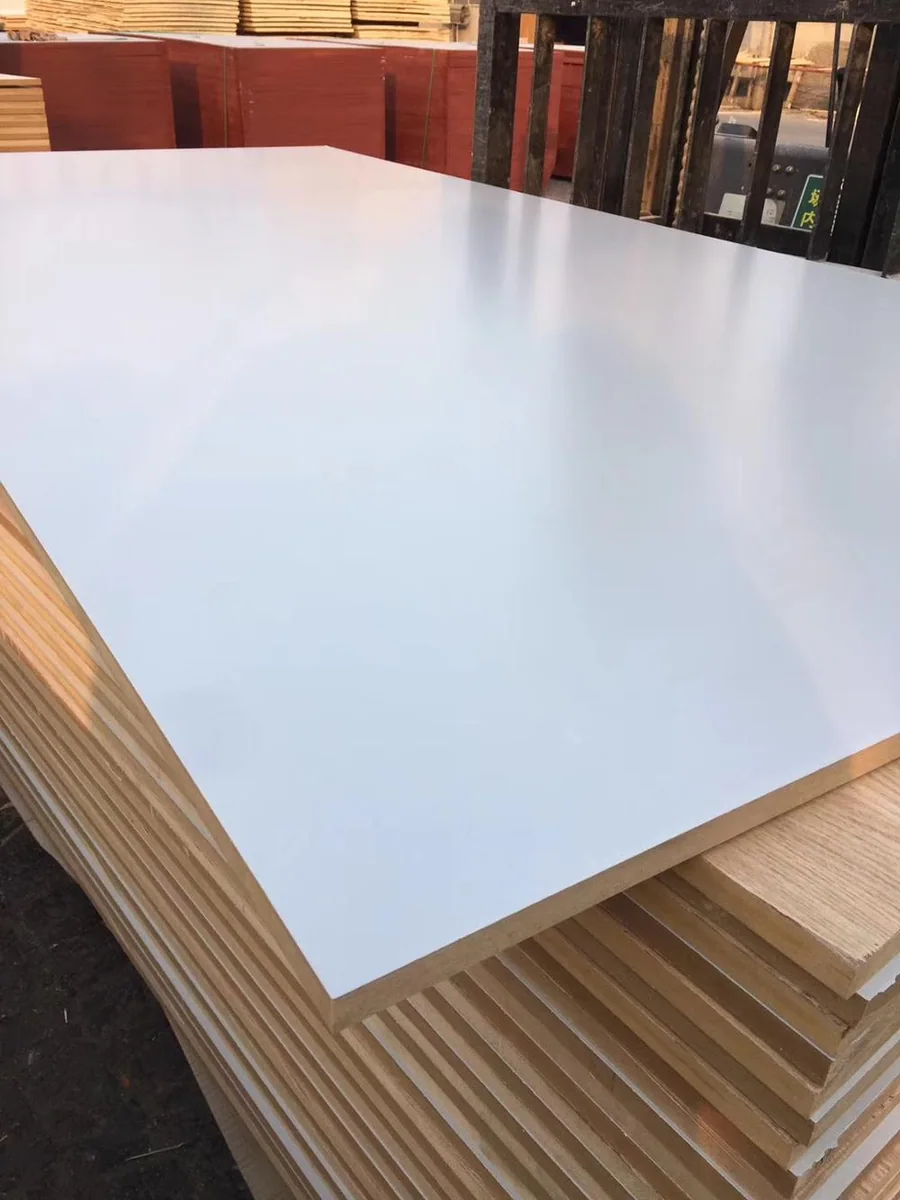
Describe defects so two inspectors can reach the same result
Use observable descriptions: exposed substrate, blister, paper tear, print discontinuity, embedded particle, scratch, edge chip or separation. Record size, position and number where those quantities determine acceptance. Words such as slight or obvious are difficult to apply consistently without a physical reference or a defined viewing condition.
Distinguish intentional woodgrain features from damage. A printed knot can belong to the selected design; missing print or a repeated contamination mark does not become acceptable merely because the finish imitates wood. Retain a representative decor sample and photographs showing accepted and rejected boundary examples under the same conditions.
Do not use colour correction or digital sharpening to settle a disputed defect. A photograph helps locate it, while physical assessment under the agreed conditions determines the relevant appearance result. Our colour and texture guide explains why screen appearance and physical matching need separate treatment.
Set tolerances around the finished fit
For thickness, specify whether the requirement applies to the finished faced board, the measurement locations and the statistic used for acceptance. An average can hide a local high point that prevents a fitting from seating correctly. For length and width, distinguish nominal size from the minimum usable rectangle after trimming. For squareness, agree the method; a difference between diagonals and a measured edge deviation are not interchangeable numbers.
Flatness also needs a defined support and conditioning arrangement. A sheet measured while tightly strapped or forced against a worktable does not provide the same observation as a panel checked in the agreed free condition. Record the panel state before comparing results from the factory, receiving warehouse and machining shop.
Blank tolerance cells should be resolved before the order. Do not interpret a missing limit as zero tolerance or as unlimited variation. Refer to the applicable product document or add an explicit contractual requirement where the downstream process needs a tighter fit.
Separate surface, core and component performance
| Requirement | Relevant evidence | Does not establish |
|---|---|---|
| Decorative surface durability | Specified scratch, abrasion, stain or heat method and result | Every chemical exposure or an unlimited service life |
| Core integrity | Applicable internal bond, bending or other core-property assessment | The strength of every machined joint |
| Moisture-related behaviour | Core grade and applicable dimensional or exposure testing | Waterproof edges or suitability for continuous immersion |
| Hardware and assembly | Testing of the specified component and fixing arrangement | A substitute for the board's required product properties |
| Emission or fire requirement | Report or classification covering the relevant construction and use | Compliance inferred from the melamine name or surface colour |
For each property, include the method and edition, specimen construction, conditioning, units, acceptance threshold and result basis. A minimum individual value differs from a minimum mean. A test load in newtons differs from a stress in megapascals. Our performance-test guide explains these distinctions.
Link the requirement to the supplied lot
Record the product and lot identifiers on the inspection record, sample labels and relevant reports. State which checks apply to routine batches and which evidence comes from product qualification or a defined change assessment. Do not present an old report on a different thickness, core or facing system as a measurement of the current shipment.
The acceptance plan should define lot boundaries and sampling before the results are known. A mixed delivery may need separate assessment for different cores, thicknesses or decors. Where results fail or the sample identity is unclear, separate the affected material and resolve the specific issue. A passing visual check cannot compensate for a required property that was not assessed.
Turn a furniture brief into an acceptance brief
Suppose the project requires white melamine MDF cabinet sides with concealed reverse faces and predrilled hardware locations. The brief should connect the selected core and thickness to the drilling drawing, define the visible finish using a retained sample, identify the reverse construction, and set the dimensional limits needed for assembly. Surface evidence should address the actual cleaning and wear demands.
This is an illustrative specification structure, not a declaration of a particular grade or test result. The final limits must come from the product requirements and project. If the design changes to an exposed shelf or a humid-service component, revisit the performance schedule instead of copying the cabinet-side specification unchanged.
Develop quality requirements from your project
Tell us what you are making and show the faces, edges or fittings that matter most. A project photograph or sketch is enough to begin choosing melamine MDF or melamine plywood. We help turn the design into a sample and practical acceptance points.
Add the sizes, quantities and destination you have for a quote. We then agree face references, finished tolerances and required evidence, with the receiving inspection plan linked to that order.
Melamine board quality buying questions
Do I need a complete quality specification before contacting you?
No. Start with the furniture use, a photo or the result you want. We help develop the panel choice, sample and measurable checks as the order takes shape.
Can the sample include matching edging?
Yes. An edged corner lets you review the face-to-edge transition, texture and gloss. For adjoining fronts, include the matching layout in the sample plan.