
MDF uses refined wood fibres; plywood uses bonded veneers, giving the two panels different edges, grain patterns and machining behaviour. MDF offers a fine-textured base for painted profiles, while plywood can make the layered edge part of the design. We manufacture both substrates ourselves and help compare the core, face and processing around the part your workshop will cut, rout, drill or finish.
Plain MDF for machining Custom-size MDF Melamine-faced plywood
How fibres and veneers form the panel
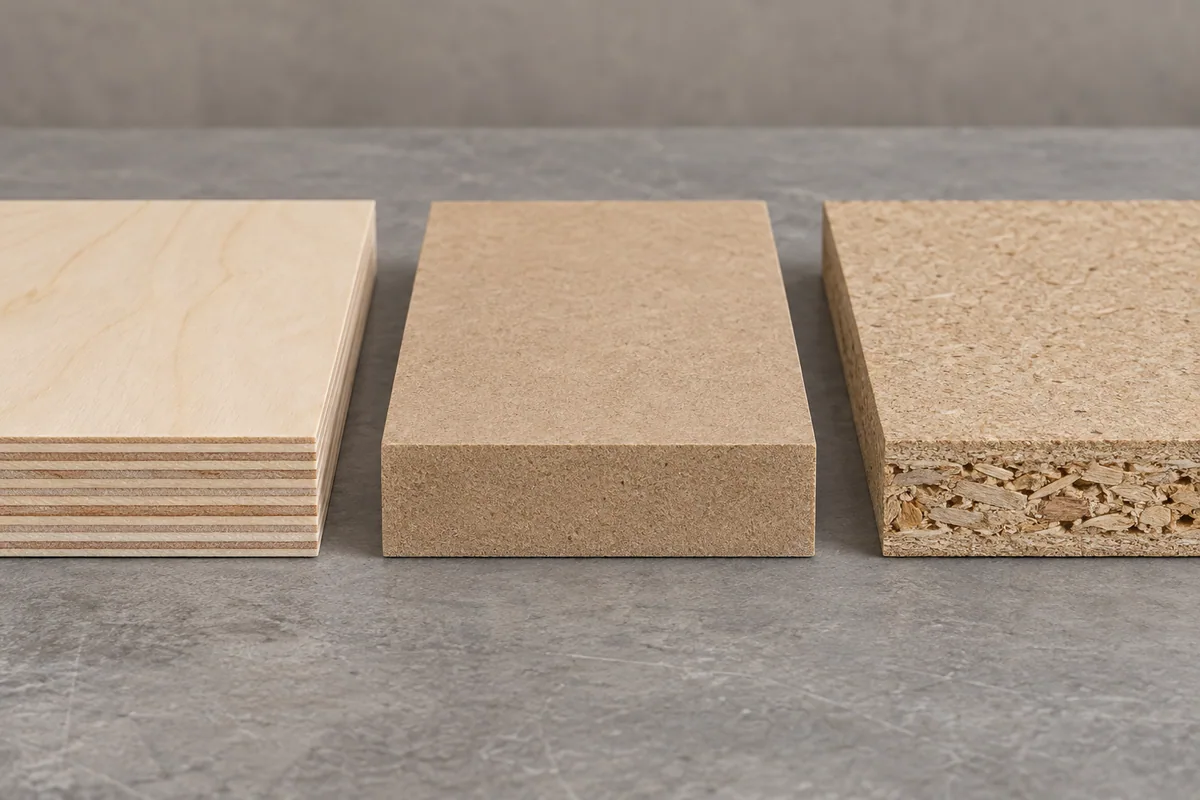
MDF is formed from refined fibres, giving the core a fine texture without the continuous visible grain of a wood veneer. Plywood preserves that veneer grain, with layers commonly changing direction through the panel thickness.
The Wood Handbook chapter on wood-based composites explains how wood elements such as fibres, particles and veneers form different engineered materials. Their arrangement and manufacture matter alongside the raw species.
Particleboard is a third construction, using wood particles rather than the refined fibres of MDF. Its coarser edge makes the distinction visible when the decorative faces look alike.
What a routed edge reveals
Routing MDF exposes a fibrous substrate. Routing plywood can expose alternating veneers, glue lines and local core features. For a painted moulding, an exposed plywood stripe may be irrelevant if the preparation is suitable; for a clear-finished edge, it can be a deliberate part of the design.
A routed recess in a veneered MDF board can cut through the decorative face and expose fibreboard. Include a coating, edge material or other finishing detail for that exposed fibreboard. Define the finished section before selecting the surface.
Strength, stiffness and the finished component
Strength concerns resistance to failure under specified conditions. Stiffness concerns deformation under load. A shelf can deflect unacceptably without breaking, so stiffness and acceptable deflection are central to its design.
ISO 16978 addresses bending modulus and bending strength testing. Results need the relevant panel identity, thickness, conditioning and test basis. For plywood, direction relative to the face grain can also matter.
Assess the finished unit using its span, support, connections, loading duration and use conditions. Product compliance values and engineering design values serve different purposes; select the data relevant to that assessment.
Choose the property that answers your design question
| Question | Relevant information | Insufficient shortcut |
|---|---|---|
| Will a shelf sag? | Stiffness, span, section, support and loading | A species name or board weight |
| Will a connector hold? | Fitting, drilling, engagement and actual core | A generic screw-holding ranking |
| Will a coating look smooth? | Face, edge preparation and finish trial | Nominal density alone |
| Will a damp location be suitable? | Product grade, exposure and assembly details | A coloured core or a decorative face |
| Can parts be interchanged? | Measured dimensions and manufacturing tolerances | The same nominal thickness label |
Use density and mass for the actual part
MDF and plywood each cover a range of constructions and densities. Compare the candidate panels by their actual construction and supplied thickness. Obtain actual mass per area or an appropriate density for the supplied panel.
Density also varies through many MDF boards rather than being perfectly uniform from surface to centre. That is one reason a routed core and an unmachined face can behave differently during finishing. The whole-board average does not describe every local property.
For a moving door, include the complete component's coating, edging and hardware when selecting hinges. For transport, include packaging. The resulting mass helps select hardware, plan handling and estimate shipment weight.
Match moisture response with the use conditions
Both panels respond to moisture. MDF can swell or change dimensions; plywood can change dimensions or distort, and its bond performance depends on construction and exposure. Select the grade and finished detail around the expected conditions.
EPF's moisture guidance explains the relationship between MDF, storage conditions and dimensional change. In a comparison, state whether the exposure is normal room humidity, occasional splash, persistent wetting or exterior weather.
Then match the specified product type and assembly to that condition. For exterior use, identify an exterior construction and its complete finishing system. If a part has existing moisture damage, assess the core, dimensions and connections as well as the surface before deciding how to repair it.
Plan paint or stain for the exposed surface
Paint can be used on appropriately prepared MDF and plywood. MDF can offer a grain-free appearance, while a wood-faced plywood may require preparation around grain or repairs. Review coating compatibility and appearance on the proposed finished sample.
Staining plain MDF colours the fibre surface; for natural oak or birch grain, choose the appropriate wood-faced construction. Staining a veneer changes an existing wood face and may emphasise local variation. EPF discusses different absorption at MDF faces and edges, which helps explain why an edge may need a different preparation step.
Compare finished cost and emissions documents
Compare prices for the same dimensions, face condition, grade and delivery scope. Include machining yield and finishing work. A comparison of the complete supplied part makes the price difference useful.
Emissions likewise require evidence for the offered product and relevant test basis. Keep the identified construction, test method and result together in that comparison. Dust generated during machining is a separate workshop-control issue.
Discuss your machining or finishing detail
Share a part photo, routed profile or finish idea through our enquiry form. If you already have competing specifications, send both; we can work through the sizes, fittings and delivery details with you. We can discuss the differences that affect your application and point to the relevant plywood and MDF options.