
Engineered bamboo panel development matters to buyers when it improves the finished part: its appearance, usable size, machining or cost. Start with the bamboo panel or component you like, then compare it with plywood and MDF options from our factory. The construction and research examples below help you choose a representative trial and compare the same finished supply scope.
Decorative plywood Poplar plywood Melamine MDF
Choose among engineered bamboo constructions
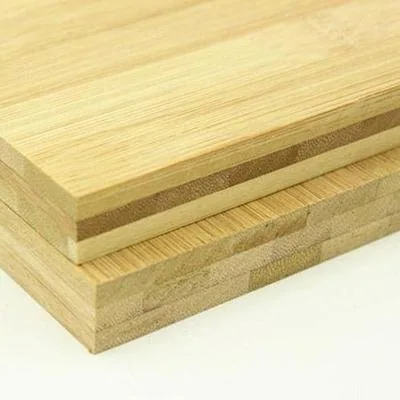
“Composite bamboo plywood” is a broad description rather than one controlled recipe. A development claim needs to identify the elements being bonded and their arrangement. A change from strips to fibre bundles is more significant than a new colour name.
| Construction family | Identify in the product description | Useful qualification question |
|---|---|---|
| Strip-laminated bamboo | Strip orientation, layer arrangement and outer-layer thickness | Can the specified component be machined and finished consistently? |
| Mat- or curtain-based panel | Woven or aligned elements, bonding and face treatment | Does the working face and documented panel performance suit the proposed duty? |
| Bamboo-and-wood hybrid | Which layers are bamboo, which are wood and how they are arranged | Do the test reports represent the complete hybrid construction? |
| Bundle-based scrimber | Bundle preparation, orientation, resin system and consolidation | How consistently does the production material achieve its declared properties? |
Use these descriptions to organise an enquiry, not to assign a performance class. Two products within one family may still differ in thickness, density, bond behaviour or permitted service conditions.
Connect process improvements with component needs
Hu and colleagues' 2022 experimental study of wide-bundle bamboo scrimber investigated fibre-bundle preparation and panel density. The results linked processing choices to mechanical properties, water absorption and thickness swelling, with a trade-off between performance and manufacturing inputs.
That finding supports a practical conclusion: a value obtained for one experimental process should not be assigned to every commercial bamboo panel. The study is evidence about the materials and conditions investigated, not a certificate for another manufacturer's production.
For a proposed process improvement, request the comparison baseline and the spread of results as well as the best value. Check whether specimens were conditioned and tested alike. An improvement in one property may change component mass, tooling requirements or another property that matters to the buyer.
Connect product development to a finished component
For furniture and interior fit-out, development can mean a more useful format, a different face arrangement or a more repeatable machining surface. Those changes should be evaluated on the buyer's part rather than only on an uncut presentation sheet.
A useful trial could combine a cabinet side with a routed pocket, a shelf edge and a matching front. Record dimensional accuracy, exposed-core appearance, hardware fit and colour after finishing. Agree which observations are cosmetic and which prevent the component from being used.
Match the supplied construction to the project design
A high bending result is not a complete structural specification. The intended use may also depend on stiffness, direction, connections, moisture conditions, sustained loading and the applicable design or approval route. The evidence must cover the supplied product and its role in the assembly.
For example, a bamboo furniture panel cannot be accepted as a replacement formwork facing simply because both products share a nominal thickness. A panel used in a proprietary system must be checked against the system's requirements. A decorative component and a load-bearing component have different qualification tasks.
Ask the responsible designer which declared properties and documents the project requires. Keep the drawing, product identity and supporting evidence linked through any material substitution. A renamed product without a documented technical change is not, by itself, an improvement.
Read environmental evidence at the product level
Bamboo's growth characteristics do not settle the environmental performance of a bonded panel. An assessment also needs a defined product, manufacturing scope and comparison basis. Separate a resource-origin claim from a product-emission result and from a life-cycle declaration.
For a proposed EPD comparison, check the declared or functional unit, product scope, data period, applicable rules and included life-cycle stages. Comparing one result per cubic metre with another per finished component, or comparing different boundaries, can reverse the apparent result without changing either product.
Keep formaldehyde or other emission requirements in their own test schedule. A sourcing certificate or an EPD is not a substitute for the required emission method and product result. Our panel-emission test guide explains how to define that separate requirement.
Move from a pilot sample to a repeatable order
Begin with a written product identity and a representative sample. Then evaluate the difficult component details and the required technical evidence. The next step is a defined trial quantity that allows the buyer to assess variation across sheets and packs.
For the repeat order, retain the construction description, material code, agreed appearance range, machining instructions and document revisions. Decide which changes require a new sample or technical review: a different resin system, altered layer arrangement or new surface treatment may affect the original assessment.
Use delivery inspection to connect the trial to production. A batch identifier and a measured defect record are more informative than an overall statement that the quality is “the same”. Track the causes of rejected components so the next manufacturing change addresses an identifiable problem.
Use development trends to improve a practical requirement
Without a defined dataset, market-growth percentages, national production totals and predictions of rapid adoption are poor guides to a purchase. Ask which product became available, what changed in its specification and whether the evidence applies to your order.
A development has practical value when it improves a requirement you can check: usable dimensions, component yield, finish consistency, documented service suitability or repeat-order reliability. A lower raw-sheet price may be offset by extra calibration or finishing; a more detailed specification may reduce that uncertainty.
Start with the bamboo appearance or component you like
Send a photo of the bamboo panel or component you like and tell us the improvement you want. Include any bamboo, plywood or MDF details you already have through our enquiry form; we help compare the materials around the finished part.
Use our bamboo construction and quotation checklist for order details. For concrete work, start with the separate wood-plywood and bamboo-formwork comparison rather than borrowing data from an interior-panel study.
Bamboo and plywood options buying questions
Can a bamboo panel photo be the starting point?
Yes. It helps identify the appearance and component you want. Share any product details you have so the comparison can include the edge, construction and intended use.
How should I compare the cost of different panel materials?
Compare the same finished parts, usable yield and processing scope. Include the machining and finishing work shown by the component trial, alongside the sheet price.