
Plan plywood formwork removal around the authorised release scope, safe handling and the condition of recovered panels. Identify what remains in place, protect faces and edges during transfer, then count the pieces accepted for the next use.
When recovered stock leaves a shortfall, PanelSource supplies replacement film faced shuttering plywood and custom-size plywood parts. Start with the missing sheet or part and the next required finish; we help match the replacement supply.
Choose the plywood supply for your next step
- Replace standard concrete-contact sheets with film faced shuttering plywood matched to the project panel requirements.
- For a black 18mm panel specified in the existing layout, compare 18mm black film faced plywood with the original construction and fit.
- Replace shaped closures or drilled facings with custom-size plywood parts from the current part drawing.
Confirm the released area and component scope
Identify the pour, member, drawing revision and exact components authorised for removal. Concrete age alone is not a complete release criterion, and a clean separation at one corner is not evidence that a supported slab can carry its construction loads.
Follow the project’s concrete-strength criteria and the responsible person’s instruction before striking formwork. Keep the removal sequence and any remaining support with the actual system design.
For post-tensioned work, use our stressing and support-release guide. A release may cover one zone or facing component while leaving other items in place.
Identify retained supports and recoverable panels
Side forms, soffit sheets, beams, heads and shores do not necessarily share the same removal stage. Identify retained supports and any facing strips associated with them on the marked layout.
Some systems incorporate specific arrangements for recovering parts of the form while other components remain. That capability depends on the equipment and engineered method; it should not be assumed for a conventional assembly merely because a similar-looking system offers it.
Keep the retained components visible in the material schedule. If an instruction releases the general bay but excludes a strip or opening zone, identify its boundaries clearly for the crew collecting plywood. Inventory pressure is not a reason to reinterpret the release scope.
Prepare the receiving route and handling arrangement
Establish where recovered panels or assemblies will be received and how they will be transferred there. The route should accommodate their actual size, weight and configuration, including attached framing where applicable.
UK HSE lifting guidance calls for planned operations, suitable equipment and competent people. Whether a form moves as one unit or as separate pieces follows the system and handling plan; neither approach is universally correct.
Separate the receiving area from falling-object exposure and ongoing dismantling work. Arrange identification and counting so the crew does not need to spread unknown pieces across an access route simply to work out what has arrived. Packaging straps and temporary site labels do not establish lifting capacity.
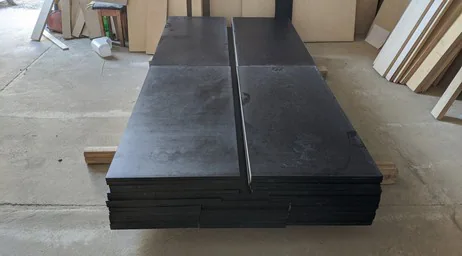
Protect edges during controlled separation
A form that does not separate as expected may still have a connection, a geometric obstruction or local concrete adhesion. Stop and identify the cause using the system procedure rather than increasing force without understanding what remains engaged.
Release the facing from the concrete using the approved stripping procedure before the lifting operation. Do not use the crane to break the bond. Protect the concrete arrises and plywood edges at the designated separation points.
APA's concrete-forming guidance also addresses avoiding surface and edge damage during stripping. Use the method and tools appropriate to the actual panel or assembly; a general instruction to hammer, pry or pull from the top down is not enough.
Inspect the concrete and facing as a matched pair
Before the evidence is cleaned away, record any unusual adhesion, torn overlay, damaged corners or impressions in the concrete. Identify the corresponding panel position. A photograph of only the loose sheet may lose the connection to the formed surface.
For repeated marks, compare their locations with joints, fixings and support details. For a local tear, record whether the veneer or overlay remains on the concrete and whether the affected location coincides with an edge, repair or opening. These observations support investigation without assigning a cause prematurely.
Use our shuttering-plywood problem guide to distinguish likely material, treatment and site interfaces. A damaged sheet after stripping does not by itself prove either a manufacturing defect or incorrect site handling.
Reconcile recovered quantity with available stock
Count full sheets, shaped pieces and retained strips separately. Record condition and the next intended use. A panel recovered from the concrete is not automatically ready for another visible face, particularly if its dimensions, holes or repairs no longer suit that location.
| Disposition | Panels | Meaning for the next pour |
|---|---|---|
| Still retained in the form | 12 | Not available for allocation elsewhere |
| Accepted and prepared for the next specified use | 76 | Available within that accepted scope |
| Set aside for further assessment | 8 | Do not count as available stock |
| Removed from the formwork stock | 4 | Replacement or another authorised disposition needed |
The example totals 100 panels, but only 76 are available for the defined next use. The figures illustrate stock accounting, not an expected damage rate or a prediction of our plywood's service life.
Make the handover to cleaning and repair explicit
The handover record should carry panel or bundle identity, previous location, unusual observations, retained components and condition decisions. Keep pieces needing assessment separate from accepted stock, including when they have the same film colour and nominal thickness.
Pass the relevant release-treatment history and surface requirements to the team preparing the next use. Otherwise, a repair or cleaning process suitable for one facing may be applied indiscriminately to every returned sheet.
Our between-pour protection guide covers cleaning, compatible repairs, edge treatment and storage. This handover establishes which material enters that process and which observations must remain traceable.
Use actual recovery information for replacement purchasing
Compare the available pieces with the next layout, not just its total concrete area. A reusable large sheet and several narrow cut pieces do not offer the same cutting yield. Identify special closures that need remanufacturing even when the overall recovered area appears sufficient.
Start a replacement enquiry with the missing sheet or part sizes and approximate quantities. Add the original panel reference when available; photographs and location records help investigate unexpected damage or fit.
Build the replacement schedule from the actual material shortfall and the next application requirements.
Plywood supply questions
Should I order the same number of sheets that were stripped?
Use the next layout and the recovered pieces accepted for that use. Retained panels, damaged sheets and incompatible cut pieces belong in separate counts.