
Wood for plywood production is selected by its role in the panel: a visible face, an exposed edge or an inner veneer. Start with the appearance and component you want, and our factory helps compare birch, poplar, pine, eucalyptus and decorative faces in the required construction. The production details below explain how log quality and veneer preparation affect the finished panel choice.
Birch plywood sheets Poplar plywood Eucalyptus plywood Pine plywood
Start with the role of each veneer layer
A decorative face, an inner crossband and a structural veneer do different work. A face may need a particular grain pattern or colour range; an inner veneer may need dimensions and integrity that allow a consistent lay-up. The selection criteria should follow those roles.
A birch-faced panel can contain another core species. Likewise, an oak decorative face does not mean the entire panel is oak. Ask whether a named species describes the face, selected layers or every veneer in the construction.
Our veneer-core plywood guide explains how to write a layer description. For mixed constructions, keep the permitted species and their positions visible in the specification instead of accepting an undefined hardwood core.
Use species information as a starting point
Birch, poplar, pine, eucalyptus and other woods can enter plywood production through different constructions and regional supply routes. The useful question is which resource can provide the veneers and finished properties required by the order, not which species is universally best.
The US Forest Service's commercially important woods chapter explains that species have characteristic properties but that specific physical properties still matter to engineering use. A species label should therefore lead to a more precise material description, not replace it.
Keep botanical identity, commercial name and measured properties separate. Also distinguish green-log density from density measured at a defined moisture condition. Neither number can simply be used as the shipping density of a finished plywood panel.
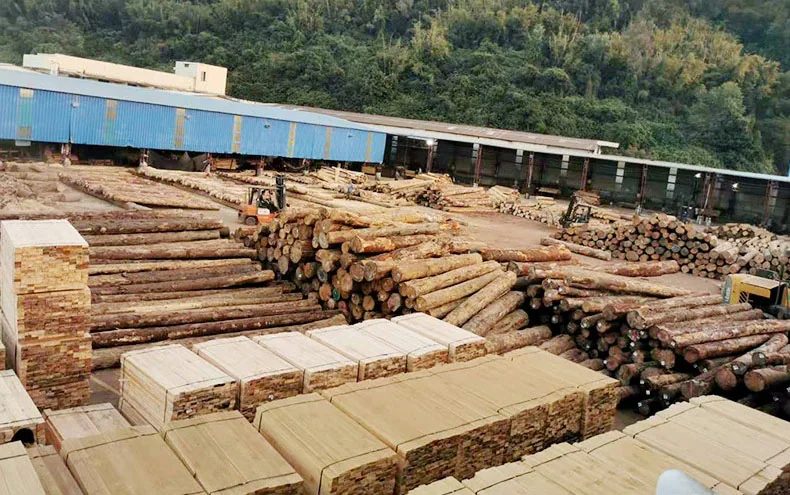
Understand how log geometry affects veneer yield
A usable log must fit the conversion route. Length, diameter, taper, curvature and end condition affect how it can be cut into blocks and presented to the equipment. Bark-inclusive dimensions should not be confused with usable wood dimensions.
Review log length, diameter, curvature and suitability for the intended veneer. The largest log does not automatically give the best usable yield.
For a proposed supply, request a diameter and length distribution rather than only an average. Two lots with the same average diameter can contain very different proportions of usable blocks. Include the measurement method and defects excluded from the quoted volume.
Choose peeling or slicing around the required veneer
Rotary peeling produces a ribbon from a rotating block. Slicing produces veneer from a prepared flitch and is used where the selected grain presentation matters. The choice affects the material preparation, output format and appearance; it is not a simple high-quality versus low-quality distinction.
Keep decorative cutting requirements with the face specification. Our veneer cuts and matching guide explains how slicing direction and sheet arrangement influence the visible pattern.
Compare the usable veneer after grading and drying
| Observation | Question to investigate | Useful output measure |
|---|---|---|
| Curved or tapered blocks | How much material is lost during preparation and rounding? | Usable veneer from the measured input volume |
| Knots, splits or decay | Which veneer areas can meet the assigned layer grade? | Accepted area by veneer grade |
| Variable moisture or thickness | Can drying produce consistent assembly material? | Dry veneer within the agreed requirements |
| Colour variation | Does it affect the visible face or only hidden layers? | Matched face sets and usable core material |
Green ribbon output is not the same as accepted dry face veneer. Keep clipping losses, drying damage and grade changes visible. A cheaper log lot may yield less of the veneer actually needed, even if its total peeled area is high.
Connect the resource change to drying and bonding
A new species or source can change the material entering the dryer and glue line. Review veneer condition, thickness, moisture distribution and the prepared bonding surface before transferring an established process unchanged.
The Wood Handbook chapter on wood-based composites explains how wood elements and manufacturing choices together influence the resulting material. Finished plywood is a designed assembly, so raw-wood properties alone do not establish panel performance.
Qualify a changed resource in the intended lay-up and thickness. Inspect the result after pressing and finishing, including bond quality and the properties relevant to the application. Our poplar plywood production guide gives a more detailed example of material-specific controls.
Keep resource identity through mixed supply
If veneers arrive from more than one source, retain the lot identity needed to connect them with the finished panel. Distinguish permitted mixing within a defined construction from an unrecorded material substitution.
Appearance alone cannot establish harvest location or verify every inner layer. A face sample may answer a colour question while leaving the core identity unresolved. Our wood-species identification guide explains when visual inspection and laboratory evidence can help.
Keep any sourcing or certification requirement separate from mechanical and bonding requirements. A documented origin does not prove a particular stiffness, just as a successful bond test does not establish where the timber grew.
Start with the finished panel you want
Start with a photo, current board or component drawing and the wood appearance you want. We help choose the face and core, then add the sizes, quantity and any performance requirements for the order.
For a visible-edge component, include an edge sample or drawing. For a weight-sensitive project, specify a mass target with the dimensions and conditioning basis. For a decorative set, include the grain layout and acceptable variation.
Discuss the wood construction for your plywood order. We can connect the material choices with the finished panel requirement, rather than quoting a species name without the details that determine its usefulness.
Plywood face and core wood buying questions
Can the face and core use different woods?
Yes. A decorative face can be combined with a specified core construction. Tell us which faces and edges will show so we can help compare the appropriate materials.
Do I need to choose the logs for a plywood order?
Start with the finished part and the appearance or performance you need. Our factory connects those requirements with the face, core and production construction in the proposal.