
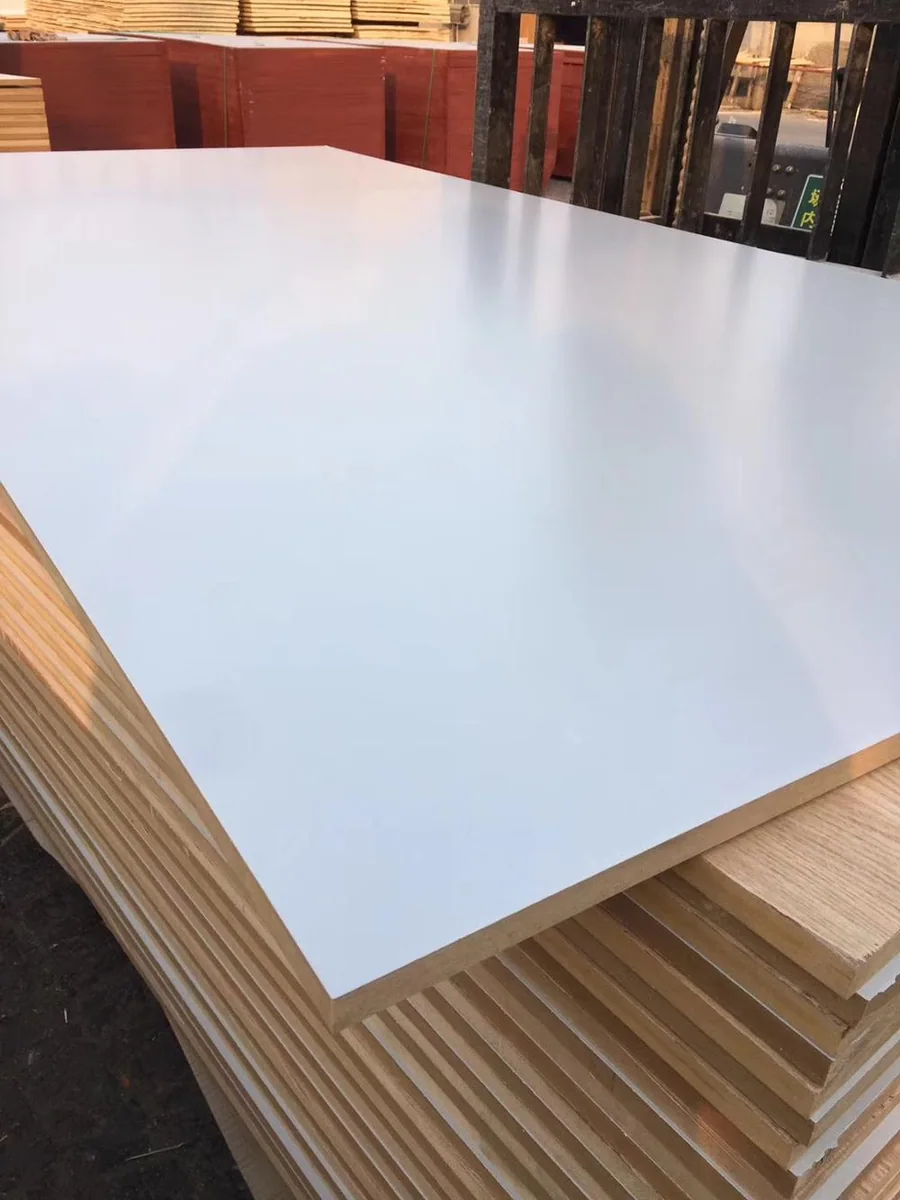
Melamine faced MDF is medium-density fibreboard with decorative paper bonded to its surface using melamine resin. The finished face gives cabinets, wardrobes and interior panels a consistent colour or woodgrain without painting the main faces. Choose the MDF core for the furniture’s use, then coordinate the decor, reverse and finished edges. Order full sheets for your workshop or prepared components around your drawing.
Compare our melamine MDF range Browse and download the colour catalogue
Why furniture buyers choose melamine MDF
- Fewer finishing steps: white, solid-colour and woodgrain faces arrive ready for cutting and edging.
- A smooth fibre substrate: MDF supports clean panel faces and detailed machining, with the exposed edges finished for the component.
- A coordinated furniture range: bring doors, sides and shelving together with the selected face, reverse and edge references.
- The supply stage your workshop needs: choose sheets, cut blanks or parts with the specified edging and machining.
| What you are choosing | Product route | What to compare |
|---|---|---|
| Sheets and the overall construction | Melamine MDF sheets | Core, face/reverse, sheet formats and supplied processing |
| White furniture components | 12mm white MDF or 18mm white MDF | Inserts and supported backs, or cabinet sides and fronts, with the actual fit and hardware |
| Solid-colour furniture | Melamine MDF colours or black melamine MDF | Colour, texture, sheen and the finished edge beside adjoining surfaces |
| A timber appearance | Woodgrain melamine MDF | Printed decor, grain direction and the visible group of fronts |
| A reflective furniture finish | High-gloss melamine MDF | Gloss, reflections, face/reverse and finished-corner appearance |
| Kitchen, bathroom or utility cabinets | Moisture-resistant melamine MDF | MR core, the cabinet location, hidden edges and service openings |
| Several parts in a cabinet or wardrobe | Melamine MDF furniture components | Part schedule, final sizes, edging, hardware preparation and labelled sets |
The category page compares the range; each product page carries its configuration and supply choices. Use the colour catalogue to shortlist decor references and download the brochures. A physical panel-and-edge sample brings the chosen appearance into your furniture.
For budget planning, see the melamine MDF price range, then include your chosen construction, processing, quantity and destination in the quotation request.
How the decorative panel is built
Prepared MDF receives melamine-resin-impregnated paper and passes through a press. The decor paper provides the colour or printed pattern; the press plate and process contribute the smooth or textured finish. The European Panel Federation describes the surfacing process, including the importance of a sound sanded substrate and balanced construction.
The MDF core and facing are separate selections. Standard interior MDF suits a dry-use route; a moisture-resistant core is the starting point for furniture exposed to humidity and splashes. Choose the grade and thickness with the component’s support, machining and fittings. A face-and-edge sample shows the material inside the decorative surface.
What a melamine surface standard covers
EN 14322:2021 covers surface requirements and dimensional tolerances for melamine faced boards for interior use. It covers different substrates, so keep the MDF grade and decorative-panel requirement together in the specification. Add the applicable moisture, emission or fire requirement for the board or assembly where your project needs it.
Directly pressed melamine paper and a separately manufactured high-pressure laminate sheet are different surface systems. If a drawing calls for HPL, use that construction in the quotation. For a heavily used counter or a special cleaning regime, identify the required abrasion, stain, heat or chemical performance for the chosen surface.
Why one or two faced sides matter
A cabinet door shows its reverse when opened, and an open shelf can show both faces. Choose each side’s decor, texture and sheen with the complete board construction. Different colours can be used where the design calls for them.
Balanced surfacing also matters for flatness. The European Panel Federation recommends matching the type and weight of resinated paper on both faces to support the panel under changing humidity. For a tall door or long panel, review the reverse construction and actual-size fitting with the selected hardware.
Choose the finish for cut and machined edges
Sawing, drilling and routing expose MDF beneath the decorative face. Choose the edge band, coating or other treatment for the part, including PVC or ABS bands where suitable. Compare the bonded and trimmed corner: its colour, joint line, radius and final dimensions are what your customer will see.
For kitchen or bathroom furniture exposed to humidity or splashes, combine an MR MDF core with the edge and opening details for that location. Include rear notches, sink interfaces, lower edges and pipe holes, as well as the visible front. Treat newly exposed core before a fitting conceals it. The MR melamine MDF guide develops those cabinet details; our moisture guide explains the measurements used when a project requires test data.

Choose colour, texture and gloss with a real sample
Shortlist a decor code or send the finish you want to match. Compare the actual face, texture, sheen and edge beside adjoining furniture under the intended room lighting. A wood name such as oak describes a printed look here; the specific decor code identifies which design you are choosing.
For neighbouring doors, mark grain direction and the pattern relationship you want. Retain the accepted panel-and-edge reference for production and replacements. The colour and texture guide covers this selection in more detail.
Record the face, reverse and finished-edge references beside your component drawing. Use the sample review worksheet.
Choose the substrate for the component
| Construction | Why consider it? | Check for your component |
|---|---|---|
| Melamine faced MDF | Smooth faces and a uniform fibre substrate for cutting or detailed machining | Selected MDF grade, finished edges, fitting and support |
| Melamine faced particleboard (MFC) | A cost-focused route for flat cabinet and furniture components | Particleboard grade, fastening, edge work and the complete supply cost |
| Melamine faced plywood | A decorative face on a layered wood core | Veneer layup, bond, face flatness and machining detail |
Compare weight, fittings and finished-part cost at the construction you will buy. Our MDF and particleboard guide develops that choice. For a plywood core, compare the melamine plywood range.
For painted, deeply routed fronts, raw MDF lets the coating follow the shaped surface. For a real wood layer suited to wood finishing, choose natural veneer MDF. These are useful alternatives when the desired finish extends below a flat decorative face.
Plan a set of wardrobe doors
Start with a wardrobe photograph or elevation. Identify full-height or shorter fronts, the two faces, grain direction, finished edges and hinge or sliding system. Keep the final door dimensions separate from the blank used before edging.
Use an actual-size trial where height, flatness or movement determines the fit. Check the completed corner and hardware alongside neighbouring doors and handles. Our furniture component guide connects that trial to the part schedule and labelled sets.
Carry the finished sample into your order
Keep the accepted face, reverse and edge references with the component drawing. Identify sheets, cut blanks or machined and edged parts, including the work remaining in your workshop. The melamine MDF order sheet helps record face codes, final sizes, edge build-up and machining datums.
List quantities by material and part, and keep any required product documents with the selected configuration. For a later change to the core, reverse or edge system, update the affected drawing and sample reference together.
What we check before shipment
- Decor, texture and sheen against the retained physical reference.
- Face/reverse identity and grain direction where specified.
- Dimensions at the supplied stage, including the agreed flatness condition.
- Cut quality, completed edges, machined details and the relevant fitting.
- Part quantities, batch and pack labels, protected faces and corners.
Connect these checks to the inspection scope for your order. Material test reports carry their own specimen and property scope; the finished sample records the appearance and fit you have selected.
Melamine MDF questions
Can I start with a furniture photo instead of a drawing?
Yes. Send the photo, intended use and the finish you want. We can help shortlist the MDF and decor, then develop the dimensions and edge details with you.
Can you supply cut and edged melamine MDF parts?
Yes. Choose full sheets, cut blanks or prepared components. The quotation connects the selected board with the final dimensions, edging and machining your workshop needs.
Is melamine faced MDF waterproof?
A melamine face does not by itself establish waterproof performance for the complete panel. For kitchen, bathroom and utility furniture, discuss the MDF grade, expected exposure, finished edges and service openings together. Include splashes, cleaning and access around pipes in the design. For exterior work, direct shower spray or persistent standing water, send those conditions so we can assess the appropriate complete panel and finishing route.
Can the two faces use different colours?
Yes. Choose the face and reverse decor with the texture and sheen you want. Keep the complete facing construction balanced, and review an actual-size part where tall-door flatness or hardware fit matters.
Can it be painted later?
An added coating needs a compatible preparation and primer system for the existing melamine face. For a new design with painted or deeply routed fronts, raw MDF is usually the more direct starting material; choose it with the intended coating and edge detail.