
Choose plywood for a cylindrical form from the required concrete diameter and the complete form section. Facing construction, joints, support and finish determine the material and supplied dimensions. PanelSource can review your drawing for plywood material or part requirements and confirm the available supply scope before quotation.
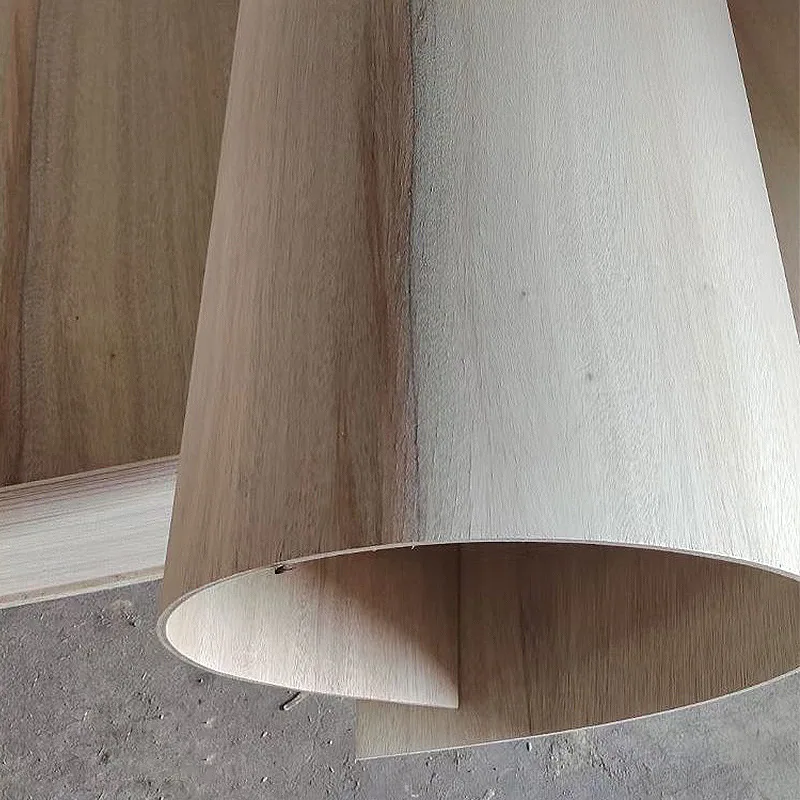
For a bent facing over shaped backing, start a material discussion with flexible plywood, checking the construction, bond, facing and designer’s requirements for concrete service. For flat closures or adjacent planar faces, explore film faced shuttering plywood. A preformed shell needs its own drawing and confirmed manufacturing scope; flexibility alone does not make a complete concrete form.
Define the diameter at the concrete-contact face
State the required formed diameter and identify the surface to which it applies. For a round column, the inside of the form defines the concrete outside diameter. The outside of a plywood shell is larger because the shell has thickness. A measurement taken across the external supports describes something else again.
Include column height, any taper, construction joints, openings and local details such as a capital or base transition. A cylindrical body and a tapered column should not share an undifferentiated “round form” drawing.
Show the permitted dimensional variation and the inspection method. A single diameter measurement does not establish roundness along the entire height; the project needs a defined way to check shape and alignment at the relevant locations.
Choose the curved-facing arrangement
A preformed curved plywood shell, a facing fitted over shaped backing and a metal-faced round-column system are different products. They can have different joint arrangements, support needs and reuse conditions. An ordinary flexible sheet is not automatically a complete concrete form.
A round-column shell and an adjustable curved-wall system are different assemblies. Use the radius, support and joint requirements for the intended column or wall; a capability quoted for one system does not define the other.
Our flexible-plywood guide explains bending direction and construction. For concrete work, add the necessary facing, bond and load-related requirements rather than specifying flexibility alone.
Use circumference to understand the drawing
The circumference of a circular concrete face is π times its diameter. That geometric relationship is useful for interpreting a drawing, but it does not establish the developed cutting length of a plywood blank or the finished dimensions of a moulded shell.
| Measurement | Example or meaning | Use in the enquiry |
|---|---|---|
| Formed diameter | 600 mm at the concrete-contact face | Defines the intended concrete size |
| Full inner-face circumference | π × 600 ≈ 1,885 mm | Geometric arc length at that surface only |
| Half inner-face circumference | π × 600 ÷ 2 ≈ 942 mm | Arc length for half the inner surface, before joint details |
| Blank or shell dimensions | Depend on construction, forming method and joint allowance | Must be shown on the manufacturing drawing |
For a bent blank, inner and outer fibres follow different radii, and the material construction affects forming behaviour. For a preformed shell, tooling and final machining introduce their own dimensional requirements. Neither should be ordered simply by cutting a flat sheet to the inner-face circumference.
Detail the seams, restraint and backing
Identify the number and location of vertical seams, any horizontal joints and the connection detail at each. A tongue, groove, overlap or sealed butt joint has a particular geometry; those names do not by themselves establish the joint's pressure resistance.
Show how the facing is restrained and supported, including the designed closures, bands, ribs, frames or other components actually used. The appropriate arrangement is system-specific. A universal band spacing cannot be inferred from a column diameter or an 18 mm thickness label.
Mark the intended joint line on any architectural finish drawing. Joint position, alignment and grout sealing influence the visible surface. Keep the structural restraint detail separate from any tape or seal used to control leakage.
Select the panel for the designed pressure conditions
The formwork design must address the fresh-concrete conditions and the complete assembly. Panel material, curved geometry, support arrangement and connection behaviour work together. A statement that a sheet is waterproof or flexible does not establish an allowable concrete pressure.
Specify substrate construction, bonding requirements, finished thickness, surface treatment and any relevant mechanical evidence. If the proposal changes from a preformed shell to a bent facing on ribs, review the support and connection assumptions as well as the material price.
Our formwork specification guide provides a material checklist. Where the project requires a special lay-up or a particular forming method, provide that requirement explicitly instead of relying on the trade name “cylindrical plywood.”
Choose the surface and release treatment
The facing finish, seams, fastening details and release treatment all contribute to the concrete appearance. Define whether the surface will remain exposed, be painted or receive another finish. A sample casting can help align the required appearance before committing to the full facing quantity.
APA's concrete-forming guidance discusses panel maintenance and release-agent application between uses. A smooth coated face should not be assumed to require no release treatment; follow the specified panel and treatment combination.
Check release-agent compatibility with both the facing and any subsequent concrete coating. A plywood shell alone does not establish faster curing or a defect-free concrete finish. Those outcomes depend on conditions beyond the facing material.
Protect the curved geometry through reuse
Stripping timing and the opening sequence belong to the project and system instructions. For subsequent use, inspect the seams, panel edges, coating and shape before reassembling the form. A shell that has sprung out of shape needs assessment against the dimensional and support requirements.
Arrange storage supports to suit the curved component and protect the working surface. Identify how nested shells are separated, restrained and handled so their own weight or packaging does not damage edges or distort the shape. Storage instructions for flat sheets should not be copied unchanged onto a curved assembly.
Keep repaired pieces identifiable. Our formwork-care guide covers general facing protection; the shell drawing supplies the additional geometry-specific requirements.
Share the form section to define plywood supply
Start with a round-form section showing the formed diameter, height, facing and backing. Tell us whether you are buying facing material, machined parts or a curved component so we can establish the available manufacturing scope.
Add quantities by diameter and the casting stages when available. For replacement parts, show the joint, shell thickness and support reference that control fit; we can then discuss dimensional criteria and packing for the proposed supply.
Send us your cylindrical-formwork drawings or email sales@plywoodsupplier.cn. We can discuss suitable panel options against the specified construction and confirm the scope before quoting.
Buying plywood for cylindrical forms
Can I order a blank using the concrete circumference?
The inner-face circumference helps interpret the drawing. The manufacturing dimensions also depend on material construction, forming method and joints, so supply a section and dimensioned part drawing.
Can you quote a complete cylindrical form?
Send the drawing and identify the required supply. We can discuss plywood materials or parts and confirm any curved-component scope; supports, restraint and complete-system requirements need their own specification.