
Where plywood wood comes from matters when your project specifies a species, source or origin record. Start with the board or appearance you want, and tell us which sourcing requirements belong in the order. We manufacture plywood and MDF substrates in Jiangsu, China, and help connect the selected face and core with the relevant material information; harvest, processing and dispatch locations describe different stages.
Birch plywood sheets Decorative plywood Poplar plywood
Identify the origin information your project needs
| Location | What it describes | What it does not establish alone |
|---|---|---|
| Natural species range | Where the identified species occurs naturally | Where a particular shipment was harvested |
| Harvest location | Where the supplied wood was grown and cut | Where it was converted into plywood |
| Manufacturing location | Where the identified processing took place | The origin of every face and core veneer |
| Dispatch location | The warehouse or port used for shipment | The forest source or species identity |
These distinctions are useful even for a straightforward order. An invoice address, a port name and a botanical map answer different questions. Decide which information is required before asking for a general origin certificate.
Use species-level references for geographic distribution
Broad names such as birch, ash and elm cover different species. A distribution statement for one member of a genus should not be transferred to every wood sold under the same common name.
For example, Kew records Manchurian ash, Fraxinus mandshurica, across parts of the Russian Far East, China, Korea and Japan. It is an ash in the family Oleaceae, not a willow. That botanical identification is more precise than an ambiguous translated trade name.
Kew's record for Betula pendula includes a broad temperate distribution, while its record for Ulmus pumila identifies a native range extending from Central Asia to southern Siberia and Korea, including parts of China. These examples illustrate distribution; they are not declarations of the wood used in our products.
Understand native ranges and planted resources
A tree can be planted outside its native range, so a natural-range map is not a complete map of potential commercial supply. Equally, a recorded occurrence does not establish that there is a harvestable resource of the size and grade a veneer mill needs.
For a plantation claim, ask for evidence tied to the actual material source. The useful information concerns the supplied lot and its traceability, not only a general description of a species as fast-growing or widely planted.
Do not assume that plantation origin automatically provides uniform veneer quality, a particular environmental claim or a fixed delivery time. Site, tree material, management, harvesting and conversion all affect what becomes available to the panel manufacturer.
Follow the material form through trade and processing
The raw material may move as logs, green veneer, dry veneer or a prepared core. A plywood factory can therefore receive material whose earlier processing happened elsewhere. The relevant record should identify the form received and connect it with the product being supplied.
FAO's forest-product classifications distinguish product categories used in statistics and trade reporting. Read the category definition before treating a national production or trade figure as evidence of local log supply.
A country may produce finished plywood using imported veneers. A large plywood output therefore does not prove an equally large domestic resource of the face species. Similarly, a veneer export does not necessarily represent the same volume or grade as a finished-panel order.
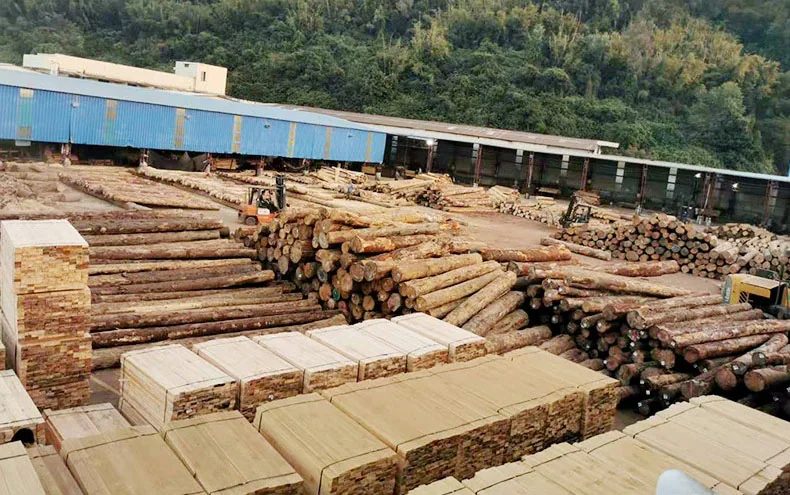
Record face and core sources separately when required
A decorative face can be a small part of the total wood volume while being the most visible part of the product name. In a mixed-core panel, the inner layers may include more than one permitted species or supply source.
If origin matters to the project, specify whether the requirement covers all wood, the decorative face or another defined part of the construction. Ask how mixed input lots are connected to the finished batch. Avoid wording that makes a face-only statement sound like a claim about the whole panel.
Our wood-selection guide explains the different layer roles. Our species-identification guide addresses the separate question of what a wood sample can establish.
Connect source records with the chosen panel
A useful evidence file links the product description, supplier and material-lot references, relevant source records and the finished batch. Check that names, dates, quantities and processing stages agree rather than relying on an isolated document with an impressive heading.
Certification has a defined scope. FSC describes chain of custody as tracking eligible forest-based material through processing and distribution. Where an FSC claim is specified, check the applicable product and transaction evidence; the presence of a company certificate does not automatically describe every board it sells.
For destination-specific sourcing requirements, state the required evidence in the enquiry and confirm its applicability to the shipment. Botanical references are background information, not a replacement for transaction-level documentation.
Plan supply around the selected material
Commercial availability depends on more than the presence of trees. The usable species, log dimensions, veneer grade, permitted sourcing route, conversion capacity and transport arrangements all influence what can be supplied.
Ask for a dated quotation against a defined construction and quantity. If a source change is proposed, identify which layer is affected and whether appearance, machining, mass, bonding or documentation needs re-evaluation.
Keep geographical preference separate from a claim that one country always produces better plywood. Compare the actual construction and supporting evidence. A familiar country name cannot resolve an unspecified core or an unsuitable bond requirement.
Start with the board and source requirement
Start with the panel or wood appearance you want and any source requirement in the project brief. We help identify whether it concerns the face, core or all wood, then develop the dimensions and quantities for your order.
Also state whether the question concerns harvest location, veneer manufacture, final panel manufacture or dispatch. This avoids answering a forest-origin question with a shipping-port address.
We manufacture plywood and MDF substrates in our own factory in Jiangsu, China. Send us your material and origin requirements so we can discuss the proposed construction and the relevant evidence together, with each claim tied to the part of the product it actually describes.
Plywood material sources buying questions
Does the manufacturing country identify where every veneer grew?
Manufacture and harvest are different stages. If your project needs origin information, tell us whether it covers the face, core or all wood so the enquiry addresses the right materials.
Can I choose a wood appearance before confirming the source details?
Yes. A photo or sample can establish the appearance you want. Share any source requirement at the same time so it stays connected with the construction being considered.