
Functional wood panels combine a suitable core with the surface, shape or performance your project needs. Choose plywood, MDF or another construction around the component: a routed door, moisture-exposed cabinet, acoustic lining or decorative panel. Our factory manufactures plywood and MDF substrates and applies facings and custom processing. Start with the use, a photo or a drawing; we can develop the panel choice and a useful sample from there.
Moisture-resistant MDF Acoustic MDF panels Fire-retardant MDF
Choose the core for the part you are making
| Panel | Basic construction | Useful selection question |
|---|---|---|
| Plywood | Cross-laid wood veneers bonded into sheets | Which layup, bond and face grade fit the use? |
| MDF | Refined wood fibres formed with binder | Will the face or routed edge need a fine finish? |
| Particleboard | Wood particles consolidated with binder | Is a flat laminated furniture part the intended use? |
| Solid wood panel | Solid pieces or strips joined into a panel | How will natural movement and appearance be managed? |
Trade descriptions sometimes call laminated particleboard “plywood” or call MDF a “density plate.” That can make a quotation look comparable when the hidden core differs. Ask for a cut-edge photograph and construction details. Our MDF material guide explains why a smooth face does not settle load, moisture or emissions.
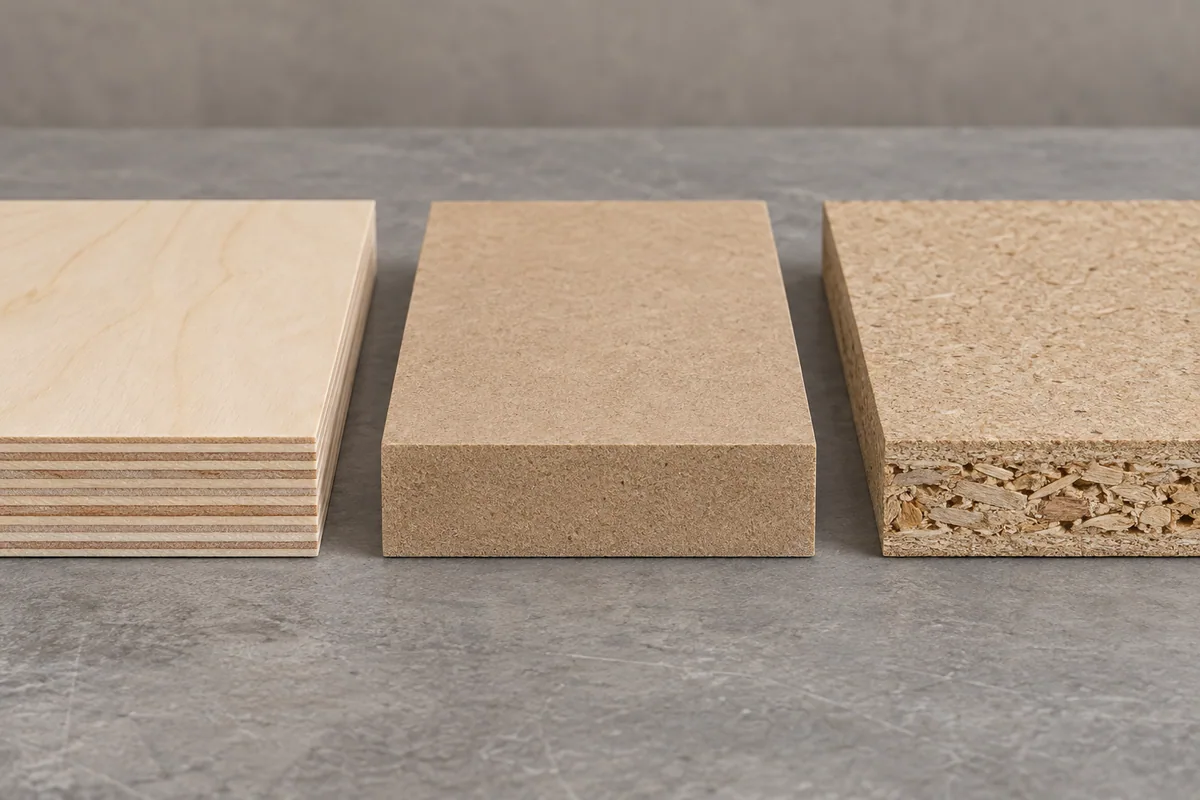
Choose the surface and substrate together
Choose wood veneer, melamine paper, film overlay or paint for the appearance and surface behaviour you need. Match that finish to a core selected for strength, water response and formaldehyde requirements. Two white melamine-faced sheets may have MDF and particleboard cores; recording face, core, reverse and edge keeps the intended construction clear.
For a routed cabinet door, an MDF substrate may be worth considering because the profile can be machined in the fibre core. For a visible wood wall panel, veneer plywood may better match the required appearance. For concrete formwork, a film-faced plywood construction is a different system. Compare proposed specimens and drawings rather than rely on the word “board.”
Moisture-resistant is a defined use choice
Ask whether the part faces dry air, humid air, occasional splashes or persistent wetting. These are different exposures. BSI’s EN 636 overview distinguishes plywood for dry, humid and exterior conditions. A moisture-resistant MDF or plywood still needs appropriate cut-edge and joint treatment; neither should be described as universally waterproof.
A casual soak is not a substitute for a defined moisture-performance test and may damage the sample without establishing its suitability. Use the grade and applicable standard, then test a representative component detail if the installation is critical.
Fire classification needs the tested product or assembly
“Fireproof board” is an unsafe shorthand for wood-based products. If the project requires reaction-to-fire performance, name the classification and test scope. BS EN 13501-1 explains classification using reaction-to-fire test data. The thickness, coating, mounting and substrate in a report may limit where its result applies.
A decorative high-pressure laminate surface and a flame-retardant-treated plywood core are not the same construction. Nor does a red, green or dark core prove fire performance. Ask for documentation that matches the panel being quoted and the intended installation; do not infer safety from appearance.
Sound absorption is not the same as sound isolation
A perforated or slotted panel can be part of an acoustic wall or ceiling system, often with a backing and cavity. Its performance depends on hole pattern, backing, mounting and test arrangement. ISO 354 describes reverberation-room measurement of sound absorption. It does not by itself certify that a wall blocks sound between rooms.
For a theatre or meeting room, the acoustic designer should state the frequency range and target, then request data for the proposed full system. A flat unperforated plywood sheet should not be sold as “sound absorbing” merely because it is wood. The same caution applies to thermal, antibacterial or insect-resistant marketing claims.
Compare environmental information for the selected board
Environmental ratings and emissions values need a defined standard and test method before they can be compared. A useful requirement names the destination, panel construction, emission test, wood-origin claim and any EPD requirement. ISO 12460-1 is one defined panel emission method, while FSC chain of custody addresses a different, sourcing question.
For a project that asks for an EPD, check the declared unit and product scope. ISO 21930 covers construction-product EPD rules. None of these documents substitutes for a structural, fire or acoustic specification.
Start with the function and develop the panel
Start with a component photo or the function you need. We can develop that into a purchase line such as: “Interior cabinet door, finished 18 mm nominal, routed edge, painted face, dry use, hinge drawing attached, destination emission requirement named, quantity and packing destination.” If acoustic treatment is needed, add the tested system and target; if fire classification is needed, add the required class and document scope. This lets us quote the right construction rather than offer a vague “multi-function board.”
Approve a physical sample showing face, reverse and cut edge. For shipment, check dimensions, face defects, core condition, labels and documents against the agreed line. We describe each claimed function only to the extent the proposed product and evidence support it.
Functional panel questions
Can one sheet be moisture-proof, fireproof and acoustic?
Some systems address multiple requirements, but each function needs its own evidence and installation scope. A trade name proves none of them.
Is melamine board always MDF?
No. Melamine-faced boards may have different cores. Check the substrate.
Does a green-coloured core prove environmental performance?
No. Colour is not a test or certified claim.