
Discuss plywood adhesives and bending stiffness through the performance your component needs. Send the part drawing and its intended exposure to compare a suitable panel construction with us. Adhesive connects the veneers so the layers can transfer load; the result also depends on wood, lay-up and service conditions. This guide helps you compare bonding evidence and glue-spread trials while keeping the finished panel at the centre of the decision.
Structural plywood constructions Compare panel options
Connect bond quality to the panel your part needs
During bending, adjacent layers need to transfer forces through their interfaces. An ineffective bond can allow separation or relative movement and change the panel response. Improving a deficient bond is therefore a different task from changing the stiffness of an already sound construction.
The USDA Wood Handbook chapter on adhesive bonding describes the interaction between adhesive, wood surfaces and bonding conditions. Successful bonding depends on more than the cured adhesive considered in isolation.
For a meaningful comparison, retain the same veneer species, layer sequence, finished thickness and conditioning. If a trial also changes compression or veneer quality, its bending result cannot automatically be credited to adhesive selection.
Match the bond requirement to the application exposure
Specify the bonding performance needed for the product and service environment, together with emission requirements where applicable. Adhesive families such as UF, MUF or PF contain different formulations and processing requirements. Compare the finished-panel evidence for the selected formulation and construction.
Ask which resin, hardener, filler and mixing basis were used when interpreting a development result. Record the supplier's applicable processing instructions and the finished-panel evidence. A change of formulation can require reassessment even when the broad resin family remains unchanged.
For purchasing, a practical question is whether the report covers the ordered panel construction and required conditioning. Our boiling-resistance test guide explains why a test exposure must be read with its method, rather than reduced to a general waterproof label.
Define what the glue-spread number actually measures
Before comparing g/m² values, establish whether they describe wet mixed adhesive, dry solids or a particular resin component. Also establish the area basis: one coated face, both faces together or one completed bond line. The same printed number can represent different applied quantities.
| Hypothetical mixture | Wet spread on the same area basis | Solids by mass | Applied dry solids |
|---|---|---|---|
| A | 150 g/m² | 50% | 75 g/m² |
| B | 200 g/m² | 35% | 70 g/m² |
The calculation is wet spread × solids fraction: 150 × 0.50 = 75, while 200 × 0.35 = 70. These assumed values demonstrate reporting arithmetic, not recommended production settings. Higher wet spread has not produced higher applied solids in this example.
Applied solids still do not directly specify the final bond-line thickness, retained quantity or performance. Formulation and transfer matter. Use the measured solids content of the actual mixture when that is the reporting basis, and keep the same denominator throughout the comparison.
Review coverage, assembly and cure together
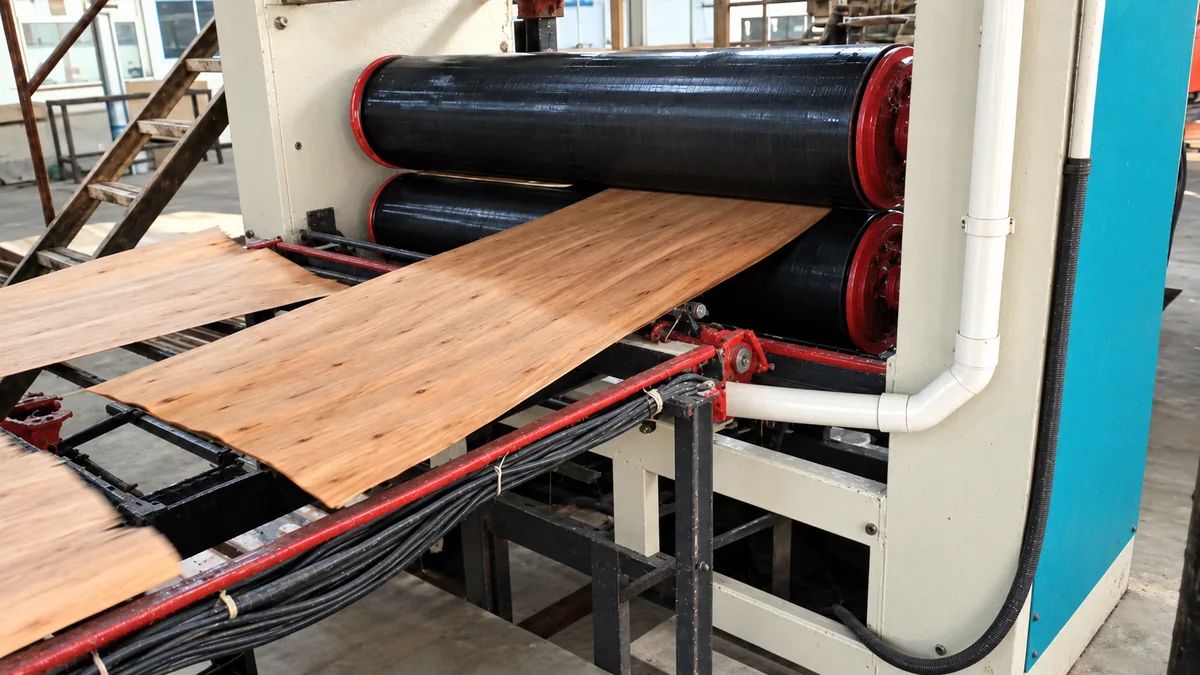
A mean application rate can conceal uneven coverage across a sheet. Inspect the transfer pattern and investigate dry areas, contamination, damaged veneer surfaces or gaps. A complete record includes how and where the spread was measured, not just the target set on the application equipment.
Insufficient retained adhesive can leave a starved joint, while excessive application is not a dependable remedy for poor contact or an unsuitable surface. Penetration, assembly time and cure conditions interact with wood moisture and temperature. The relevant window must be established for the actual adhesive system and construction.
Increasing pressure or extending pressing time should not be treated as an automatic improvement. See our prepress and hot-press guide for the separate roles of contact, handling and cure.
Set a clear outcome for the adhesive comparison
Define the decision first: maintaining required bonding performance while reducing application, resolving a recurring bond defect or comparing candidate systems under a stated exposure. These are different experiments and may require different response measures.
A 2021 study on 9 mm birch plywood investigated adhesive consumption, pressing pressure and holding time together using a designed experiment. Its results belong to that specified material and experimental range; they do not establish a glue-spread table for every plywood thickness.
Keep material identity, mixing records, actual spread, assembly timings and pressing records with each trial panel. Record actual finished thickness and density, because a process change can also change the geometry or compression state. Our process-trial guide covers comparisons and repeatability.
Measure bond quality and bending response separately
EN 314-2 defines bonding requirements, whereas EN 310 addresses apparent bending modulus and bending strength. Neither result should be substituted for the other.
| Response | Record with the result |
|---|---|
| Bonding assessment | Glue-line selection, conditioning, failure observations and applicable acceptance basis |
| Bending modulus | Direction, specimen dimensions, span, conditioning and test method |
| Bending strength | Failure load, calculation basis and observed failure mode |
| Production consistency | Independent trial panels, within-panel variation and repeat-run results |
Retain individual observations as well as averages. A good average can conceal a glue line or panel position that fails the specified requirement.
Interpret an improvement without overclaiming its cause
If bond results improve but bending modulus changes little, the trial may have improved bond reliability without materially changing panel stiffness. If bending changes while bond results remain similar, check thickness, orientation, conditioning and veneer allocation before assigning the difference to the resin.
Also examine how the specimens failed. Wood rupture, interfacial separation and mixed failure provide different information, although the applicable method governs their formal assessment. Use the full set of representative results when assessing the proposed construction.
Start with the component and its service conditions
Send the component drawing or intended application and describe its service exposure. We can discuss the panel construction and bonding requirement, then plan a representative sample. Add any specified emission or bending requirement and an approved reference when the project needs to match an existing construction.
Use our enquiry form with the sizes and quantity you have for pricing. Our production specification guide connects the finished-panel agreement to measurable process records, while the stiffness guide covers thickness and support decisions.
Practical buying questions
Do I need to choose a resin before asking for a quotation?
Start with the application, service exposure and any required bonding result. We can discuss the panel construction and process around that finished-product requirement.
What should accompany a sample used for comparison?
Keep the sample identity, construction, actual thickness and relevant conditioning with the assessment. That helps distinguish a bonding change from a change in veneer arrangement or geometry.