
Start choosing MDF or HDF with the furniture you want to make and the finish you want to achieve. A painted routed front, a decorative shelf and a bathroom cabinet can need different core and finishing details. We manufacture MDF substrates and apply decorative facings in our factory, helping connect the grade, weight, finish and custom sizes. Use the comparisons below to turn a project photo or idea into a practical board choice.
Plain MDF Moisture-resistant MDF Melamine MDF Veneered MDF
Begin with the manufacturing family
Fibreboard is a broad family of panels based on fibres. The relevant standard distinguishes the product family and its requirements. EN 622-5 covers dry-process boards, MDF; other parts of the EN 622 series address other fibreboard families. Do not assume every hard, dense fibreboard is the same construction as the MDF used for a routed cabinet front.
When a supplier uses a local trade name such as density board, ask which product standard and manufacturing description it refers to. A photograph of the surface cannot settle that classification. State the requested grade in the order documents so the same terminology is used by purchasing, production and inspection.
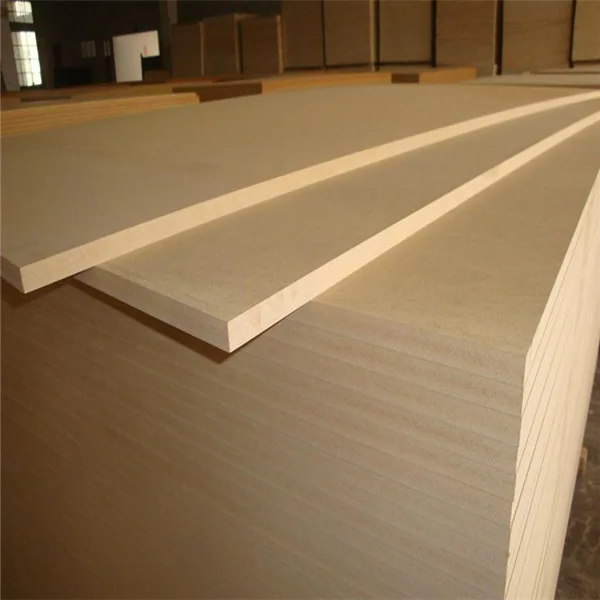
Compare MDF, HDF and lightweight options
Density terms describe a material characteristic or product family within a stated classification system. A commercial HDF label does not, by itself, establish flooring suitability, structural capacity or humid-use performance. Likewise, a lightweight MDF product is not automatically a thermal or acoustic insulation panel.
Ask for the declared density range and its measurement basis if weight or machining behaviour matters. Avoid applying one universal set of density boundaries to products specified under different systems. Our density and sheet-weight guide explains how a density figure can be used without turning it into a quality ranking.
Compare MDF and HDF for the same component
Compare named boards with the same declared end use, nominal thickness and component dimensions. A flooring-core HDF offer and a board for a routed cabinet front are not interchangeable simply because both use wood fibres. Keep each product's standard, use grade and declared density together; use the density and sheet-weight guide to assess the mass of the actual size you need. A higher density figure alone does not establish better edge machining, a compatible coating or adequate fixing performance.
Use a representative profile, joint or hardware detail from your component drawing to compare the candidates at the supplied stage. Agree the tooling, preparation, finish and measurement points using our sample guidance; record dimensions, fit, edge condition and surface appearance. Match any required grade and emission evidence to each named construction, then carry the selected board and sample reference into the order specification. We can quote the agreed full sheets, cut blanks or machined parts with the remaining workshop work clearly identified.
| Purchasing question | Keep the comparison consistent | Record for each named board |
|---|---|---|
| Weight and handling | Same component dimensions, supplied stage and stated mass or volume basis | Declared density and its measurement basis, or measured supplied-part mass; include facing and machining where supplied |
| Routed edge and finish | Same profile, preparation and intended finish system | Identified routed and finished sample: edge detail, surface appearance and fitting dimensions |
| Joint and hardware | Same fixing, hole detail, support and intended duty | Trial with the intended hardware; relevant joint or mechanical-property evidence with its test method, specimen dimensions and conditioning |
| Moisture conditions | Same service exposure and agreed test and conditioning basis | Declared use grade and relevant moisture-performance reports with method and specimen thickness; dated moisture readings recorded separately |
| Processing and quoted scope | Same finished dimensions, quantity, supplied stage, packing and delivery basis | Included operations, remaining workshop work and comparable price basis for each proposal |
Choose the offer that meets your component's essential requirements with a clear scope of supply. Keep its named board reference and accepted sample in the order and in the receiving check. If a proposed substitute changes the grade, thickness, facing or machining stage, review the affected details and update the accepted references before it enters the order.
Name the standard and edition
The official Chinese standards record identifies GB/T 11718-2021 as the current MDF standard, replacing GB/T 11718-2009. Where that standard is specified, use the applicable product type and requirements from the stated edition. Do not copy an older category name into a current order without checking its meaning.
A Chinese standard and a European standard should not be treated as identical because both concern MDF. Test methods, product types, thickness groupings and conformity rules must be compared explicitly. For an export order, confirm the destination and project requirements before deciding which documentation is appropriate.
Separate the classification axes
| Description | What it concerns | What it does not establish alone |
|---|---|---|
| Dry-process MDF | Manufacturing family and product-standard scope | The finish or every required performance level |
| Higher or lower density | Mass per unit volume | Waterproofing, load capacity or a universal quality grade |
| Dry or humid use | Declared service conditions and associated grade | Unrestricted exterior or immersion suitability |
| Load-bearing type | Product category for a defined structural use | A ready-to-use capacity for any component |
| Fire-specified board | Documented fire performance within a defined scope | The classification of every coating and mounting arrangement |
| Melamine-faced or veneered | Decorative surface construction | The underlying core grade or emission result |
Distinguish dry interiors, humid conditions and exterior systems
Identify the actual service environment: protected furniture, a humid interior, local splashes, weather exposure or persistent wetting. These conditions are different. When asking for waterproof MDF, describe where moisture reaches the part. Tie the chosen moisture-resistant grade to the application and include protection for machined edges, openings and joints.
EPF's specialty-grade overview describes MDF products developed for different requirements. Use these distinctions to connect the application with its grade. For exterior use, include the intended exposure, finishing and installation details when choosing the panel construction.
Separate a product grade from a design calculation
A board intended for load-bearing use still needs design information appropriate to its application, thickness, supports, fixings and service conditions. EN 622-5 expressly distinguishes its product-property requirements from characteristic values used for design calculations. Do not use a conformity-table number as an allowable shelf or floor load.
Furniture also needs component-specific evaluation even when it is not a building structure. A dense door can overload an unsuitable hinge arrangement, while a wide shelf can require additional support. Specify the component's dimensions and use alongside the board grade.
Keep special properties independent of colour
Green or red colouring may help identify a manufacturer's product, but colour itself does not prove moisture or fire performance. Request the product identity and relevant evidence. If more than one property is required, such as humid-use suitability and a fire classification, establish that the same proposed construction meets both.
Emission requirements also belong on their own line with the test method and destination criteria. Neither natural-looking fibres nor a particular resin name proves a compliant finished panel. Use our fire-specified MDF guide where fire evidence is part of the brief.
Add the finish and format after the core classification
Choose raw, melamine-faced, wood-veneered or another specified finish and define the reverse face and edges. Then add the required sheet size, thickness, machining and tolerances. A raw humid-use board and a melamine-faced dry-use board solve different requirements; the decorative face does not silently upgrade the core.
For purchasing options, our MDF range guide compares the finishes we can discuss. This classification article provides the vocabulary needed to describe the underlying board accurately.
Turn your MDF choice into a panel order
Send your furniture idea, a photograph or the finish you like through our enquiry form. We help select the core grade and surface, then develop sizes, quantity and destination for a quotation.
Compare our raw and custom-size MDF, melamine MDF and veneered MDF. Add any specified standard or performance requirements as the order develops so the sample, documents and supplied parts remain connected.
MDF grades and finishes buying questions
Can I choose the finish before knowing the grade?
Yes. Bring a colour, veneer or painted-finish idea and tell us the use. We help pair it with the appropriate core and finished-edge detail.
Does higher density always make the better furniture panel?
Choose for the component. Weight, routing, hardware, moisture conditions and finishing all matter; a representative sample makes the comparison more useful.