
We manufacture fireproof MDF for interior panels, joinery and furniture, with custom dimensions, surfaces and machining. Share what you want to make, a drawing or a photograph. Our factory team can help choose the board, develop the finish and prepare sheets, cut blanks or finished components.
Fire-retardant MDF Grooved MDF designs Fireproof plywood alternative
Choose the board for your design
MDF’s fibre-based construction suits smooth painted surfaces, profiles and repeatable machined details. Start with the finished component and the work you want our factory to complete.
| Application | Product to explore | Useful choices to discuss |
|---|---|---|
| Painted lining, joinery or furniture part | Fire-retardant MDF | Thickness, finished dimensions, edge profile and coating. |
| Decorative grooves or perforations | Grooved MDF or perforated MDF designs | Pattern, borders, backing and finish developed on the selected fire-retardant MDF. |
| Veneer-based panel construction | Fireproof marine plywood | Veneer layup, visible face, fastening and moisture conditions. |
We manufacture both MDF and plywood, so the comparison can follow your design and workshop needs. The MDF fundamentals guide explains the fibreboard construction in more detail.
Set the dimensions and physical properties
Specify the finished part size and thickness, allowing for any veneer, adhesive and coating added to the substrate. Include the dimensional tolerance that matters to a frame, fitting or adjoining panel. Our fire-retardant MDF can be developed in custom thicknesses and formats; the quotation records the agreed construction.
| Property | Why it matters to the part | Information to share |
|---|---|---|
| Thickness and density | Fit, handling and machining | Finished dimensions and preferred weight. |
| Internal bond and bending | Core integrity and component design | Profiles, supports, span and intended load. |
| Thickness swelling | Suitability for the indoor conditions | Humidity, cleaning and edge exposure. |
| Fixing performance | Reliable assembly of the selected part | Fasteners, pilot holes and mounting detail. |
EN 622-5 specifies dry-process MDF requirements. Its product-property values support material selection; component design uses the relevant design data. We coordinate the chosen grade, physical properties and fire requirement for the intended use.
Plan surfaces and machining
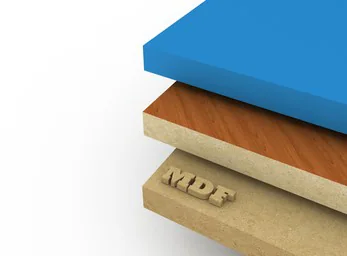
We can develop painted, veneered, grooved or perforated components from your design. Mark the visible face, reverse, exposed edges and part orientation. For grooves, include width, depth, spacing and start or stop positions. For perforations, show the pattern, unperforated borders and fixing locations.
Choose the supplied stage around your workshop: raw sheets for your own processing, machined blanks ready for finishing, or finished parts. Agree the surface preparation, edge sealing, facing adhesive and coating sequence. The US Forest Service fire-safety chapter describes treatment-specific performance considerations; the selected MDF and finish instructions guide our production plan.
For an acoustic MDF panel, include backing, fabric, cavity and support with the pattern. Keep the acoustic requirement with the finished system and its relevant information.
Develop a routed wall panel and sample
For a painted wall with vertical grooves, send the elevation and desired joint rhythm. We can plan the groove layout across adjoining panels, edge returns and fixing borders. Include the remaining board thickness beneath the deepest groove and any reverse machining in the drawing.
A useful sample includes the broad face, deepest routed detail, exposed edge and one joint. Review paint appearance, edge preparation, dimensions and fit under the intended lighting. Where hardware is involved, trial the actual fitting and pilot-hole detail on the selected MDF. Retain the accepted sample, material identity and drawing revision as the production reference.
Include the indoor-emission requirement
Tell us the destination and requested emission method or limit for the MDF and supplied finish. ISO 12460-1 describes a chamber method for measuring formaldehyde emissions from wood-based panels. We keep the material identity, method and relevant results with the proposed construction.
Veneer adhesives and coatings belong in the finished-part specification too, including products your workshop will apply after delivery. Our MDF emissions guide explains how panel information supports that selection. The fire and emission requirements can then be coordinated for the same finished component.
Coordinate the fire specification
Bring the project’s required standard, full classification and document list into the selected MDF specification. EN 13501-1 addresses construction-product reaction-to-fire classification, considering end use. ISO 11925-2 is a small-flame ignitability method. Keep the specified method and result together when reviewing the panel information.
The relevant MDF records identify the substrate, thickness, treatment, exposed finish and permitted mounting. For grooves or holes, include the geometry, remaining section and backing so the finished construction can be considered within the appropriate scope. Fire information for plywood stays with that plywood construction; MDF has its own material and report identity.
A material’s reaction-to-fire information and a wall or door’s fire-resistance duration address different requirements. For a rated assembly, keep the complete framing, joints, backing and fixings with its supporting documents. We help connect the MDF component and supplied finish with that project detail.
Prepare your factory quotation
Start with the use, drawing or photograph, approximate quantity and destination. Add known dimensions, finish and machining. Our team can help develop the remaining choices and plan a sample.
The production quote identifies sheets, blanks or finished components, quantities by configuration, agreed tolerances and relevant documents. Separate trial pieces and matching spares in the quantity plan. Include face and edge protection, part labels, pack limits and timing so the delivery suits your workshop or site.
Fireproof MDF buyer questions
Do you manufacture fire-retardant MDF yourselves?
Yes. We manufacture MDF in our own factory in Jiangsu, China and can develop custom thicknesses, dimensions, surfaces and processed components for your interior project.
Can you help when I only have a design photo?
Yes. Share the photo, intended use and approximate size. We can help turn the appearance into a board, profile and finish proposal, then develop a sample and quotation.
Can I order painted or veneered fireproof MDF?
Yes. Tell us the colour or veneer and exposed edges. We can plan the facing, adhesive, coating and machining together, with the project requirements kept with the finished construction.
How do I choose MDF for a humid interior?
Describe the humidity, cleaning and edge exposure. We will help coordinate the moisture grade, physical properties and sealing with the fire requirement for that component.
What documents should accompany my MDF order?
Share the project’s requested fire and emission information. We help assemble the relevant material identity, technical data and reports for the selected thickness, finish and use, alongside the order reference.
What should the sample include?
Choose the detail that decides your next step: the routed profile, perforation border, painted edge, veneer joint or actual fitting. Keep the accepted material and finish reference for production.