
MDF furniture quality depends on the board grade, finish, edges and fittings selected for the job. MDF can be a useful choice for painted fronts, decorated cabinet parts and interior furniture; its name alone does not establish emissions or moisture performance. We manufacture both MDF and plywood substrates in our own factory and help you compare them for the part you want to make.
Bring a furniture photograph, drawing or finish reference. We help turn familiar sales claims into useful choices about the core, surface, sample and delivered cost.
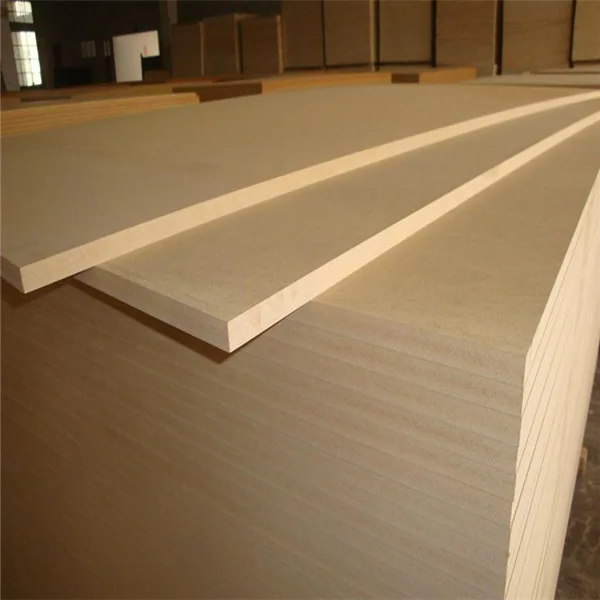
Plain MDF for painted parts Melamine MDF for furniture Natural veneer MDF
MDF and emissions: compare the actual product
Comparing MDF and particleboard by the apparent size of wood pieces or the presumed amount of glue does not establish a finished panel's emissions. Different binders, processes and grades exist within each family. A meaningful report identifies the product, test method, result and applicable requirement. Our MDF emissions guide explains why odour and generic “E0” language are weak substitutes for product evidence. UK HSE also distinguishes MDF board constituents from dust generated during machining; these are separate exposure questions.
What “solid wood particleboard” means
Particleboard is an engineered board made from particles bonded under heat and pressure; “solid wood” in a marketing phrase does not convert it into a plank cut from a log. The European Panel Federation describes particleboard's particle construction. MDF is a fibreboard, while plywood is a veneer-layered panel. Ask for a cut-edge sample and the exact core name beneath any melamine, paint or veneer. A real wood veneer face also does not make the entire panel solid timber.
Choose the MDF grade for the room
Dry-use MDF is a poor choice for uncontrolled wetting, particularly at raw edges. The blanket statement still ignores defined humid-use grades. EPF describes MDF.H and MDF.HLS for different humid-use roles. A bathroom cabinet specification also needs cut-out sealing, edge finishing and leak management. A green-coloured core is not enough evidence of a grade because colouring practices vary; check the product description and document. Repeated direct water contact remains a different service condition.
Density: balance weight and component performance
Average density can affect weight, machining and some mechanical behaviour, but the density profile through a panel, binder and grade matter too. EPF explains property testing, including density and screw-withdrawal assessment. A heavy board is not automatically suitable for a long shelf, and a lighter board is not automatically defective. For a shelf or hinge, examine the relevant property and sample assembly. Compare equal thicknesses for the same intended use, using the relevant property data and a representative assembly.
Check the finished edge as well as the face
A smooth face helps painting, but it says little about a raw cut edge, humidity grade, screw holding or emissions. Melamine paper may make different substrates look identical on the surface. EPF notes that facing and back balance matter for melamine-surfaced MDF. Check both faces, thickness, edge finish, hinge bore, sample assembly and product documents. A decorated surface can conceal the core; an edge view is often more informative than a showroom photograph.
| Sales phrase | Question to ask | Useful evidence |
|---|---|---|
| Eco board | Which product and emission method? | Product-specific report |
| Solid wood particleboard | What is the actual core? | Construction and cut edge |
| Waterproof MDF | Which grade and wetting condition? | Grade document and edge detail |
| High density means strong | Which load and fixing property? | Property data and part test |
| Perfectly smooth | How are edges and reverse finished? | Full component sample |
Compare the cost of the finished furniture part
Machining, finishing, edge banding, hardware, rejection and transport contribute to the delivered cost. A low substrate price can disappear when a routed door needs repeated filling and coating. For humid interiors, include the appropriate substrate grade alongside the decorative facing. Request comparative quotations for the same drawing, dimensions, finish, quantity and destination, then inspect samples. Our component-level MDF versus plywood guide helps structure that comparison.
Keep the useful details with your sample
Record the component, substrate type, grade, thickness, surface on each side, edge and hole treatment, hardware, service environment and reports. For adjacent decorative parts, add a colour or grain reference and permissible variation. Keep reports linked to the relevant production lot or documented product range. If an offered construction differs from the approved sample, reconcile it before the order is confirmed.
Start with the furniture you want to make
Start through our enquiry form with a drawing, photo or description of the furniture. We help complete the finish, environment, sizes, quantity, destination and required documents. We can discuss our melamine MDF, veneered MDF or raw MDF against that part. For the design risks after the core is chosen, read our MDF trade-off guide.