
A Comprehensive Guide for Contractors and Building Material Buyers
Concrete construction is one of the most material- and labor-intensive sectors in building projects. Among all the components, formwork accounts for 35%–60% of the total cost of reinforced concrete structures, according to multiple construction management studies. This includes the cost of materials, labor, installation, and removal. A seemingly small decision, such as choosing the right plywood, can significantly impact project costs, timelines, and concrete surface quality.
Among various formwork materials—steel, aluminum, plastic, and timber—film faced plywood is one of the most widely adopted solutions globally. Its popularity stems from cost-effectiveness, ease of handling, surface quality, and reusability. However, not all plywood is created equal. Differences in veneer quality, adhesive bonding, phenolic film coating, and core construction can directly influence durability, safety, and efficiency.
To help buyers make informed decisions, here are five common mistakes to avoid when purchasing film faced plywood.
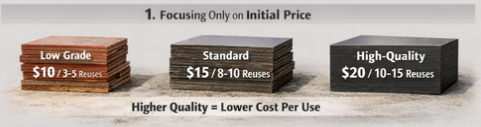
1️⃣ Focusing Solely on Initial Price
It is tempting to choose the cheapest plywood available. However, initial price rarely reflects total project cost. Low-grade boards may save money upfront but often result in:
Shorter reuse cycles (3–5 uses)
Higher risk of cracking or warping under wet concrete pressure
Additional labor for surface corrections and panel replacement
Data example: For a mid-rise building requiring 1,000 m² of slab formwork:
Plywood Type Reuse Cycles Total Material Cost (Estimated)
Low-grade 3–5 $15,000+
Standard 8–10 $12,000
High-quality 10–15 $10,500
Insight: High-quality panels may have a higher unit price but reduce cost per use and minimize project delays.
Practical tip: Calculate the cost per expected reuse cycle, not just upfront cost, before making a purchasing decision.
2️⃣ Ignoring Phenolic Film Surface Quality
The phenolic film coating is critical for:
Moisture protection
Concrete release
Wear resistance during repeated pours
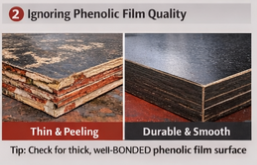
Boards with thin or poorly bonded film can result in surface peeling, rough concrete finishes, and reduced reuse cycles.
Industry benchmark: High-quality film faced plywood typically has 30–50 µm phenolic coating, heat-pressed to provide durability for 8–15 pours.
Practical tip: Request sample panels and test a small concrete pour to inspect surface finish.
3️⃣ Overlooking Core Veneer Structure
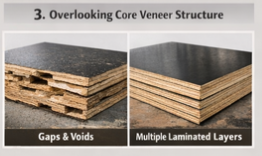
The plywood core is the backbone of the panel. Cross-laminated, uniform veneers provide dimensional stability and load-bearing capacity.
Poorly constructed cores may contain gaps, uneven veneer thickness, or weak bonding points.
Under wet concrete, weak cores can bend, crack, or fail, posing safety risks and increasing material waste.
Data insight: Panels with 7–9 cross-laminated layers typically withstand up to 0.8–1.0 kPa pressure per cm² without deformation, compared to 4–5 layer panels which may deform under 0.5 kPa.
Practical tip: Inspect cross-section samples or request technical datasheets from suppliers.
4️⃣ Not Considering Adhesive Bonding Performance
Concrete formwork plywood is exposed to moist, alkaline, and outdoor conditions. Boards glued with low-quality adhesives risk delamination and structural failure.
Recommended: WBP (Weather and Boil Proof) phenolic resin adhesives
Avoid: generic glues not rated for repeated water exposure
Technical insight: WBP-bonded panels can maintain strength and adhesion for 8–15 reuse cycles, whereas non-WBP panels often fail after 3–5 uses.
5️⃣ Underestimating Reuse Cycles
Reusability is a key factor in determining long-term cost efficiency.
Plywood Type Typical Reuse Cycles Practical Implication
Low-grade 3–5 Frequent replacement, higher labor cost
Standard film faced 8–10 Cost-effective for most projects
High-quality formwork 10–15 Optimal for repeated pours, lower total cost
Practical tip: Track the actual performance of plywood on-site and align your purchase volume with expected reuse cycles.
✅ Choosing the Right Film Faced Plywood
Selecting reliable plywood requires evaluating:
Veneer quality and core structure
Phenolic film durability
Adhesive bonding performance
Expected reuse cycles and site conditions
Recommendation: Work with suppliers who provide technical datasheets, reuse cycle guarantees, and consistent production quality.
At CUZI Industry, we specialize in manufacturing high-performance film faced plywood for concrete formwork, optimized for durability, smooth surface finish, and repeated site use.
Film faced plywood may seem like a simple material, but its quality directly affects construction efficiency, concrete finish, and total project cost. Avoiding common purchasing mistakes and focusing on structural performance and reusability can save contractors both time and money.