
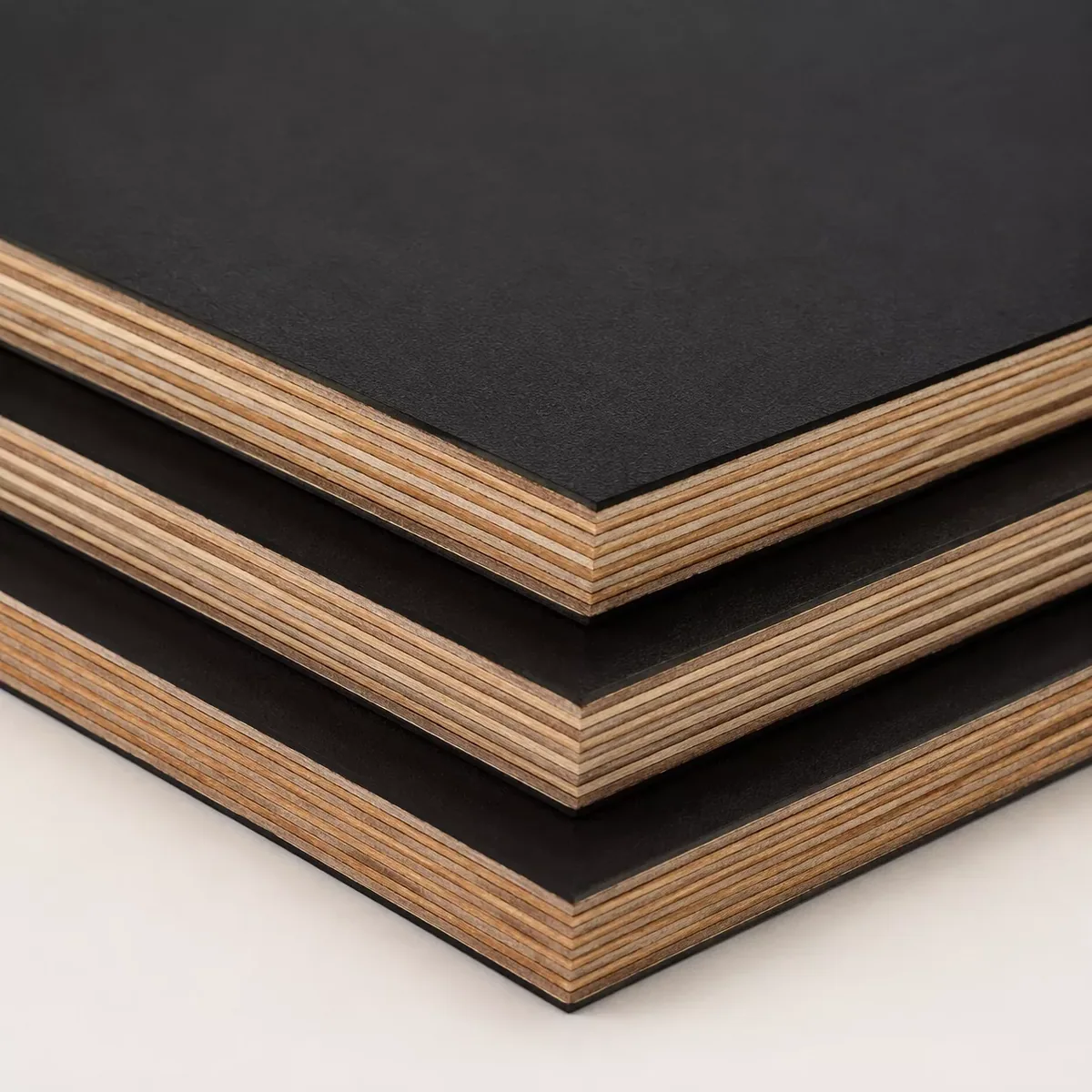
Melamine plywood gives cabinets, shelving and furniture a decorative face that is easy to coordinate with everyday use. Choose the colour and texture you like, then consider sliding objects, spills, cleaning and exposed edges. We manufacture the plywood core and apply decorative facing in our factory, helping bring the surface, reverse and finished edge into one sample and quotation. The test report below supports a closer review of the identified facing.
Melamine faced plywood Black melamine plywood Woodgrain melamine plywood
Identify the actual surface and substrate
A melamine-faced board uses decorative resin-impregnated paper on a wood-based substrate. EN 14322:2021 concerns interior melamine-faced boards; the scope shown by BSI names fibreboard, particleboard and sandwich-board substrates. When a plywood product is offered under the broader trade label “melamine plywood,” first verify its substrate and the relevant surface test basis rather than assume every EN 14322 claim applies unchanged. Our melamine plywood range should be compared by full construction.
Abrasion is not the same as a scratch
A cabinet shelf sees repeated sliding of objects; a door might receive a single hard scratch. These are different damage mechanisms. EN 14323:2021 gives test methods for melamine-faced board characteristics. Ask for the result and product identity relevant to the quoted décor. Keep the tested texture and overlay identified when comparing surface performance for a proposed decor.
Review the tested 18mm facing before choosing your decor
Our SGS report identifies two 18mm natural hardwood plywood configurations: A with melamine paper facing and B with film paper facing. It includes abrasion testing to ISO 7784-2:1997, impact resistance, bonding checks and formaldehyde results, with the configurations identified in the document. Start with the A configuration when reviewing melamine plywood for furniture or cabinetry. Include the decor, texture, reverse face and finished edge in your enquiry so the report and your component requirements stay connected.
Choose the surface for spills and cleaning
For furniture, ask which household liquids and cleaning agents may touch the surface, at what concentration and contact time. A stain result is not an approval for strong acids, alkalis or industrial solvents. Test an approved sample using the cleaning method required by the project and follow the surface maker's care instructions. If the project is a laboratory or industrial fit-out, specify its chemical-resistance requirements separately; do not rely on a generic “corrosion-proof” claim.
Heat and repeated cleaning need their own scope
Hot pans, appliances and steam near a kitchen door are not the same as ordinary room temperature. The furniture designer should define expected heat and cleanability; we can match surface evidence to a proposed panel where available. A smooth face may be easy to wipe, but abrasive pads can damage gloss and texture. A woodgrain print or dark colour may show scratches differently from a light matt surface, so inspect the actual décor in use conditions.
Include cut edges and openings in the moisture plan
When a panel is cut for hinges, shelf supports or a sink, the exposed core and glue lines become possible moisture paths. Specify edge banding or coating and check the edge finish on a sample. The Wood Handbook explains moisture movement in wood panels; a durable decorative face does not make wood dimensionally inert. A bathroom or washroom installation also needs a leak-control and maintenance plan.
| Claim heard | Useful question | Acceptable basis |
|---|---|---|
| Wear-resistant | Which abrasion test and level? | Result for the proposed facing |
| Scratch-proof | What scratching load or rating? | Test with stated method |
| Corrosion-proof | Which chemical, contact and cleaning? | Project-specific stain/chemical evidence |
| Waterproof | Are all edges and holes protected? | Core grade and finished detail |
Compare melamine facing with HPL
High-pressure laminate (HPL) is a separate sheet material with its own classification, often bonded to a supporting substrate. EN 438-3 describes HPL sheets intended for bonding. A melamine-faced panel should not be priced or tested as HPL solely because both are decorative surfaces. Compare total construction, edge design and relevant results.
Plan your melamine plywood order
Send a furniture photo, decor reference or intended use through our enquiry form. We help choose the plywood core, face and edge combination, then develop dimensions, quantity and processing for a quotation. Add any wear or cleaning requirements when you have them. Our furniture-finish comparison helps match the surface to the project.
Melamine plywood buying questions
Can a melamine face be repainted like unfinished wood?
It may need special preparation and a compatible coating; test adhesion rather than assume ordinary paint will hold.
Does both-side facing prevent warping?
Balanced facing helps, but core, moisture, storage and furniture design still affect flatness.
Will one test report cover any colour?
Only within the report's stated product scope; confirm the proposed décor.