
The right plywood subfloor gives your wood flooring a base that suits its layout and installation method. Start with the room, floor plan or renovation photo. Our factory makes plywood and custom panel parts, and we help develop the panel sizes and construction around your project. The sections below connect support, joints, flatness and moisture with the flooring manufacturer’s fixing or bonding instructions.
Structural plywood for subfloors Custom panel sizes
Identify which installation method the floor requires
| Method | What is connected | What to establish before work |
|---|---|---|
| Floating click installation | Flooring elements lock together above the supporting surface | Compatible underlay, movement clearances and whether any joint treatment is specified |
| Joint-glued floating installation | Specified tongue-and-groove joints are bonded; the floor remains separate from the base | The permitted joint adhesive and its application location |
| Full-surface bonding | The underside of the flooring bonds to the prepared substrate | Flooring and substrate compatibility, adhesive coverage and moisture preparation |
| Mechanical fixing | The flooring attaches to a suitable supporting base with specified fasteners | Base construction, fixing schedule and any separately required adhesive |
A tongue-and-groove edge does not automatically mean full-surface gluing, and a click profile does not settle every installation option. Read the instructions for the product code on the delivered packs. Do not infer hidden water-activated glue from a manufacturer describing a floor as glue-free.
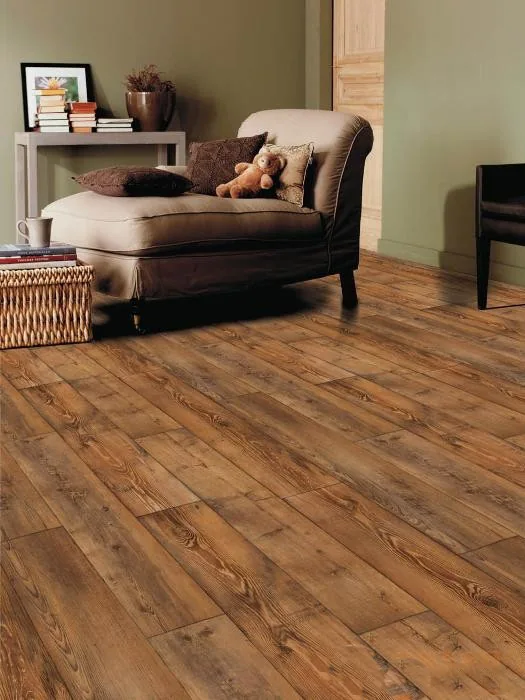
Check the product-specific permission to bond
The selected flooring system determines whether the floor floats, clicks together or bonds to the substrate. Use the installation method permitted for the actual range rather than applying one method to all laminate floors.
Keep the current flooring instructions and adhesive data sheet together. If a contractor proposes a different method, resolve that substitution with the relevant manufacturers before installation. A stronger adhesive does not make a prohibited installation method suitable.
Describe both sides of the bond
Identify the flooring underside: solid timber, a plywood-backed engineered plank, another wood-based core or a treated backing. Then identify the substrate: cementitious screed, calcium-sulphate screed, plywood, existing tile or another surface. Include primers, levelling compounds and old residues in the description.
The adhesive is attached to the surface it actually touches. For example, a floor bonded over a weak skim coat relies on that coat as well as the adhesive. A plywood panel with a factory film is a different bonding surface from bare sanded veneer.
For plywood subfloors, establish the panel grade, support and fixing before specifying the finish above them. Our tongue-and-groove plywood subfloor guide addresses that supporting layer. Flooring adhesive cannot correct an inadequately supported or loose base.
Separate adhesive durability from moisture control
A cured adhesive's resistance to water is different from its ability to control vapour arriving from a screed. It is also different from protecting flooring joints against spills from above. Treat these as separate requirements in the installation plan.
Specify the moisture test method and the acceptance limit required by the chosen system. A handheld reading without an identified method cannot be compared directly with a limit obtained using a different test. Record where and when the tests were taken and which substrate they represent.
Use the applicable adhesive instructions for substrate preparation, moisture assessment and curing. Where the system needs a barrier or primer, include the compatible products in the installation specification.
Specify application by coverage and adhesive transfer
For full bonding, use the required trowel or application system and the specified working time. Spread an area the installer can cover before the adhesive loses the ability to transfer properly. A large spread area may look productive while leaving the final boards poorly bonded.
During installation, check representative lifted boards for the contact required by the adhesive manufacturer. Examine areas near the edge of a spread and any substrate depressions. Keep enough adhesive available for the specified consumption; a lower rate is not a saving if the bond is incomplete.
Distinguish open time, positioning time and the time before traffic, sanding or heavy loading. A skin on the exposed adhesive is not proof that the installed bond has cured. Use the actual site temperature and humidity when applying the product's instructions.
Keep movement and heating details in the assembly
Leave the flooring's specified movement spaces at walls, columns, thresholds and other fixed elements. Do not fill a required movement joint with rigid glue merely to make it look closed. Check how skirtings, kitchen units and door trims interact with a floating floor.
For underfloor heating, obtain the permitted floor build-up and the commissioning and restart procedure. Include the thermal resistance of the flooring and any underlay. A flexible adhesive label alone does not establish compatibility with every heating system or temperature cycle.
Use product documents and a compatibility trial
Buy a clearly identified adhesive with a current technical data sheet, safety data sheet, shelf life and storage history. Odour is not an emission result, and touching wet adhesive does not measure bond performance. Follow the product's handling requirements.
When the substrate or finish is unfamiliar, arrange a representative compatibility trial with the adhesive supplier. Check adhesion, surface staining and the permitted method of cleaning squeeze-out. An untested solvent can damage a prefinished plank even if it removes the adhesive.
Plan the plywood for your wood floor
Send a room plan, site photo or the floor you want to create through our enquiry form. We help develop the plywood construction and panel schedule. Add the flooring instructions and project design as they become available, then confirm dimensions, quantity and destination for pricing.
For the installation materials, our marine and wood-floor adhesive comparison explains the different bonding jobs. Use the laminate flooring selection guide to compare finished flooring.
Plywood subfloors buying questions
Does every wood floor need glue?
The flooring system determines the method. Floating click floors, joint-glued floors, full bonding and mechanical fixing connect the layers differently; use the instructions for the selected product.
Can you help before I have a panel schedule?
Yes. Start with the room or floor plan and proposed flooring. We help develop the plywood panel choices and sizes around the project requirements.