
Plywood is made from bonded wood veneers, MDF from refined fibres, and particleboard from bonded wood particles. Plywood offers layered edges and wood faces; MDF suits painted profiles and decorative facing; particleboard is widely used for flat, faced furniture parts. Paint, veneer and melamine can give these cores similar-looking surfaces. We manufacture both plywood and MDF substrates ourselves and help turn your furniture or interior idea into a suitable panel and factory supply plan.
Plain MDF Melamine MDF for furniture Melamine-faced plywood
What is inside plywood, MDF and particleboard?
In plywood, thin veneers are bonded into a layered panel, commonly with the grain of adjacent layers running across one another. APA describes plywood's cross-laminated veneer construction. MDF is a dry-processed fibreboard made from refined wood fibres and binder; EN 622-5 defines MDF requirements. Particleboard uses bonded particles or chips rather than separated fibres. The US Forest Service separates veneer, fibre and particle panel families. The selected grade adds density, emission, bond and service-condition information to that core description.
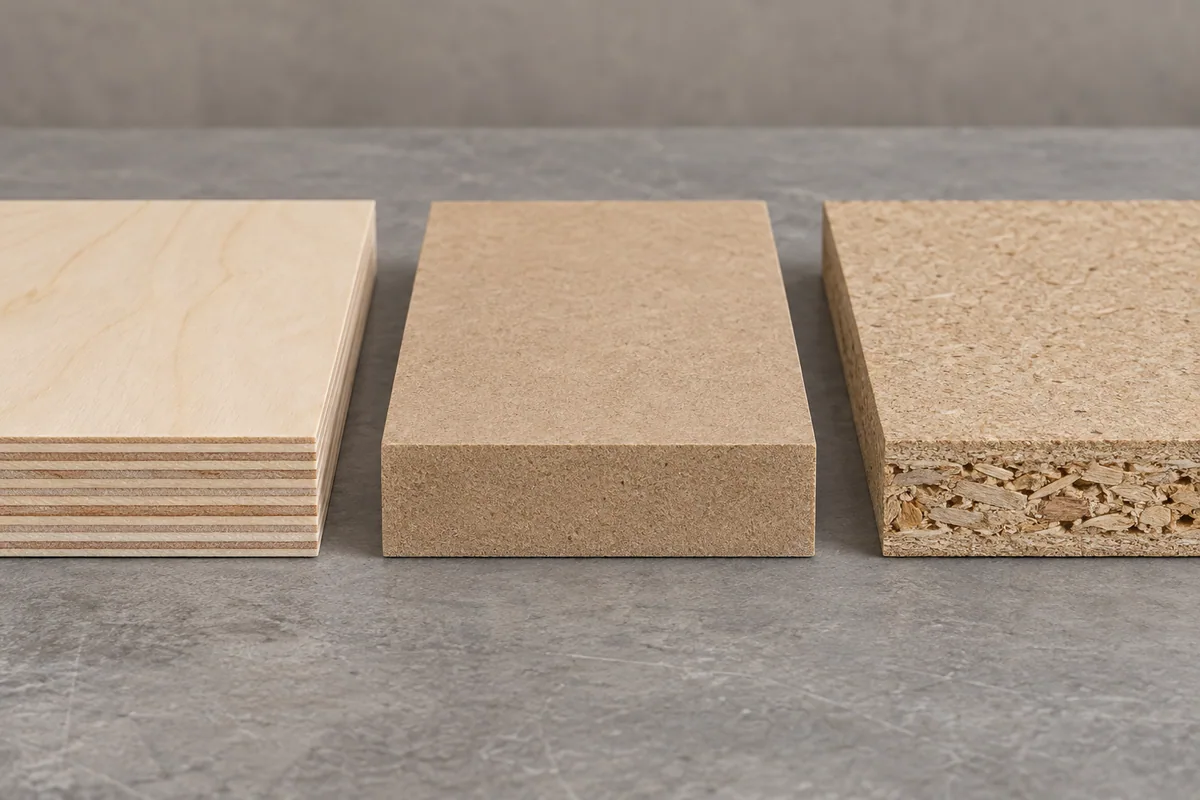
Choose the core and decorative face together
A sawn plywood edge usually shows veneers; MDF appears more uniform and fine-textured; particleboard shows coarser particles, sometimes with finer surface layers. The face may hide all three behind melamine paper, paint, veneer or another finish. A cut-edge photo and construction description help connect the chosen decor with its underlying board. For wood veneer facing, also distinguish the decorative species from the core species.
Match the service grade to the location
Plywood and MDF both offer grades for different service conditions, including suitable choices for interior cabinetry. EN 636 distinguishes plywood for dry, humid and exterior conditions. MDF also has different dry and humid-use grades under its relevant specification. Particleboard has its own grade system; a dry interior fitment board is not interchangeable with a humid-use or structural grade. Select the substrate and coating together. Describe the humidity, splashes, exterior exposure or loading relevant to the component and connect that use with the required product data.
Choose a core for the machining you need
MDF's fine, even structure is useful for routed profiles and painted faces, but edge preparation and dust control matter. Plywood can provide a visible layered edge and a veneer face, but machining may expose core gaps or splinter a face if tooling and grade are poorly matched. Particleboard often serves flat, factory-faced furniture parts economically, while its exposed cut edges need suitable edge treatment and fastener planning. We would sample the actual hinge bore, screw pattern or CNC cut rather than infer performance from a generic material label.
Connect panel properties with supports and fixings
A shelf's deflection depends on span, depth, load, panel thickness, support and grade. Fastener holding depends on the board, edge distance, screw and assembly detail. Compare the relevant properties for the candidate boards under the same conditions, with indoor humidity and outdoor exposure identified separately. The Wood Handbook covers moisture and mechanical behaviour of wood products; the project designer must use the specific product values where loads matter.
| Question | Plywood | MDF | Particleboard |
|---|---|---|---|
| What forms the core? | Bonded veneers | Refined fibres | Bonded particles |
| What should be specified? | Face/core species, bond, grade | Grade, density, machining | Grade, density, surface layers |
| What should be sampled? | Face and cut edge | Routed edge and fixing | Edge band and fixing |
| What is not implied? | Marine or exterior use | One universal density | One universal moisture class |
Review emissions and sourcing for the selected board
Connect emissions requirements with the adhesive system, finished construction, test method and destination. Review reports that identify the offered board and keep the method with the measured result. Our MDF emissions guide explains this distinction. Responsible fibre or timber sourcing is another question and should be supported by the chain-of-custody evidence applicable to the order, not inferred from board type.
Start with the component and finish
Write down the component, exposure, face finish, thickness, span, fixing, edge treatment, emission requirement and quantity. Then compare quotations for equal constructions. For a painted routed front, the MDF option deserves a fabrication sample; for a visible veneer face or layered edge, compare a specified plywood; for a flat laminated carcass, evaluate the specified particleboard and other substrates by grade and hardware. Our MDF-versus-plywood component guide takes that next step.
Compare candidate boards as the component you will actually buy. Keep the core and grade, both faces, finished thickness and edge details on the same drawing, then make a representative part with the proposed machining and hardware. Let the sample show the visible edge, routed profile, edge band or connection that matters to the job. Assess the remaining finishing or assembly steps under the intended conditions, and retain the relevant load, moisture and emissions information with the product documents for the selected construction.
Make the quotation clear about the supply stage: full sheets, cut blanks, machined parts or finished components. Identify the factory-applied faces, cuts, edge work and holes, together with any work and cost left to the buyer. Carry the accepted construction, drawing revision, sample reference and required document identity into the order, packing list and receiving check. This gives the workshop a clear record of the supplied panel and the operations included in its price.
Bring your panel idea to our factory
Share a furniture photo, sketch or finish idea through our enquiry form. We help choose the plywood or MDF construction, then develop dimensions, processing, samples and delivery around the actual part.