
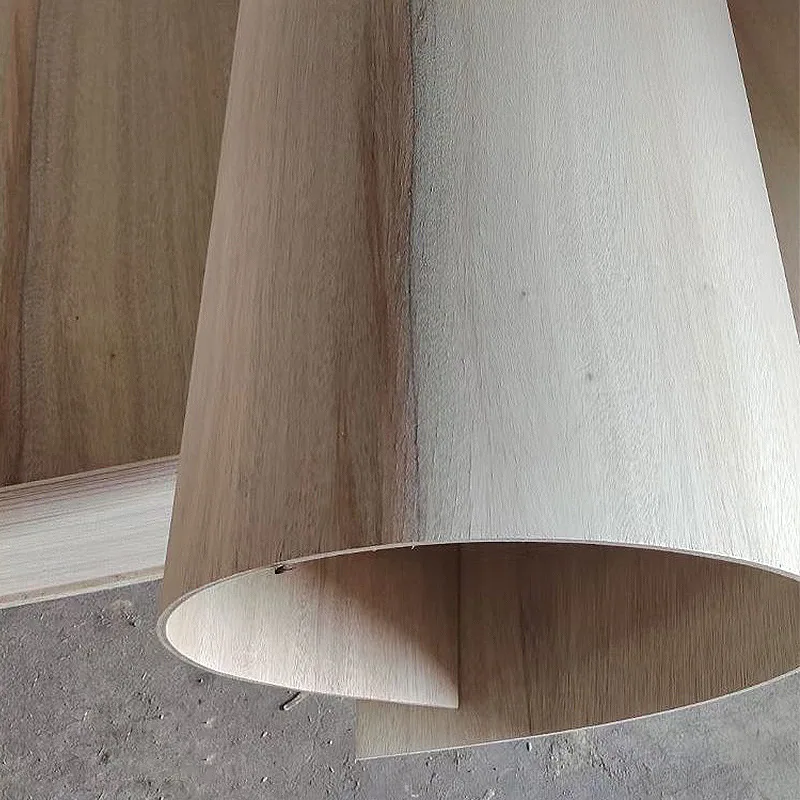
Flexible plywood helps create rounded cabinet ends, reception desks, column wraps and other curved interior details. Also called bending plywood or flexi ply, its veneer construction gives it a preferred bending direction. Start with a photo or sketch of the shape you want; our factory team helps choose the panel, facing and sample. A frame or laminated build-up holds the finished curve.
Flexible plywood Flexible MDF for curved details Decorative plywood faces
Why a bending panel behaves differently
Veneer species, ply thickness and grain arrangement affect bending. Ask for the offered construction and bending direction, then assess the intended radius on that material before adopting a radius from another panel.
Show which way you want the panel to bend
Mark the sheet edges, curve direction and cylinder axis on a sketch. A panel selected for one bending orientation cannot simply be rotated in the cutting layout. Our drawing and radius guide shows the information to include.
Start with the shape of your finished piece
A column wrap curves across its width while remaining straight along its height. A bowl or saddle shape changes curvature in two directions and needs a different forming assessment. A sheet that wraps a cylinder does not automatically form a spherical corner. The US Forest Service's curved-plywood guidance explains that compound forming depends on multiple material and process variables and requires exploratory trials. Send sections through the whole shape rather than one radius when the surface twists or tapers.
What holds the finished shape?
A loose sheet normally tends to recover when bending force is removed. It may be attached to a framework or bonded with other layers over a former to create a stable curved assembly. That assembly includes supports, adhesive, joints and possibly a decorative facing. The number of layers, curing process and springback affect the final geometry. The ease of bending a raw panel is therefore different from the strength or rigidity of the completed furniture part.
Compare ways to make a curved panel
Thin conventional plywood, kerf-cut panels, curved veneers laminated in a mould and flexible plywood may all produce curves through different methods. Kerf cutting removes material and creates a distinct edge and strength condition. Moulded plywood starts from a specified layup formed under controlled conditions. Aircraft plywood and structural curved roof panels belong to product and engineering requirements of their own. APA's curved-panel design publication addresses structural roof panels, not a blanket approval for decorative bending ply.
| Material or method | How curvature is obtained | Decisive check |
|---|---|---|
| Flexible plywood | Specialized veneer layup bends readily | Direction and trial radius |
| Thin conventional plywood | Existing panel bends within its limits | Product-specific forming suitability |
| Kerf-cut board | Machined cuts permit a curve | Residual section and reinforcement |
| Moulded veneer assembly | Layers bond in a curved form | Layup, adhesive and finished geometry |
Useful roles in furniture and fit-out
Rounded cabinet ends, reception-desk fascias, column casings, display units and stage scenery are practical subjects for a bending-plywood discussion. Specify the visible face and whether it will receive veneer, laminate or paint. The decorative skin may need a different minimum radius from the base panel. A cabinet end also needs edge protection and fixing details, while a column casing needs a secure support and access plan. Our application guide compares these scenarios.
Choose the construction for the room
Choose bonding, moisture suitability and emissions evidence for the environment where the finished curve will be used; flexibility is a separate material property. EN 314-2 addresses plywood bonding quality; flexibility itself establishes no bond class. Specify the actual interior environment and required product evidence, including any finished-assembly fire requirement. Match the chosen coating and veneer with that core specification and its supporting documentation.
Bring us your curved furniture idea
A photo or sketch is enough to start through our enquiry form. Tell us whether you are making furniture, a column casing or another interior feature. We help develop the inside or outside radius, bend orientation, supporting frame and decorative finish through our custom-dimensions service. Add curved dimensions, layer arrangement, quantity and destination as the design develops. Our forming-process guide explains the next fabrication decisions.
Flexible plywood buying questions
Can I begin without a measured radius?
Yes. Send a photo or sketch of the intended piece. We help identify the curve and bend direction, then agree measured geometry and a sample before production.
Will flexible plywood keep its shape on its own?
A loose sheet normally recovers after bending. The finished component uses a frame or bonded layers to hold its shape, which is why the complete sample matters.