Choose plastic-coated plywood for your formwork, lining or fabricated component, manufactured in our own factory in Jiangsu, China. We connect the permanent facing, plywood construction and finished details in one panel supply.
A photo, drawing or the dimensions you already know is enough to start. Tell us how the part is used and cleaned; we will help develop the facing, core, cut edges and fixings, with sheet or processed-part supply and a useful sample plan.
Order the working face and finished panel together.
Start with PP-faced plywood for reusable concrete formwork, or a PET, PVC or ABS decorative facing for interior parts. We’ll connect the surface you need with the plywood core, reverse and processing in one factory offer.
Plastic-coated plywood supply choices
Choose for your order
Our starting range
PP formwork route
Wear-resistant polypropylene facing, 0.5–1.2mm, with a phenolic WBP plywood core and the selected reverse. The PP specification includes a three-coat epoxy/polyurethane edge finish.
Decorative interior route
PET, PVC or ABS sheet facing, 0.35–0.8mm. Choose the colour, texture and sheen with the selected interior core adhesive and finished edge.
Plywood and facing attachment
Calibrated eucalyptus, birch or combi core. Select the facing application system and the internal veneer bond as separate parts of the panel configuration.
Thicknesses and sheet sizes
9, 12, 15, 18, 21 and 25mm in the technical-sheet range; 1220 × 2440mm or 1250 × 2500mm sheets. Send other part sizes for a cutting quotation.
Supplied processing
Full sheets, cut blanks or processed parts with the agreed holes, recesses, joints, sealing and fixing details. Mark finished dimensions on the drawing.
Surface and delivery reference
Working face, reverse, colour or texture, approved sample and temporary protection, with its removal stage and pack identification.
The PP formwork table lists 620–700kg/m³ panel density. Its loading guidance uses 650kg/m³, including approximately 34.8kg for an 18mm, 1220 × 2440mm sheet. Keep PP formwork properties with that configuration; decorative panels use their selected facing, core and surface requirements.
TECHNICAL DATA · TDS-PS-25 · Rev 2.0 (Oct 2026)
Plastic-Coated Plywood technical data
Choose the plastic-faced plywood route around the job: PP for reusable formwork, or PET/PVC/ABS decorative surfaces for interior parts. Specify the polymer and both faces with the plywood core. The PP wear and concrete-release figures below apply to the PP formwork configuration; decorative laminates carry their own surface requirements.
Open the complete coated-plywood specification, properties and loading tables
Declared values from our technical data sheet TDS-PS-25, Rev 2.0 (Oct 2026). The values for your order are confirmed in the quotation.
Thermoplastic Overlay Options
Type A: Wear-Resistant Polypropylene (PP, 0.5–1.2 mm) | Type B: Decorative PET/PVC/ABS Sheet (0.35–0.8 mm)
Overlay Bonding Process
High-temperature polymeric hot-melt fusion or 100% solids reactive PUR lamination
Plywood Substrate
Calibrated Eucalyptus, Birch, or Combi Multi-Ply Core
Core Adhesive System
Phenolic WBP (EN 314-2 Class 3 for PP Formwork) or E0/MUF (for Interior PET/PVC)
Standard Sheet Sizes
1220 × 2440 mm, 1250 × 2500 mm
Thickness Tolerance
±0.30 mm (EN 315)
Service Class / Exposure Duty
Service Class 2 & 3 (High-Reuse Concrete Formwork, Flight Cases & Waterproof Interiors)
Edge Sealing (PP Formwork)
3-coat waterproof epoxy/polyurethane edge coating
Length & Width Tolerance
±1.0 mm (EN 315)
Squareness
≤ 1.0 mm / m (EN 324-2)
Panel Flatness
≤ 1.5 mm / m (EN 315)
Reference Standards
EN 13986, EN 636-3, EN 314-2 Class 3, DIN 18215, ISO 9001
Harmonized System (HS) Code
4412.33 / 4412.39
PP formwork configuration — panel and surface properties
Total Panel Density, kg/m³
620 – 700 Test method: EN 323
Moisture Content of Wood Core, %
8.0 – 11.5 Test method: EN 322
Surface Overlay Bond Strength, MPa
≥ 1.25 MPa; cohesive wood failure with no overlay delamination Surface bond test: EN 311
Surface Abrasion Resistance (PP Overlay), mg loss
≤ 25 mg (≥ 2,000 revolutions without wear-through) Test method: ASTM D4060 (Taber)
No surface cracking around nails or screws Test method: ASTM D1004
Bending Strength — Longitudinal (MOR //), MPa
≥ 50.0 Test method: EN 310
Modulus of Elasticity — Longitudinal (MOE //), MPa
≥ 6,200 Test method: EN 310
Water Absorption of Plastic Face (24h), %
< 0.05% (100% waterproof face) Test method: ISO 62
Thickness, ply count, weight and container loading
Nominal Thickness
Ply Count
Area Weight
Sheet Weight (1220x2440)
Est. Load / 40HQ
9 mm
7 plies
5.85 kg/m²
17.4 kg
~1,540 pcs
12 mm
9 plies
7.80 kg/m²
23.2 kg
~1,155 pcs
15 mm
11 plies
9.75 kg/m²
29.0 kg
~924 pcs
18 mm
13 plies
11.70 kg/m²
34.8 kg
~770 pcs
21 mm
15 plies
13.65 kg/m²
40.6 kg
~660 pcs
25 mm
17 plies
16.25 kg/m²
48.4 kg
~553 pcs
The loading table uses 1220 × 2440 mm sheets at a 650 kg/m³ planning density and approximately 26.8 tonnes of net panels. Quantities are approximate; the selected construction, packing, container payload and route limits determine the final loading plan.
For PET, PVC or ABS interior panels, define the selected decorative face, core adhesive, surface duty and edge finish in that configuration. The PP formwork reuse and abrasion figures remain with the PP panel.
Start with the formwork, lining or part you are making. We can discuss the facing and plywood around its working conditions, then quote sheets or processed components with the required edges, holes and finished sizes. The schedule below helps turn your initial photo or drawing into a complete order.
Information to include in a plastic-coated plywood enquiry
Requirement
What to send
Application & supplied stage
Formwork, lining, furniture or another component; sheet, blank or processed-part requirement.
Plastic facing identity
Specified polymer, such as PP or PVC if required; coating, film or sheet, grade/reference and relevant construction details.
Facing interface & reverse
Facing-to-board bond or application system, surface preparation and the required material on each side.
Plywood construction
Face and reverse veneers, core species and layup, internal bonding requirement and relevant core acceptance.
Thickness & dimensions
Finished panel thickness, facing thickness where specified, sheet or part dimensions, tolerances and measurement stage.
Machining & edge details
Drawing revision, cut edges, holes, recesses, joints, fixing positions and required protection or finishing.
Match the working surface to formwork, linings or parts.
For formwork, compare the concrete finish and working sequence; for linings or fabricated parts, focus on contact, cleaning and the fitted detail. Define the result that matters to your application, then choose a representative panel sample and the relevant checks.
Concrete forming brief
Include the formwork design, pressure and support requirements, fixings, joints, contact face and concrete-finish acceptance. Review release, stripping, cleaning and the condition of edges and holes through the agreed trial sequence.
Specify contact, cleaning, abrasion or impact conditions that matter to the part. Include joints, fittings and the reverse, with the intended cleaner and maintenance method. Loading, traction or fire requirements need their own evidence.
Compare formwork panels against the same concrete-finish criteria. Keep each face’s use, cleaning, damage, repairs and replacement history together so the purchasing comparison reflects acceptable output under the actual working conditions.
Choose cleaning products and tools for the actual facing. Trial the proposed method on the selected panel before adopting it as the routine care procedure.
Compare the output your project accepts.
For each working face, record the panel identity, pour or use sequence, contact conditions and agreed finish criterion. Track acceptable output alongside cleaning, edge condition, repairs and any replacement. This gives purchasing a useful basis for comparing panel, handling and maintenance costs.
Our PP formwork technical sheet lists 30–50+ reuses without chemical release agent for its stated PP configuration. Use the selected panel, concrete-finish target and site working sequence to plan your trial and supply; keep these figures separate from the decorative PET, PVC and ABS route.
For interior linings and fabricated parts, compare the intended contact, cleaning method, surface appearance and fitted detail. Include any required loading, traction or fire performance in the configuration and document request.
NAME WHAT COVERS THE WOOD
Choose the permanent facing for your working surface.
Share the surface reference or material requirement you have. We identify the permanent polymer and its coating, film or sheet construction, then compare colour, texture and the intended use on that basis. PP, PVC and resin-impregnated paper facings each retain their own material description.
Distinguish the facing constructions in a comparison
Description
Identity to establish
Identified polymer facing
Actual polymer and grade, coating or laminated film/sheet, any reinforcement or surface treatment and connection to the plywood.
Phenolic paper film
Resin-impregnated paper overlay. This is a different construction from an identified PP/PVC film or sheet.
MDO / HDO
Resin-impregnated fibre overlays with their own product and use specifications; not a substitute description for a PP facing.
Melamine paper / HPL
Identify the decorative paper system or separately manufactured laminate sheet, substrate and bond; a shared decor does not make them equivalent.
Name the permanent facing and its grade on the material schedule, then add the colour, texture, sheen and working-side requirements. Keep the plywood’s internal adhesive separate from the facing description so the quotation identifies both.
Keep any reinforcement or top treatment, facing-to-board application system and veneer construction with the selected surface. For solid plastic, plastic-core composites or PVC-membrane MDF, use the corresponding panel specification when comparing samples and prices.
TWO BONDS · TWO SIDES
Review the facing and plywood as one delivered panel.
Keep the permanent facing, its interface and the plywood veneers together in the panel brief. We identify the facing-to-board system and internal veneer bond separately, alongside the layup, reverse and finished thickness, so purchasing and production share one complete reference.
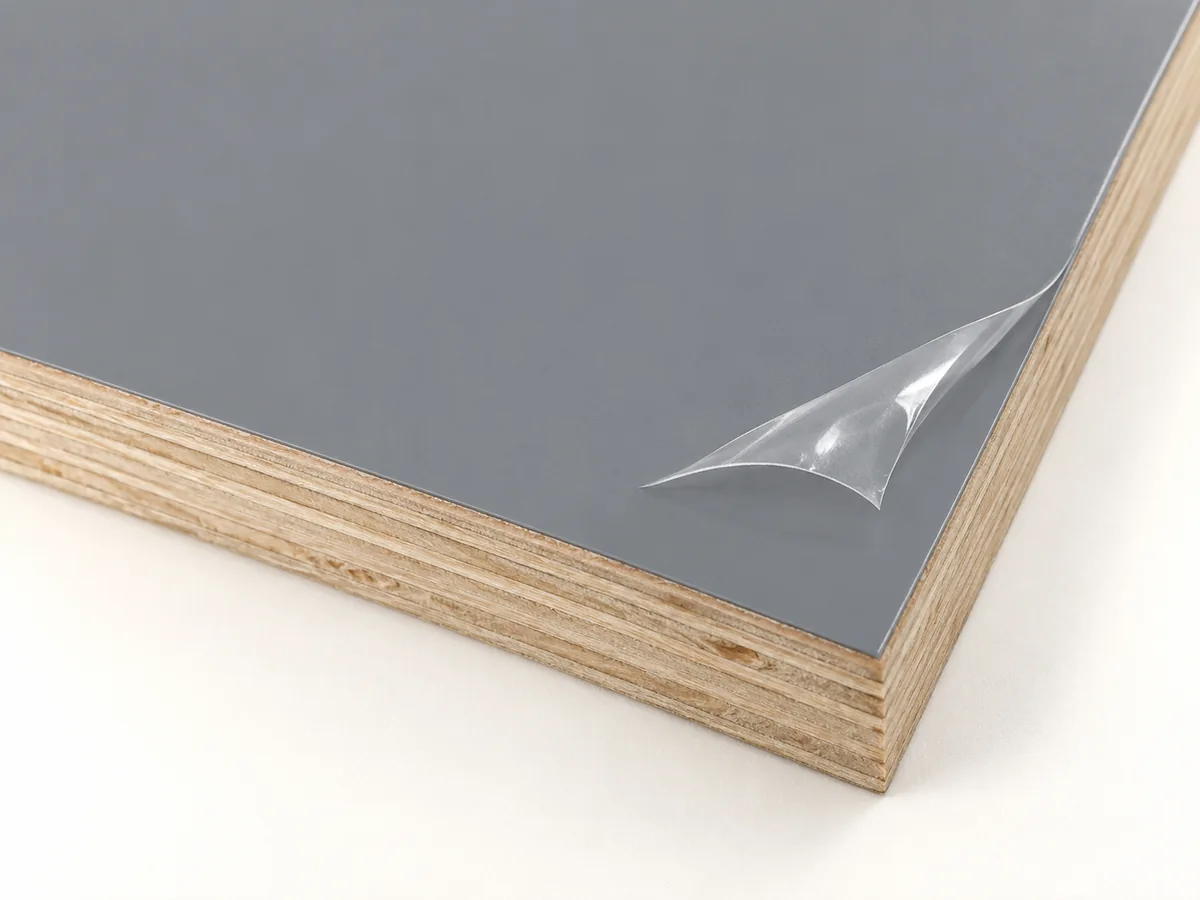
Permanent grey facing and separate clear handling protection at a plywood corner.
Keep handling protection separate from the working face.
The clear film is lifted above an intact opaque face in this view. Name temporary protection and its removal stage separately from the permanent facing, then compare the completed surface and thickness at the stage used by your drawing. The actual material and application reference identifies the polymer and interface.
Fields in the panel build-up
Specification fields only. Blocks do not show actual layer thickness, veneer count or a required adhesive layer; the application system is identified for the proposed product.
Details after processing
Locations show the details to identify, without dimensions or a protection method. Include the actual cut, hole, joint and fixing arrangement.
Choose the working side and reverse arrangement: the same facing on both sides, a different reverse or another defined build-up. Review a complete panel after the planned application and processing to assess flatness and the delivered condition.
Record any temporary protective film separately from the permanent facing. Include its removal stage and handling instructions. If the facing includes a top treatment, texture or reinforcement, retain the relevant product reference with the sample.
Measure the panel at the stage your drawing uses.
Specify the completed permanent-panel thickness after facing and pressing, with its tolerance and measurement method. Include the plywood, permanent working faces, reverse and any interface contribution in that finished requirement. The selected application system determines whether there is a separate bond layer.
Record temporary protective film separately, including its removal stage. Measure the permanent panel for a frame or fitting after removing protection as instructed. A dispatch measurement through the protective film serves a different handling check.
Retain the supplied construction and actual finished measurements with the drawing. This keeps facing thickness, press effects and any final machining connected to the fit your assembly needs.
Get the edges, holes and fixings ready for your assembly.
Send the critical edge, recess, hole or fixing with your drawing. We can develop the proposed panel and processing around that detail, with its edge treatment and handover stage included in the quote. A representative processed sample helps your workshop review fit and finish.
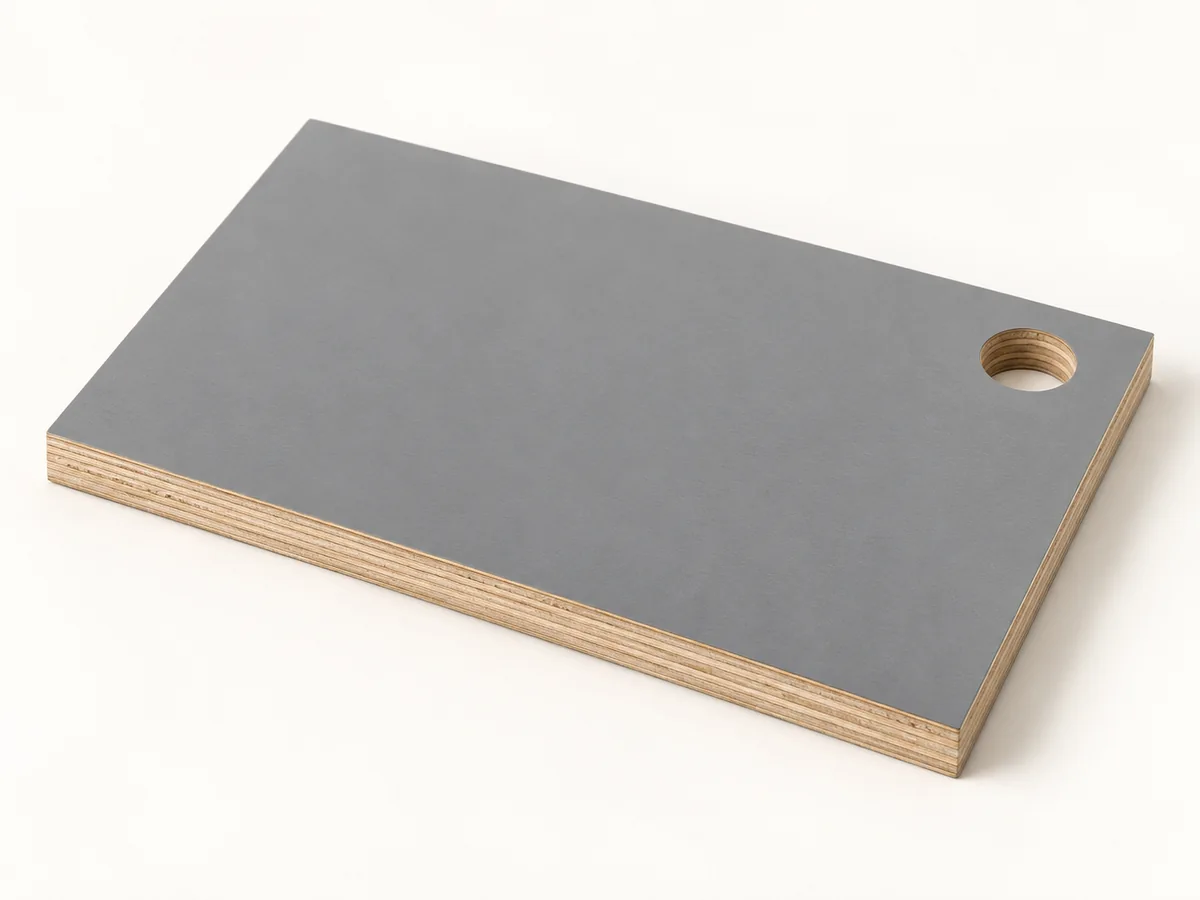
A faced plywood blank showing a round opening and exposed wood edges.
Bring the opening into the panel brief.
A cut edge and through-hole expose the plywood beneath the facing. Include the tool path, opening, seating and supplied edge condition so the quotation covers the work your assembly needs. Use the actual component drawing to set hole size, position and connection detail.
Open edge, hole, finished-fit and handling details
Inspect the facing edge, local lifting, chipping and exposed core at the critical detail. Use the actual tooling, preparation and fixing arrangement. Where a part needs adhesive or a finish on the coated surface, confirm that interface separately; a polymer name alone does not establish compatibility.
Plan joints, sealants, caps and edge finishes around the intended exposure and applicable product instructions. Keep exposed wood, openings and possible damage points with the whole-panel bond and protection requirement, so the surface and substrate are assessed together.
For a frame-mounted or replacement facing, include the panel outline, seating, fixing pattern, finished thickness and hardware. Keep the required frame or system acceptance with the drawing, then review the selected panel’s fit and fixing details with the responsible project team.
Name the edge used for each fixing position.
Mark hole centres, opening sizes and recess depths from the named wood-edge or finished-edge datum. Show caps, seals and trims separately so the drawing distinguishes the final outline from the plywood remaining beside and behind a fixing.
Include countersinks, opposing cuts, nearby edges, local veneers and the seating or support behind the connection. A cap can change the outside dimension without adding wood to the connection. Keep the selected fastener, assembly sequence and component check with that detail.
Review the cut facing, interface and exposed core after the actual machining process. Record any sealing or protection completed before dispatch and any work left for the installer, so receiving can check the supplied surface, openings and edge condition.
Plan handling from the supplied panel and pack weights.
The loading table uses 650kg/m³ for 1220 × 2440mm sheets, including approximately 34.8kg at 18mm. Use the weight of the selected complete panel or processed part for handling. Add protection, pallets and other packing to net panel weight when preparing the container plan.
Try the working face and finished detail together.
Start with the colour or texture you want and the application you have in mind. We can plan a complete panel or processed-component sample around the facing, plywood, critical edge and fitting your purchasing decision needs.
Keep the permanent facing, its attachment, plywood and reverse together in the sample, with the critical finished detail.
01
Identify the build-up
Facing, application system, plywood, internal bond, reverse and finished dimensions.
02
Make the detail
Drawing, cutting, opening, edge treatment, fitting and installation arrangement.
03
Run the working sequence
Actual contact, cleaning, handling or forming conditions and the agreed inspection points.
04
Retain the result
Appearance, fit, interface and edge condition, method, acceptance and open questions.
Retain the selected sample, complete build-up and relevant records with the quotation. If the polymer, facing grade, application process, plywood layup, bond or reverse changes, review the affected sample and evidence before the next run.
Give each sample a clear purpose: appearance, facing adhesion, internal bond, finished fit or the operating sequence. For a working trial, keep the accepted output and panel condition with the cleaning, repair and replacement history. Retain the drawing and the stage at which temporary protection is removed.
ONE CONFIGURATION · A CONNECTED DOCUMENT PACK
Bring the right panel records into your project.
Send the destination and approval checklist you have. We’ll connect the permanent facing, application system, plywood core, internal bond, reverse and finished dimensions with the technical, sample and order records your team needs.
Records for your plastic-coated plywood configuration
Record
Connect it with
Technical data and surface records
TDS-PS-25 and the selected PP formwork or decorative configuration, with polymer grade, thickness, test method, result and applicable scope.
Sample and processed component
Surface reference, drawing revision, finished measurement stage, edge treatment, holes, fittings and the accepted sample or trial.
Working sequence
Contact conditions, support and fixing arrangement, accepted output, cleaning, damage, repair and replacement records for the selected panel.
Market and project requirements
Requested sourcing, emissions, fire, traction or environmental documents matched to the complete panel and intended use.
Production and shipment
Order and lot reference, dimensions, surface and edge checks, pack codes, quantities, protection instructions and dispatch weights.
Facing adhesion, internal veneer bond and installed-system performance answer different approval questions. Keep each report’s method, specimen condition and scope with the selected configuration. For recycling requirements, include the bonded wood-and-facing construction and the recovery route being assessed.
Separate full sheets, blanks and finished-part quantities. Use item codes, drawing revisions and facing/reverse references on the schedule and packing list. Identify included machining, edge work, temporary protection and any site-completed operations.
Agree face separation and protection, support for the actual shapes, corner and edge protection and handling instructions. Include pack dimensions, gross mass, unloading constraints and storage conditions applicable to the proposed panel.
Plan receiving checks before processing or use changes the panel. Compare identity, quantity, dimensions, surface and critical edges against the same accepted reference. Keep a different facing or substrate visible as an alternative rather than a silent substitution.
Plan production, container shipping and after-sales support.
Available to order. Production takes 10–15 days, with the schedule recorded in your order confirmation. Panels ship by container; freight and delivery terms are agreed for the order and destination. Plan transit time separately from production.
The technical loading guide uses approximately 26.8 tonnes of net panels. Packing, the selected construction, container payload and route limits determine the final shipment plan.
Supply includes a 180-day warranty. Contact our factory with the order reference, photographs and issue details; we’ll agree the return or replacement arrangement and related freight for the order.
PLASTIC-COATED PLYWOOD QUESTIONS
Answers for a clearer surface decision.
Does plastic-coated plywood always mean PP-faced plywood?
We offer a PP-faced route for reusable formwork and PET, PVC or ABS decorative-facing routes for interior parts. Tell us the application and surface reference; we will identify the permanent facing, core and reverse together in your quotation.
Is phenolic film-faced plywood the same construction?
Phenolic film-faced plywood uses a resin-impregnated paper overlay. PP, PET, PVC and ABS facings use their specified plastic film or sheet construction. Choose the surface around your use, then keep its attachment system, plywood and reverse with the product data.
Is plastic-faced plywood a solid plastic board?
No. This brief concerns an identified facing over veneer-core plywood. A solid plastic or plastic-core composite board has a different panel body and needs its own product specification.
Does the coating make the whole panel waterproof?
For a waterproof project, we can develop the PP formwork route with phenolic WBP core bonding and the specified edge sealing. Include the intended exposure, cut edges, holes, joints and fixings so the complete supplied panel suits the application. The plastic-face water-absorption result applies to the face; the plywood bond and processed details have their own requirements.
How many times can a panel be reused for formwork?
Our technical sheet lists 30–50+ reuses without chemical release agent for its PP formwork configuration. Plan the selected panel around your concrete-finish requirement, support, handling and cleaning sequence. Keep the working-trial and repair records with that configuration when assessing reuse for your project.
Can it replace a facing in an existing formwork frame?
We can prepare a panel around your frame drawing, seating, fixing pattern and finished thickness. Send the system requirements and sample reference so the selected construction and fit can be reviewed with the responsible project team.
Which colours, thicknesses and sizes should we request?
The technical range lists 9, 12, 15, 18, 21 and 25mm, in 1220 × 2440mm or 1250 × 2500mm sheets. Share the preferred colour, texture or surface reference and any cut sizes. We will quote the selected PP or decorative facing, core, reverse and processing.
What should accompany a plastic-coated plywood enquiry?
Start with a photo, drawing or known sizes and tell us what the panel will do. Add the quantity, destination and any fixed material or project requirements you have. We will help develop the facing, plywood, edges, fixings, cleaning brief and sample plan.
Do you manufacture plastic-coated plywood?
Yes. We manufacture plywood with specified plastic facings in our own factory in Jiangsu, China. Send the permanent facing, plywood construction and application so the offer identifies the actual complete panel, included processing and approval scope.
Is temporary protective film part of the permanent panel thickness?
Record it separately, with its removal stage. A dispatch measurement through protective film and a fit measurement on the permanent panel concern different surfaces. Identify which stage the drawing and acceptance use.
Does an edge cap increase the wood available behind a fixing?
An outboard cap changes the finished outline while the plywood remaining beside the opening stays defined by the wood edge. Show both datums, hole and recess dimensions, local veneers, fitting and support on the drawing, then check the completed connection in the selected panel.
What should a formwork panel trial record?
Record the agreed concrete-finish criterion and accepted output for each identified face, alongside its use, cleaning, damage and repair or replacement history. This lets your team compare useful output and operating costs for the selected panel and site sequence.
How much does an 18mm plastic-coated plywood sheet weigh?
The loading table lists approximately 34.8kg for an 18mm, 1220 × 2440mm sheet, using 650kg/m³. The PP formwork panel density range is 620–700kg/m³. Use actual weights for the selected complete panel, processed parts and packed shipment.
What are your production, shipping and warranty terms?
Production takes 10–15 days according to the confirmed order. Panels ship by container, with freight and delivery terms agreed for your destination. Supply includes a 180-day warranty; returns, replacements and related freight are agreed for the order and issue.
YOUR WORKING FACE · ONE COMPLETE PANEL ORDER
Show us the job. Let us help define the panel.
Send a photo, drawing or the dimensions you know, with the application, quantity and destination when available. We will help connect the permanent facing, plywood and processed details into a sample plan and factory quotation covering the supplied work your project needs.
Optional Google Analytics and Ads cookies measure visits and enquiries. Reject keeps these cookies off; basic cookieless measurement continues. Enquiry details are never sent to Google. Privacy details.