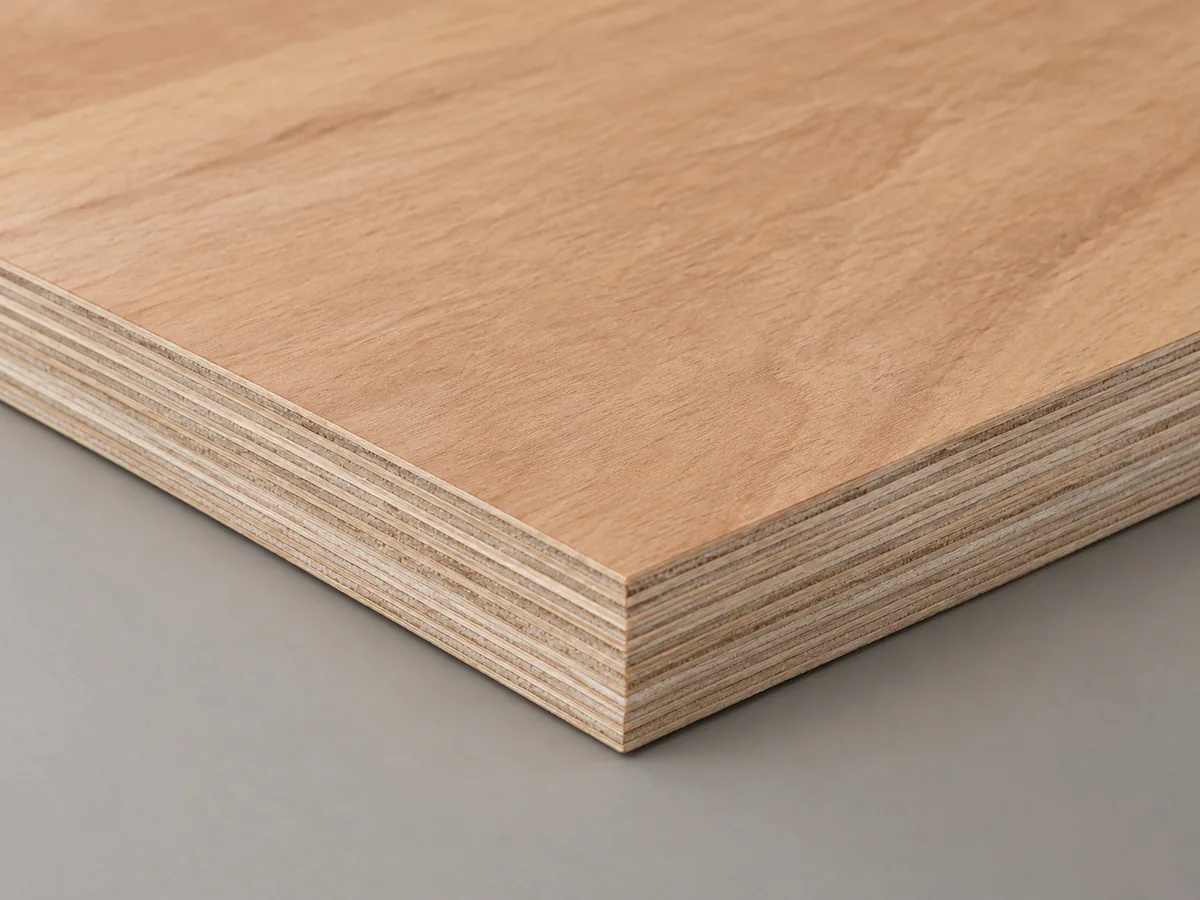
The eucalyptus core, finished face and machining your project needs.
Choose all-eucalyptus plywood, eucalyptus-core panels with decorative faces, or eucalyptus-faced plywood from our factory in Jiangsu, China. Order full sheets, cut blanks or machined parts for your furniture or joinery project.
Bring a sketch, finish reference or the sizes you have. We’ll turn the layers, finished edge and fitting details into a clear factory quotation, with samples to help your team decide.
Bring the surface your customer will see and the part your workshop will make into one order. Start with our eucalyptus-core range, then select the faces, bond and processing around the application.
Eucalyptus plywood supply choices
Choose for your order
Our starting range
Construction and faces
Eucalyptus core with selected eucalyptus faces, or Okoume, birch or Bintangor faces. All-eucalyptus and eucalyptus-faced routes keep each layer identified.
Thickness choices
4, 6, 9, 12, 15, 18, 21, 25, 28 and 30mm in the technical-sheet range, with the tolerance selected for the supplied stage.
Sheet formats
1220 × 2440mm and 1250 × 2500mm; custom 1525 × 3050mm on request. Send other drawn sizes for a cutting or component quotation.
Surface and appearance
B/BB, BB/BB or BB/CC; plugged and sanded substrate options, with calibrated faces or the selected decorative finish.
Bond and use
MUF or phenolic bond options. Choose the humid-interior or exterior duty with the intended use and required product records.
Supplied work
Full sheets, cut blanks or machined parts, including the agreed holes, profiles, edges, surface preparation and identified packing.
The technical table lists a 570–610kg/m³ density range. For 1220 × 2440mm sheets it uses 590kg/m³ for loading guidance, including approximately 31.6kg at 18mm. Keep the selected configuration and actual pack weights with the handling plan.
TECHNICAL DATA · TDS-PS-07 · Rev 2.0 (Oct 2026)
Eucalyptus Plywood technical data
Build furniture, machined parts and construction panels around a eucalyptus core, with eucalyptus faces or another selected decorative veneer. The eucalyptus construction below has a 570–610 kg/m³ density range, cross-banded veneers and MUF or phenolic bond options. Select the face, duty and finished dimensions for your component.
Open the complete eucalyptus specification, properties and loading tables
Declared values from our technical data sheet TDS-PS-07, Rev 2.0 (Oct 2026). The values for your order are confirmed in the quotation.
≥ 1.15 (Apparent Cohesive Wood Failure ≥ 80%) Test method: EN 314-2 Class 2 / 3
Panel Shear Strength (Planar / Rolling Shear), MPa
≥ 2.10 Test method: EN 789
Surface hardness — Brinell, HB
≥ 2.6 HB · EN 1534
Surface hardness — Janka, N
≥ 3,800 N · ASTM D1037
Screw Withdrawal Resistance — Face / Edge, N
≥ 1,750 (Face) / ≥ 1,320 (Edge) Test method: EN 320
Thickness Swelling (24h Cold Water Immersion), %
≤ 8.0 Test method: EN 317
Formaldehyde release — E1, mg/m³
≤ 0.124 mg/m³ · EN 717-1
Formaldehyde release — E0, mg/m³
≤ 0.050 mg/m³ · EN 717-1
CARB P2 / TSCA Title VI option
Select the required resin and product documentation; ASTM E1333 results carry their stated unit and limit.
Thickness, ply count, weight and container loading
Nominal Thickness
Ply Count
Area Weight
Sheet Weight (1220x2440)
Est. Load / 40HQ
4 mm
5 plies
2.36 kg/m²
7.0 kg
~3,828 pcs
6 mm
5 plies
3.54 kg/m²
10.5 kg
~2,552 pcs
9 mm
7 plies
5.31 kg/m²
15.8 kg
~1,696 pcs
12 mm
9 plies
7.08 kg/m²
21.1 kg
~1,270 pcs
15 mm
11 plies
8.85 kg/m²
26.3 kg
~1,019 pcs
18 mm
13 plies
10.62 kg/m²
31.6 kg
~848 pcs
21 mm
15 plies
12.39 kg/m²
36.9 kg
~726 pcs
25 mm
17 plies
14.75 kg/m²
43.9 kg
~610 pcs
28 mm
19 plies
16.52 kg/m²
49.2 kg
~544 pcs
30 mm
19 plies
17.70 kg/m²
52.7 kg
~508 pcs
The loading table uses 1220 × 2440 mm sheets at a 590 kg/m³ planning density and approximately 26.8 tonnes of net panels. Quantities are approximate; the selected construction, packing, container payload and route limits determine the final loading plan.
Tell us what you are making and which surfaces or details matter. We can help choose the construction, thickness, size and supplied stage, with alternatives to compare where useful. The table is a planning guide; you can enquire before every field is complete.
Information to include in a eucalyptus plywood enquiry
Requirement
What to send
Component & supplied stage
End use, exposure and whether you require sheets, blanks or identified processed parts.
Material identity
All-eucalyptus, eucalyptus-core, eucalyptus-faced or a declared mixed construction; face and reverse species.
Internal veneer schedule
Species distribution, layer arrangement, grain orientation and core features relevant to the part.
Nominal and finished thickness, sheet or part dimensions, tolerances, squareness, flatness and measurement stage.
Bond & exposure
Expected conditions, specified bond requirement and the applicable evidence for the proposed panel.
Machining & hardware
Drawing revision, profiles, holes, fixing positions and the assembly sequence.
Facing, finish & edges
Added veneer, overlay, coating or laminate; reverse, exposed edges and final component thickness.
Required documents
Named material, sourcing, emission or performance requirements and the intended application.
Sample & approval
Representative cut, joint or finished detail; checks and retained reference needed for approval.
Quantity & delivery
Part or sheet quantities, pack identification, destination, receiving restrictions and timing.
Your quotation brings the selected layers, dimensions, finish and included processing together. Keep that panel schedule with the accepted component sample and drawing revision for production.
Choose eucalyptus throughout, in the core or on the face.
Choose all-eucalyptus when you want eucalyptus throughout the wood veneers. Choose a eucalyptus core with the decorative face and reverse your component needs, or specify a eucalyptus face over the selected core. Our team helps bring the layer arrangement and finished appearance together.
All-eucalyptus requirement
Eucalyptus throughout the wood veneers. Declare any additional facing or overlay separately.
Eucalyptus-core requirement
Choose the outside veneer species and appearance grade around the component.
Eucalyptus-faced requirement
State whether one or both sides need eucalyptus. Keep the inner construction explicit.
These diagrams show layer roles only. The core block represents the internal construction, not a single veneer. Colours, proportions and blocks do not specify actual wood appearance, veneer thickness or ply count.
For a mixed or combi core, agree the materials and their distribution through the panel, including any alternatives you want to compare. If botanical species or origin matters to your purchasing team, include that requirement so the relevant identity and documents can be planned with the order.
Use the layer schedule alongside the section you will cut, route or fix through. Discuss internal joints, gaps, overlaps and repairs where they affect that detail, then retain the selected construction with the component sample and inspection requirements.
Select the edge your workshop will cut and finish.
Review the face, reverse and core with the edge finish your component needs. For an exposed plywood edge, request a cross-section or machined sample; for a banded or covered edge, include the edge material and finished size. We help connect those details to the panel construction.
START WITH THE FINISHED APPLICATION
Find the eucalyptus construction for your application.
Choose the panel around the furniture, joinery, decorative surface or working face you need. We manufacture eucalyptus-core options across several faced plywood ranges, each with its own construction and supplied finish. Use the relevant configuration for your quotation and samples.
Furniture & interior parts
Send a cabinet part, frame, divider or joinery detail. Mark the visible surfaces, exposed edges and fittings, then compare the selected construction after the machining and finish your workshop will use.
Choose a Bintangor face over a eucalyptus core when that decorative surface suits your project. Select the reverse, grade and finish alongside the core, with the visible edge or edge treatment shown on the component drawing.
Choose eucalyptus-core options in our brown film and MDO ranges for the specified working surface. Discuss the substrate, overlay, reverse and service conditions together, then use that product’s construction for the quotation.
For structural, marine, fireproof or formwork projects, share the required performance and intended use. We help select the relevant construction and records, including the separate eucalyptus-based fireproof marine plywood range where it suits the project brief.
For concrete formwork, send the layout, supports, fastening, required concrete finish and planned working cycle. Our formwork core comparison helps frame the material choice alongside the project’s pressure and design requirements.
VALUE AFTER CUTTING & ASSEMBLY
Get more from the sheet through the finished component.
Compare the sheet price alongside cutting, machining, finishing and assembly. We can discuss full sheets, prepared blanks or processed parts around the work your team will carry out, with the key sample details agreed before the order.
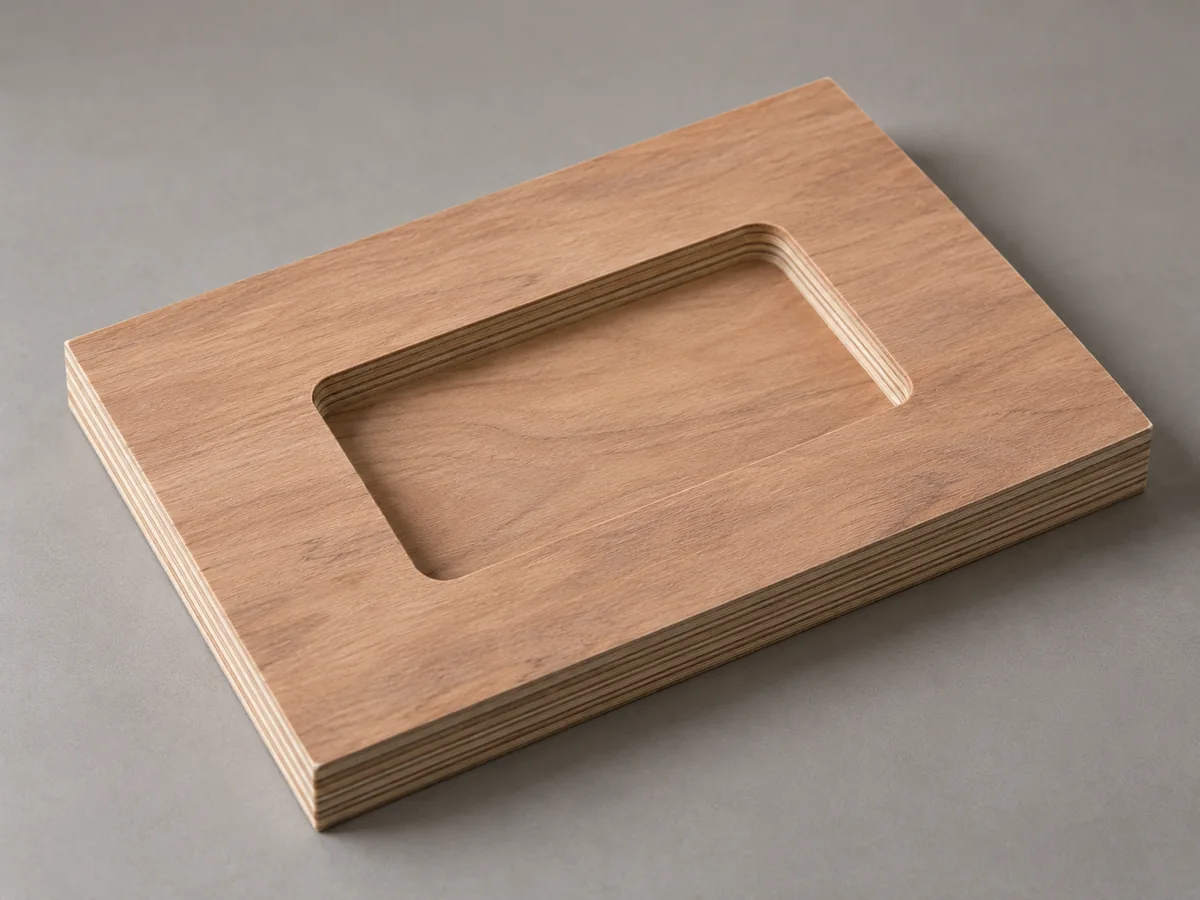
Plywood component with a blind routed pocket and visible veneer layers.
Try the pocket, edge or fitting in the selected panel.
Request a sample machined for your drawing, including the pocket, edge or fitting detail that matters. Mark the face used for depth measurement and review the remaining section with the actual layer arrangement. The drawing and component trial establish the detail for your production process.
Open cutting, pocket, fitting and weight details
Machined edges, pockets & fittings
Try the smallest critical pocket, housed joint, exposed edge or fastener location. Use the intended tool, preparation and fitting, and record whether the fixing enters the face or edge. Check the revealed core, local damage and fit at the specified thickness, retaining the sample with the drawing.
For screws and other fittings, use the actual connection geometry, material condition and fastening arrangement in the trial. USDA’s fastening guidance explains the technical background. Keep the fitting, preparation and result with the selected panel and production drawing.
Visible faces & finished perimeter
Mark the surfaces your customer will see and the role of the reverse. Compare patches, grain and colour under the intended clear coat, paint or laminate, with the perimeter and adjoining joints. Agree the permitted features and repairs against the grading basis and finished sample.
Mass, direction & support
For weight-sensitive parts, compare the actual panel or finished component in the stated condition. Include coatings and hardware where they form part of the supplied component. We can discuss measured material and packing information around your handling and delivery needs.
For supported or loaded parts, share the panel direction, supports, connection layout and required stiffness or strength. APA’s plywood guidance provides background on veneer construction, appearance, bond classification and rated performance. Use the relevant information for the panel selected for your project.
Plan the cutting list around your real parts.
Show blank and finished dimensions, visible grain direction and any rotation permitted by the drawing. Include trimming, kerfs, edging and profiling allowances in the cutting plan. List installed parts, spares and review pieces separately by code, with matching or assembly groups kept together.
Show the pocket and remaining section on the same drawing.
Record the supplied panel thickness and tolerance, depth from the identified face, opposing cuts, distance to edges and the hardware position. Review the actual veneers remaining below the pocket in the selected panel; keep the finished fit and any component check with that drawing revision.
Keep sheet, finished-part and pack weights separate.
The technical range gives a panel density of 570–610kg/m³. Its loading table uses 590kg/m³ for 1220 × 2440mm sheets, with an 18mm sheet listed at about 31.6kg. For your component, use the actual supplied construction and measured mass after machining, facing and hardware assembly.
For delivery, add protection, pallets and other packing to net panel weight. The loading table uses approximately 26.8 tonnes of net panels; packing, container payload and route limits determine the final shipment plan.
A SAMPLE YOUR TEAMS CAN DECIDE ON
Review the board as a finished detail.
Choose a sample that represents the purchasing decision. A clean face offcut may show colour, while a machined edge, assembled fitting or finished adjoining pair answers a different question.
Use the selected all-eucalyptus, eucalyptus-core or eucalyptus-faced construction in the sample, and keep its face, reverse and supplied finish with the drawing.
01
Identify the construction
Record face, reverse, core, veneer schedule, bond, thickness and the proposed product reference.
02
Make the critical detail
Use the drawing revision and intended machining, joint, support or hardware preparation.
03
Complete the surface
Review the face, reverse, exposed edge and joint through the proposed finishing or facing sequence.
04
Retain the approval
Record appearance, fit, measurements and acceptance, with the method and unresolved choices.
Keep the accepted sample and specification together for the first batch and repeat orders. If a different face, internal species, layup, bond or finishing route is proposed, identify the change and review the affected checks before replacing the reference.
For a visible joint or fitted corner, include the adjoining piece, finished edge and hardware. Keep the appearance reference separate from the component used to check machining, fit or service performance, so each sample has a clear purpose.
ONE CONFIGURATION · A CONNECTED DOCUMENT PACK
Give purchasing and production the same panel reference.
Send the destination and approval checklist you have. We’ll connect the selected face, core, reverse, thickness, bond and supplied finish with the technical data, accepted sample and order records your team needs.
Records for your eucalyptus plywood configuration
Record
Connect it with
Technical data and panel reports
TDS-PS-07 or the selected specialist product, with construction, thickness, bond, test method, result and applicable scope.
Sample and finished detail
Face and edge references, drawing revision, machining datum, hardware, finish, and the fit or component check being approved.
Sourcing and destination requirements
The requested material, sourcing claim or emissions requirement, with the applicable product and transaction documents.
Production and inspection
Order and lot reference, selected veneer arrangement, supplied dimensions, face criteria and agreed processing checks.
Packing and dispatch
Sheet or part codes, drawing revision, quantity, orientation, pack identity and recorded shipment weight.
For structural, marine, fireproof or formwork work, include the named requirement and intended use. We’ll organise the relevant product records alongside that configuration, with the required direction, supports or installed assembly where applicable.
Plan sheets and parts for your next workshop operation.
Tell us whether you need full sheets, cut blanks or processed components. List the quantity by size or part code, with the drawing and supplied finish. We can organise labels that connect the selected panel, sample, batch and packing list for receiving.
We can discuss face, corner and edge protection around the next workshop operation, with the pack size, gross mass and unloading needs. Agree the receiving checks for thickness, fit, appearance and material identity in the supplied condition.
Compare quotations for the same construction, usable format, quantities and included processing. If you want a different core, facing or finish as an option, we can show it separately with the price and timing for that choice.
Choose the supplied stage that fits your workshop: full sheets, cut blanks or drawing-specific parts. List the cutting, holes, profiles, surface preparation, facing, coating and protection required. Keep buyer-supplied hardware and later finishing separate so each quotation covers the work you expect to receive.
List installed parts, spares and approval pieces separately by code and direction. Use the component planning details to define direction, blank sizes, process allowances and quantities for the actual cutting plan. Keep alternatives with their own construction and appearance references.
Make the pack useful at your workshop.
Keep the panel reference, face and reverse, part code, drawing revision and lot on the pack labels, with quantity and supplied stage. Include directional marks where they matter for appearance or assembly, helping receiving staff allocate parts to the correct workshop job.
Use actual pack dimensions and gross mass for unloading, with the material’s handling and conditioning instructions. Check the stated thickness stage, face, edge condition and identity at receipt, and record discrepancies with the affected part or lot before mixing stock.
Plan production, container shipping and after-sales support.
Available to order. Production takes 10–15 days, with the schedule recorded in your order confirmation. We ship by container; freight and delivery terms are agreed for the order and destination. Allow transit time separately when planning the project.
Supply includes a 180-day warranty. Contact our factory team with the order reference, photographs and issue details; we’ll agree the return or replacement arrangement and related freight for the order.
EUCALYPTUS PLYWOOD QUESTIONS
Answers for a better material comparison.
Which eucalyptus plywood constructions can I choose?
Choose all-eucalyptus for eucalyptus throughout the wood veneers, eucalyptus-core plywood with separately selected faces, or eucalyptus-faced plywood over the selected core. For a mixed core, agree the material distribution. We help organise the layer arrangement around your component.
How does eucalyptus plywood compare with poplar or birch plywood?
Start with the part and the properties that matter: finished weight, machining, appearance, connection or specified performance. Compare identified boards with their thickness, direction and condition stated. Our team can help plan a component sample and relevant records for the alternatives.
Can you help with waterproof or exterior eucalyptus plywood?
Yes. Tell us the exposure and component you are making. We help select the bond, faces, edge protection and supplied finish for that use. The species and exposure requirement are specified separately; marine or structural work also uses the relevant panel and performance scope.
Can I choose a decorative face or overlay over a eucalyptus core?
Yes. Our Bintangor, brown film and MDO ranges include eucalyptus-core options. Choose the decorative or working face, reverse and finish with the core, then use that product’s selected construction for your quotation and samples.
Can I request custom sizes, thicknesses and face grades?
Yes. Our technical range lists 4, 6, 9, 12, 15, 18, 21, 25, 28 and 30mm. Standard sheets are 1220 × 2440mm and 1250 × 2500mm, with custom 1525 × 3050mm on request. Send your part sizes, quantities and visible-face requirements for a quotation with the selected grade and processing.
How can I compare component weight and machining?
Use the selected boards in the stated condition, or compare finished components including coatings and hardware. Machine the critical edge, pocket or fitting, then retain the measured weight, fit and exposed-core condition with the material reference.
How do you plan repeat orders around the selected sample?
Keep the panel schedule, drawing, supplied finish, sample identity and agreed checks with the order. If you choose a different species distribution, layup, bond or process, we help review that change with the affected sample detail and product records.
Can I enquire with a photo or an incomplete drawing?
Yes. Start with a photo, sketch, drawing or sizes you have, plus the application, quantity and destination when known. We help complete the layer arrangement, thickness, face finish and machining, then plan the sample and any purchasing documents.
Do you manufacture eucalyptus plywood?
Yes. We manufacture plywood in our own factory in Jiangsu, China. We can discuss all-eucalyptus, eucalyptus-core or eucalyptus-faced constructions, supplied as full sheets, cut blanks or machined parts, with samples and finishing planned around your order.
Can all-eucalyptus plywood have an added decorative surface?
Yes. Choose the eucalyptus wood-veneer construction and added veneer, overlay or coating as separate parts of the build-up. Keep the reverse, bond, appearance grade and complete finished thickness with the selected panel schedule.
How should the cutting list account for panel direction?
Mark the visible grain and required panel direction on each part. Include blank and finished dimensions, trimming, kerfs, edging and profiling allowances. List quantities, spares and matching groups by part code; the accepted drawing defines permitted rotation and the production layout.
Which pocket and fitting details should I send?
Show the actual board thickness and tolerance, pocket depth from the named face, opposing cuts, nearby edges and hardware. We can prepare the critical section in the selected construction so your workshop can review the remaining veneers, machining and finished fit together.
How much does an 18mm eucalyptus plywood sheet weigh?
The technical table lists approximately 31.6kg for an 18mm, 1220 × 2440mm sheet, using its 590kg/m³ planning density. The declared density range is 570–610kg/m³. Use the selected construction and actual supplied weight for handling, including finish and hardware when comparing complete parts.
What are your production, shipping and warranty terms?
Production takes 10–15 days according to the confirmed order. Panels ship by container, with freight and delivery terms agreed for your destination. Supply includes a 180-day warranty; returns, replacements and related freight are agreed for the order and issue.
YOUR LAYER REQUIREMENT · A CLEAR COMPONENT ORDER
Tell us what you want to make with eucalyptus plywood.
Send a photo, sketch, drawing or the sheet sizes you have, with the application and quantity when known. Our factory team will help choose the eucalyptus layers, face finish, cutting and machining, then arrange samples and a clear quotation. Add any purchasing-document requirement when available.
Optional Google Analytics and Ads cookies measure visits and enquiries. Reject keeps these cookies off; basic cookieless measurement continues. Enquiry details are never sent to Google. Privacy details.